Kuandyk Ulpan, Omarova Alua, Delellis Nailya
Institute of Life Sciences, Karaganda Medical University, Karaganda, Kazakhstan.
Department of Health Science, Central Michigan University, Mount Pleasant, MI, United States.
Front Public Health. 2025 Jun 3;13:1595672. doi: 10.3389/fpubh.2025.1595672. eCollection 2025.
The issue of good hygiene among school-aged children is crucial for public health and sustainable development. Despite the availability of global studies covering countries with different socio-economic conditions, there is a lack of local data reflecting the specifics of Kazakhstan. Therefore, the aim of this study was to determine the level of knowledge, attitude and practice of schoolchildren regarding personal and public hygiene in schools of Central Kazakhstan.
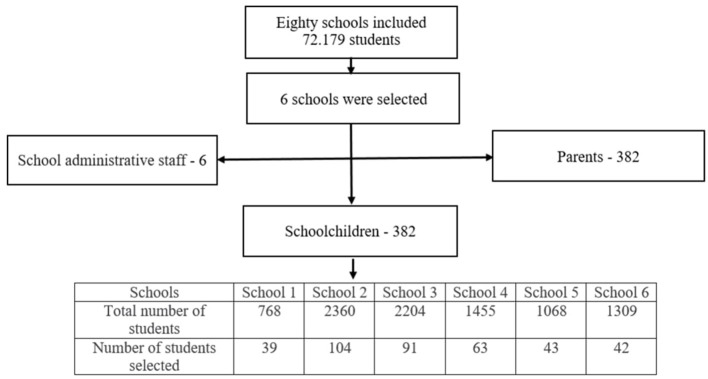
School-based cross-sectional study was conducted from September 2024 to December 2024 in six schools of Central Kazakhstan. The simple random sampling technique was used to select the school. A computer-generated sequence of random numbers was used to randomly select students. Subsequently, 382 students aged 11-18 years were selected from a total of 72.179 students. The data were collected through a questionnaire using the online Google forms service. It consisted of socio-demographic data and information on knowledge and practice of personal and public hygiene of students in schools. The data were computerized. A statistical analysis of the data was carried out using SPSS (Statistical Package for Social Sciences). < 0.05 with a 95% confidence interval was considered statistically significant.
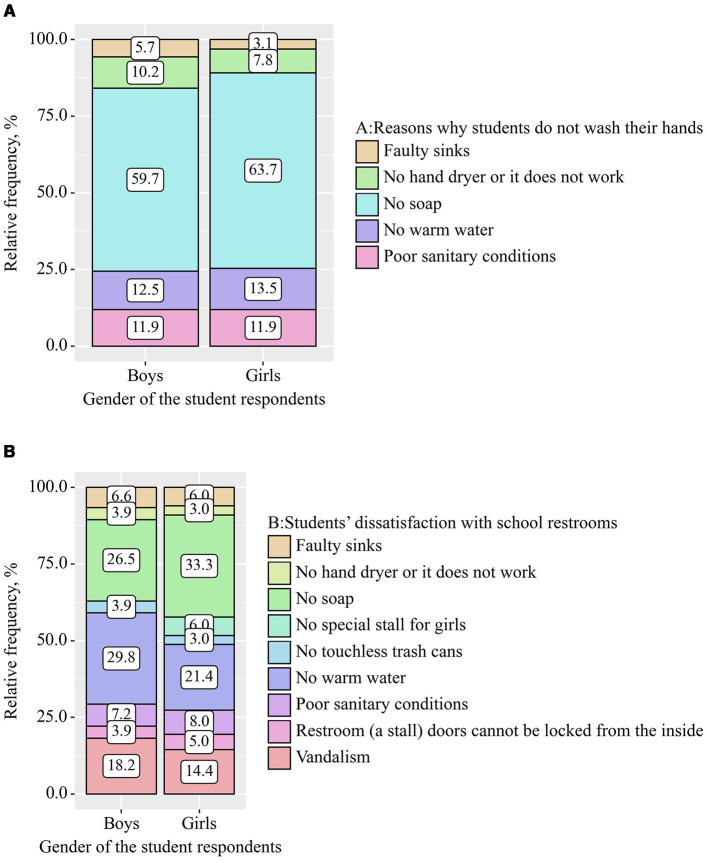
The results showed significant gender differences in hygiene knowledge and behavior. More than 90% of students knew about the basic rules of personal hygiene, with girls demonstrating higher knowledge and practices compared to boys (e.g., brushing teeth twice a day: 97% of girls vs. 87.8% of boys, < 0.001). Hand washing before eating was known to 99% of girls and 92.8% of boys ( < 0.05). In terms of hygiene practices, girls brushed their teeth twice a day more often (68.7% of girls vs. 57.5% of boys, < 0.05). However, there were differences in hygiene compliance at school due to insufficient infrastructure, such as lack of soap, hot water and poor condition of restrooms.
The study revealed a high level of knowledge about personal hygiene among school students in Karaganda, especially among girls. However, practical compliance with hygiene rules was often limited by infrastructural problems in schools. Strengthening hygiene education programs and improving sanitary conditions in educational institutions is necessary.
学龄儿童的良好卫生习惯问题对公共卫生和可持续发展至关重要。尽管有涵盖不同社会经济状况国家的全球研究,但缺乏反映哈萨克斯坦具体情况的本地数据。因此,本研究的目的是确定哈萨克斯坦中部学校学生在个人卫生和公共卫生方面的知识、态度和实践水平。
2024年9月至2024年12月在哈萨克斯坦中部的六所学校进行了基于学校的横断面研究。采用简单随机抽样技术选择学校。使用计算机生成的随机数序列随机选择学生。随后,从总共72179名学生中选出382名11至18岁的学生。数据通过使用在线谷歌表单服务的问卷收集。问卷包括社会人口数据以及学生在学校的个人卫生和公共卫生知识与实践信息。数据进行了计算机化处理。使用SPSS(社会科学统计软件包)对数据进行统计分析。95%置信区间下P<0.05被认为具有统计学意义。
结果显示在卫生知识和行为方面存在显著的性别差异。超过90%的学生了解个人卫生的基本规则,女孩在知识和实践方面表现优于男孩(例如,每天刷牙两次:97%的女孩对87.8%的男孩,P<0.001)。99%的女孩和9