Aldebei Asem, Hammouri Yara S, Abdallat Salah A, Hjazeen Anees, Muhanna Alsharif M, Arnous Hadeel, Alshwayyat Rama, Alkotob Mohammad
Dermatology, Royal Medical Services, Amman, JOR.
Community Health Nursing and Biostatistics, Royal Medical Services, Amman, JOR.
Cureus. 2025 May 18;17(5):e84321. doi: 10.7759/cureus.84321. eCollection 2025 May.
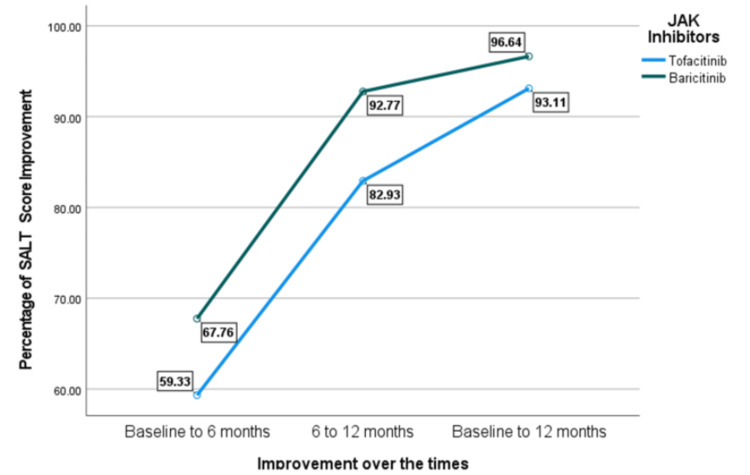
Introduction Alopecia areata (AA) is an autoimmune disorder causing non-scarring hair loss on the scalp, eyebrows, eyelashes, and other areas. Janus kinase (JAK) inhibitors have emerged as promising treatments, but data on their efficacy in Middle Eastern populations, including Jordanians, are limited. The Severity of Alopecia Tool (SALT) score is commonly used to assess disease severity, while Clinician-Reported Outcome (ClinRO) measures provide additional insights. Aim To evaluate the efficacy of JAK inhibitors in Jordanian AA patients using the SALT score as the primary outcome measure. Methods A retrospective cohort study was conducted at King Hussein Hospital, Jordanian Royal Medical Services, from January 2020 to December 2023. Medical records of AA patients aged ≥18 years treated with JAK inhibitors were reviewed. Data included demographics, disease duration, previous treatments, and adverse effects. Efficacy was assessed by the percentage change in SALT scores at six and 12 months. Statistical analyses included repeated-measures MANCOVA (Multivariate Analysis of Covariance), Chi-square, and independent t-test. A p-value <0.05 was considered significant. Results Our analysis included 57 patients, of which 31 (54.4%) received tofacitinib and 26 (45.6%) received baricitinib. A significantly higher proportion of baricitinib users had treatment durations >12 months (53.8%) compared to tofacitinib users (12.9%), while shorter durations (three to six months) were more common among tofacitinib users (41.9% vs. 15.4%; = 0.003). Baricitinib users showed greater improvement in SALT scores between six to 12 months (92.77% vs. 82.93%; = 0.030, partial η² = 0.084), with a trend toward greater total improvement at 12 months (96.64% vs. 93.11%; = 0.055, partial η² = 0.067). Although not statistically significant, baricitinib showed numerically higher ClinRO improvement in eyebrows from six to 12 months (84.58% vs. 70.29%; = 0.212) and in eyelashes (83.92% vs. 73.40%; = 0.313), suggesting better late-stage response compared to tofacitinib. Conclusion JAK inhibitors demonstrated efficacy in Jordanian patients with alopecia areata, leading to enhanced SALT scores and noticeable hair regrowth, with baricitinib demonstrating greater improvement in SALT scores compared to tofacitinib.
引言
斑秃(AA)是一种自身免疫性疾病,可导致头皮、眉毛、睫毛和其他部位出现非瘢痕性脱发。Janus激酶(JAK)抑制剂已成为有前景的治疗方法,但关于其在包括约旦人在内的中东人群中的疗效数据有限。脱发严重程度工具(SALT)评分常用于评估疾病严重程度,而临床医生报告结局(ClinRO)指标可提供更多见解。
目的
以SALT评分为主要结局指标,评估JAK抑制剂在约旦斑秃患者中的疗效。
方法
2020年1月至2023年12月在约旦皇家医疗服务机构的侯赛因国王医院进行了一项回顾性队列研究。对接受JAK抑制剂治疗的≥18岁斑秃患者的病历进行了审查。数据包括人口统计学信息、病程、既往治疗情况和不良反应。通过6个月和12个月时SALT评分的变化百分比评估疗效。统计分析包括重复测量多变量协方差分析(MANCOVA)、卡方检验和独立t检验。p值<0.05被认为具有统计学意义。
结果
我们的分析纳入了57例患者,其中31例(54.4%)接受了托法替布治疗,26例(45.6%)接受了巴瑞替尼治疗。与托法替布使用者(12.9%)相比,使用巴瑞替尼的患者中治疗持续时间>12个月的比例显著更高(53.8%),而较短疗程(3至6个月)在托法替布使用者中更为常见(41.9%对15.4%;p = 0.003)。巴瑞替尼使用者在6至12个月期间SALT评分改善更大(92.77%对82.93%;p = 0.030,偏η² = 0. .084),在12个月时总体改善有更大趋势(96.64%对93.11%;p = 0.055,偏η² = 0.067)。虽然无统计学意义,但巴瑞替尼在6至12个月期间眉毛(84.58%对70.29%;p = 0.212)和睫毛(83.92%对73.40%;p = 0.313)的ClinRO改善在数值上更高,表明与托法替布相比后期反应更好。
结论
JAK抑制剂在约旦斑秃患者中显示出疗效,导致SALT评分提高和明显的毛发生长,与托法替布相比,巴瑞替尼在SALT评分方面改善更大。