Chen Shih-Hsun, Wu Szu-Ying, Chang Yun-Xun, Lui En-Ning, Chang Chih-Kang, Lin Sheng-Wei, Hsiao Michael, Yang Jinn-Moon, Liang Po-Huang
Institute of Biochemical Sciences, National Taiwan University, Taipei, Taiwan.
Institute of Biological Chemistry, Academia Sinica, Taipei, Taiwan.
Cell Death Dis. 2025 Jun 18;16(1):459. doi: 10.1038/s41419-025-07774-y.
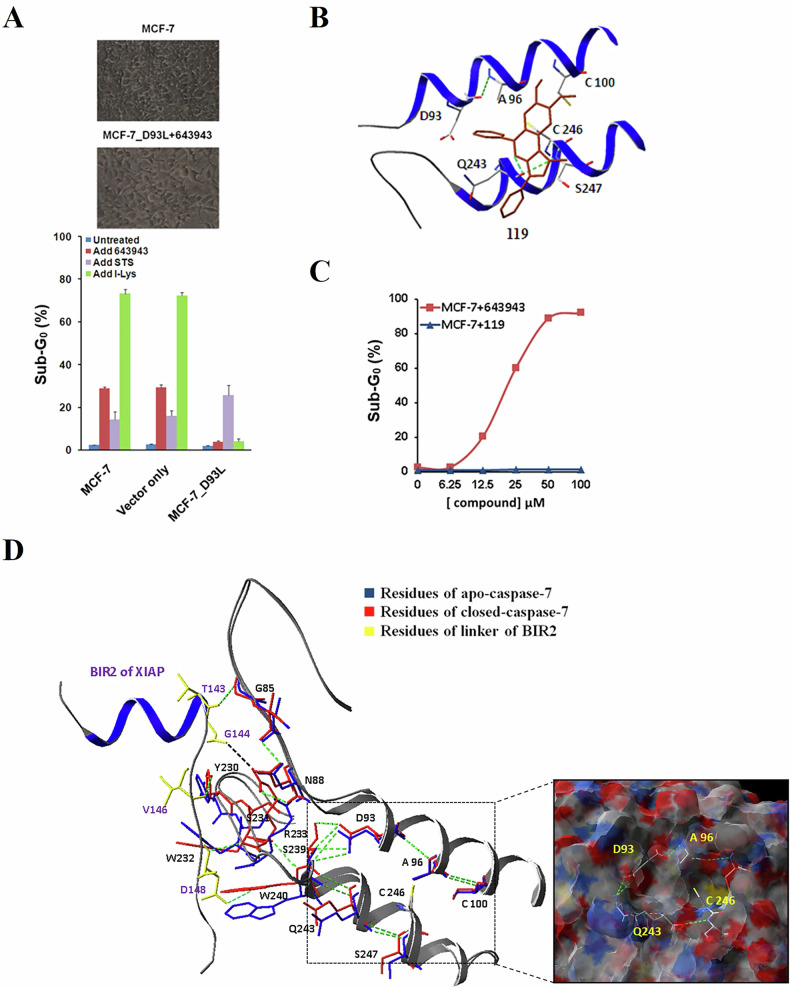
X-linked inhibitor of apoptosis (XIAP) inhibits caspases 3, 7, and 9, thereby preventing cell apoptosis. Endogenous Second mitochondria-derived activator of caspase (Smac) competes out the binding of caspases with XIAP and causes apoptosis, so that Smac mimetics are under clinical trials for anti-cancer chemotherapy. We demonstrated by selectively alkylating caspase 7 (CASP7) to release the active CASP7 for killing the drug-resistant cancer cells with accumulated XIAP:CASP7 resulted from caspase-3 down-regulation (CASP3/DR). However, finding a reversible inhibitor of the protein-protein interaction (PPI) poses a significant challenge. Here, we identified a reversible XIAP:CASP7 inhibitor, 643943, through a multiple-mode virtual screening strategy. In vitro experiments revealed that 643943 bound to CASP7, released the linker-BIR2 domain of XIAP, and activated the caspase. Removing an essential hydroxyl group on 643943 or replacing the OH-interacting Asp93 on CASP7 caused loss of 643943 cytotoxicity, revealing the binding mode. This compound thus selectively killed MCF-7 and other CASP3/DR triple-negative breast cancer cell lines, but not the cancer and normal cell lines expressing higher levels of CASP3 in vitro and in vivo. Moreover, 643943 overcame chemoresistance via down-regulating β-catenin and its associated ABC transporters in paclitaxel-resistant MCF-7 cells. Our studies not only serve as a proof-of-concept for using XIAP:CASP7 as a drug target, but also provide the first reversible XIAP:CASP7 inhibitor for cancer therapy of CASP3/DR malignancies.
X连锁凋亡抑制蛋白(XIAP)可抑制半胱天冬酶3、7和9,从而防止细胞凋亡。内源性的第二线粒体衍生的半胱天冬酶激活剂(Smac)可竞争取代半胱天冬酶与XIAP的结合并引发凋亡,因此Smac模拟物正处于抗癌化疗的临床试验阶段。我们通过选择性地烷基化半胱天冬酶7(CASP7)以释放活性CASP7来杀死耐药癌细胞,这些癌细胞因半胱天冬酶-3下调(CASP3/DR)而积累了XIAP:CASP7。然而,找到一种蛋白质-蛋白质相互作用(PPI)的可逆抑制剂是一项重大挑战。在此,我们通过多模式虚拟筛选策略鉴定出一种可逆的XIAP:CASP7抑制剂643943。体外实验表明,643943与CASP7结合,释放XIAP的连接子-BIR2结构域,并激活半胱天冬酶。去除643943上的一个必需羟基或替换CASP7上与OH相互作用的天冬氨酸93会导致643943失去细胞毒性,从而揭示了其结合模式。该化合物因此在体外和体内选择性地杀死MCF-7和其他CASP3/DR三阴性乳腺癌细胞系,但对表达较高水平CASP3的癌细胞系和正常细胞系无效。此外,643943通过下调耐紫杉醇的MCF-7细胞中的β-连环蛋白及其相关的ABC转运蛋白克服了化疗耐药性。我们的研究不仅为将XIAP:CASP7用作药物靶点提供了概念验证,还为CASP3/DR恶性肿瘤的癌症治疗提供了首个可逆的XIAP:CASP7抑制剂。