Wang Man, Zhao Yuanzhuo, Xu Kangchun, Liu Chao, Zhong Hui, Wu You, Zhang Ke, Wei Shanzhai
Department of Nephrology, Shuyang Hospital of Traditional Chinese Medicine, Shuyang, Jiangsu, China.
The Second Clinical Medical College, Nanjing Medical University, Nanjing, Jiangsu, China.
Front Immunol. 2025 Jun 4;16:1617968. doi: 10.3389/fimmu.2025.1617968. eCollection 2025.
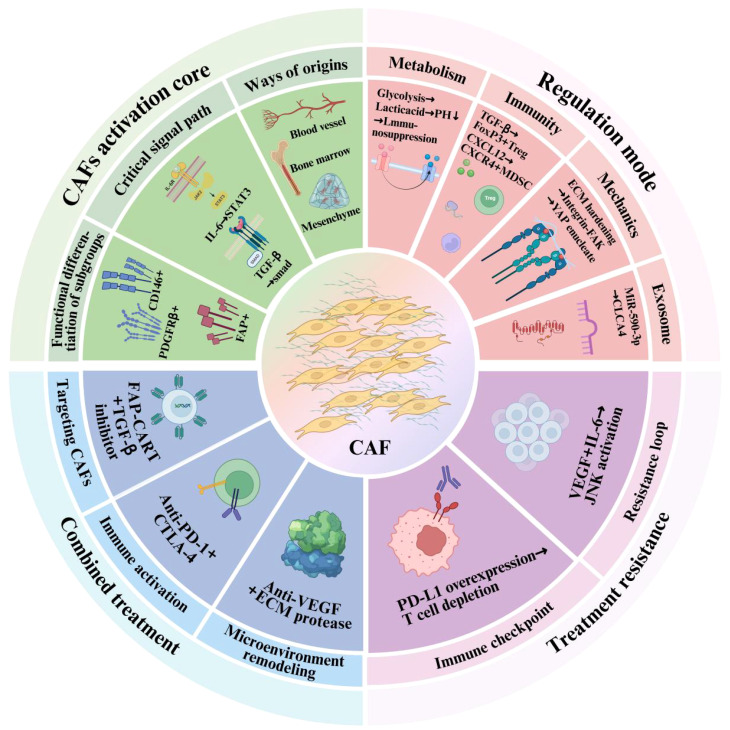
Clear cell renal cell carcinoma (ccRCC) progression heavily relies on the immunosuppressive tumor microenvironment (TME). In the ccRCC TME, the cancer-associated fibroblasts (CAFs) drive a self-perpetuating cycle of immune evasion and therapeutic resistance through diverse interactions between cells and molecules. Furthermore, heterogeneous CAFs facilitate tumor growth through metabolic reprogramming and modulate immune suppression by driving the M2 polarization of tumor-associated macrophages (TAMs) and the expansion of regulatory T cells (Tregs), which promote a multilayered immunosuppressive network. In addition, CAFs reshape the mechanical properties of extracellular matrix (ECM), hinder the infiltration of cytotoxic T lymphocytes (CTLs) and further exacerbate immune escape. Moreover, CAF-derived exosomes can confer resistance to chemoradiation therapy. Interleukin-6 (IL-6) secreted by CAFs synergizes with vascular endothelial growth factor (VEGF) to facilitate adaptive resistance to targeted therapy. Emerging therapeutic strategies-including fibroblast activation protein (FAP)-targeted CAR-T cells and transforming growth factor-β (TGF-β) inhibitors-can partially reverse this immunosuppressive property. Combination therapies employing immune checkpoint inhibitors and VEGF antagonists exhibit promising synergistic effects, although the clinical translation remains hampered by CAF heterogeneity, dual functional roles, and the lack of specific biomarkers. Future studies should integrate single-cell sequencing and spatial multi-omics techniques to comprehensively analyze the spatio-temporal dynamic heterogeneity of CAF subpopulations and develop precision treatment strategies based on molecular subtyping, aiming to break the vicious cycle of "CAF-TME-resistance" in ccRCC.
透明细胞肾细胞癌(ccRCC)的进展在很大程度上依赖于免疫抑制性肿瘤微环境(TME)。在ccRCC的TME中,癌症相关成纤维细胞(CAFs)通过细胞与分子之间的多种相互作用驱动免疫逃逸和治疗抵抗的自我延续循环。此外,异质性CAFs通过代谢重编程促进肿瘤生长,并通过驱动肿瘤相关巨噬细胞(TAMs)的M2极化和调节性T细胞(Tregs)的扩增来调节免疫抑制,从而促进多层次的免疫抑制网络。此外,CAFs重塑细胞外基质(ECM)的力学特性,阻碍细胞毒性T淋巴细胞(CTLs)的浸润并进一步加剧免疫逃逸。此外,CAF衍生的外泌体可赋予对放化疗的抗性。CAFs分泌的白细胞介素-6(IL-6)与血管内皮生长因子(VEGF)协同作用,促进对靶向治疗的适应性抗性。新兴的治疗策略——包括靶向成纤维细胞活化蛋白(FAP)的嵌合抗原受体T细胞(CAR-T)和转化生长因子-β(TGF-β)抑制剂——可以部分逆转这种免疫抑制特性。尽管临床转化仍受到CAF异质性、双重功能作用以及缺乏特异性生物标志物的阻碍,但采用免疫检查点抑制剂和VEGF拮抗剂的联合疗法显示出有前景的协同效应。未来的研究应整合单细胞测序和空间多组学技术,以全面分析CAF亚群的时空动态异质性,并基于分子亚型制定精准治疗策略,旨在打破ccRCC中“CAF-TME-抗性”的恶性循环。