Backman Chantal, Lam Ashley, Papp Rosie, Kolle Aurelie Tonjock, Engel Franciely Daina, Li Wenshan, Shah Soha, Webber Colleen, Tanuseputro Peter, Domecq Marie-Cecile, Papp Steve
Faculty of Health Sciences, University of Ottawa, ON, Canada.
Institut du Savoir Montfort, Ottawa, ON, Canada.
Geriatr Orthop Surg Rehabil. 2025 Jun 17;16:21514593251350490. doi: 10.1177/21514593251350490. eCollection 2025.
We conducted a systematic review and meta-analysis to compare post-operative rehabilitation outcomes between two common treatments in patients who have suffered an intertrochanteric hip fracture: intramedullary nails vs dynamic hip screws.
We searched MEDLINE, EMBASE, Cochrane Central Register of Controlled Trials, and Web of Science up to August 10, 2022. The inclusion criteria were defined as Population: adults (>18 years old); Interventions/Comparators: intramedullary nails and dynamic hip screws; Outcomes: function, quality of life and survival; and Study type: randomized controlled trials and non-randomized studies. A meta-analysis was performed, and the fixed-effect model was selected to pool the data for homogeneous studies (I < 50%) and the random effect model was selected for heterogeneity I>50%. The -value of less than 0.05 was considered statistically significant. A narrative synthesis was conducted on the remaining outcomes with insufficient data (ie, missing means, or standard deviations).
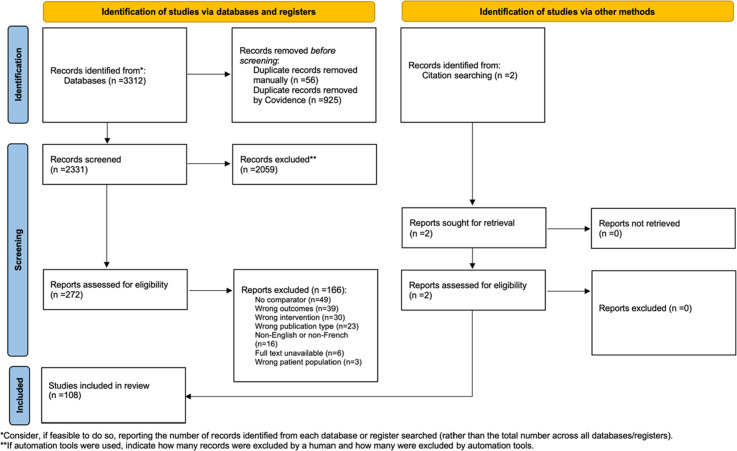
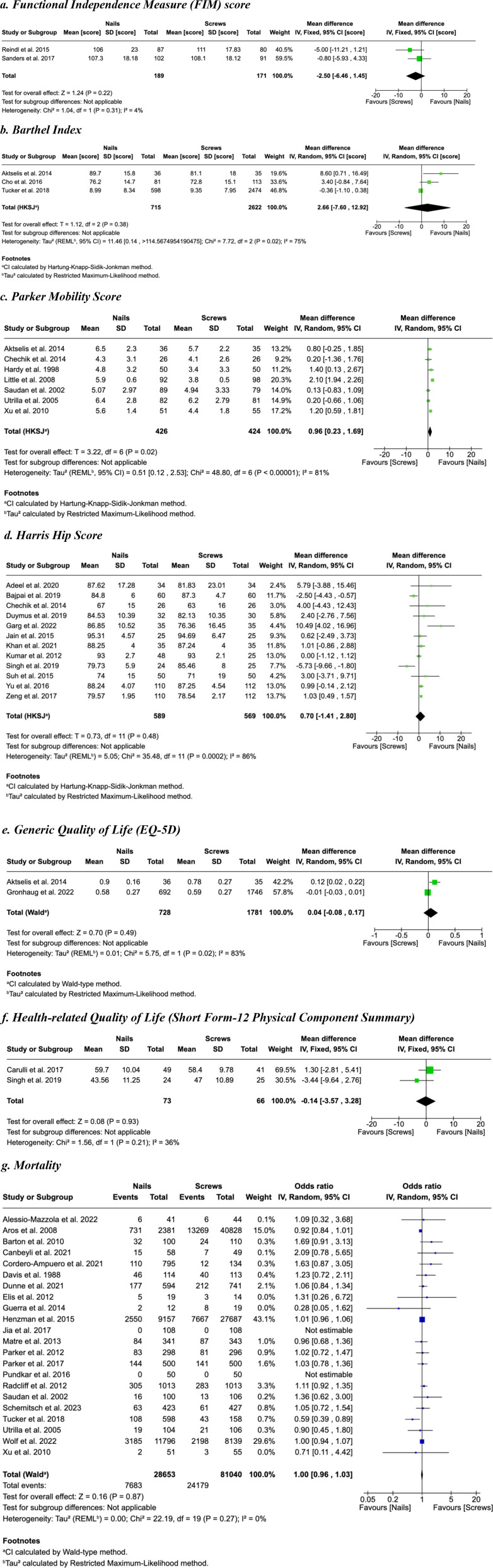
108 studies were included in the review. 42 studies had outcomes that were included in the meta-analysis. There were modest differences after sensitivity analysis for the Parker mobility score mean difference (MD) = 0.70, 95% CI [0.12, 1.28], T = 3.11, df = 5, = 0.03, and Harris hip score (MD = 0.94, 95% CI [0.34, 1.54], T = 3.54, df = 9, = 0.006) favoring the nails. There were no statistically significant differences in the Functional Independence Measure (FIM) (MD = -2.50, 95% CI [-6.46, 1.45], Z = 1.24, = 0.22), the Barthel Index (MD = 2.66, 95% CI [-7.60, 12.92], T = 1,12, df = 2, = 0.38), the generic quality of life (MD = 0.04, 95% CI [-0.08, 0.17], Z = 0.70, = 0.49), the health-related quality of life (MD = -0.14, 95% CI [-3.57, 3.28], Z = 0.08, = 0.93) or mortality (1.00, 95% CI [0.96, 1.03], Z = 0.16, = 0.87) outcomes.
This review showed some differences in functional outcomes in the treatment of intertrochanteric fractures favoring intramedullary nails over dynamic hip screws. There were no differences between the groups for quality of life and mortality outcomes. The narrative synthesis showed additional outcomes that warrant further investigations.
我们进行了一项系统评价和荟萃分析,以比较股骨转子间骨折患者两种常见治疗方法(髓内钉与动力髋螺钉)的术后康复效果。
我们检索了截至2022年8月10日的MEDLINE、EMBASE、Cochrane对照试验中央注册库和科学网。纳入标准定义为:人群:成年人(>18岁);干预措施/对照:髓内钉和动力髋螺钉;结局:功能、生活质量和生存率;研究类型:随机对照试验和非随机研究。进行了荟萃分析,对于同质性研究(I<50%)选择固定效应模型合并数据,对于异质性I>50%选择随机效应模型。P值小于0.05被认为具有统计学意义。对数据不足(即缺少均值或标准差)的其余结局进行了叙述性综合分析。
该评价纳入了108项研究。42项研究的结局纳入了荟萃分析。敏感性分析后,帕克活动度评分平均差(MD)=0.70,95%可信区间[0.12,1.28],T=3.11,自由度=5,P=0.03,以及哈里斯髋关节评分(MD=0.94,95%可信区间[0.34,1.54],T=3.54,自由度=9,P=0.006)存在适度差异,支持髓内钉。在功能独立性测量(FIM)(MD=-2.50,95%可信区间[-6.46,1.45],Z=1.24,P=0.22)、巴氏指数(MD=2.66,95%可信区间[-7.6,12.92],T=1.12,自由度=2,P=0.38)、一般生活质量(MD=0.04,95%可信区间[-0.08,0.17],Z=0.70,P=0.49)、健康相关生活质量(MD=-0.14,95%可信区间[-3.57,3.28],Z=0.08,P=0.93)或死亡率(1.00,95%可信区间[0.96,1.03],Z=0.16,P=0.87)结局方面,没有统计学显著差异。
本评价显示,在股骨转子间骨折治疗的功能结局方面,髓内钉优于动力髋螺钉存在一些差异。两组在生活质量和死亡率结局方面没有差异。叙述性综合分析显示了其他值得进一步研究的结局。