Muhie Nurye Seid, Bekele Abdela Assefa, Tegegne Awoke Seyoum
Department of Statistics Mekdela Amba University Tulu Awulia Ethiopia.
Department of Statistics Assosa University Assosa Ethiopia.
Health Sci Rep. 2025 Jun 17;8(6):e70867. doi: 10.1002/hsr2.70867. eCollection 2025 Jun.
The most prevalent opportunistic illness among people living with HIV/AIDS is tuberculosis. The aim of this study was to determine predictors of longitudinal viral load and survival time to death among adult TB/HIV coinfected patients treated at two selected Amhara region Comprehensive Specialized Hospitals, Ethiopia.
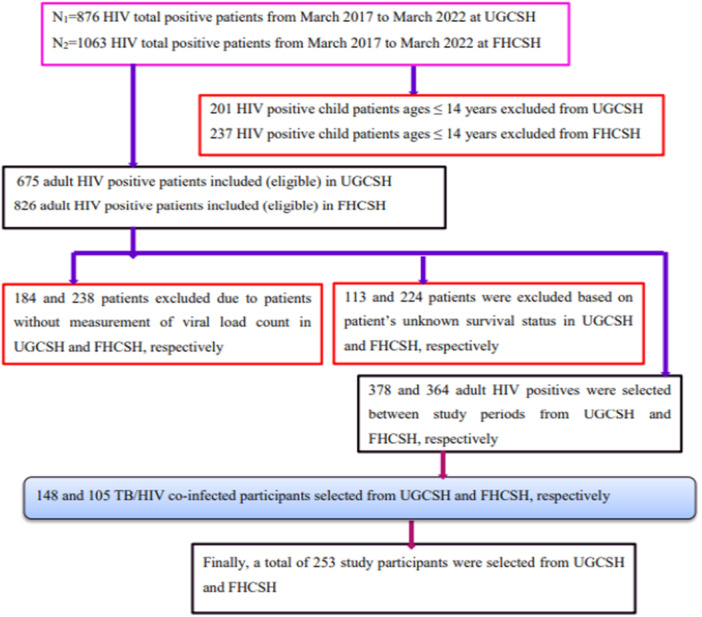
A retrospective follow-up study design was conducted from March 2018-2022 in the University of Gondar Comprehensive Specialized Hospital and Felege Hiwot Comprehensive Specialized Hospital. Descriptive statistics, separate Cox PH model, separate generalized linear mixed model, and joint model were employed to analyze the coinfected patient data.
Among 253 TB/HIV coinfected participants, 26.5% mortality and the rest were censored. Random intercept and slope model for the longitudinal viral load count Cox PH model for time to death were selected based on AIC and BIC values. The estimate of the association parameter due to the slope ( and due to the viral load count variability through time is positive ( ).
These results concluded that the joint model is not only the simplest model, but also provided a better fit to the coinfected patients' data than the separate model. The parameter estimation under the joint model revealed that INH, residence, CD4 cell count, functional status, and BMI were considered as significant joint predictors of viral load count and time to death among TB/HIV coinfected patients. Furthermore, the results of the association parameter concluded that the higher the viral load count of the patient, the higher the chance of mortality, and correspondingly, patients with lower viral load count have a lower chance of mortality. In this study, important potential joint predictors should be given special attention by adult TB/HIV coinfected patients and health professionals to minimize viral load and risk of mortality.
结核病是艾滋病毒/艾滋病感染者中最常见的机会性疾病。本研究的目的是确定在埃塞俄比亚阿姆哈拉地区两家选定的综合专科医院接受治疗的成年结核病/艾滋病毒合并感染患者的纵向病毒载量预测因素和死亡生存时间。
2018年3月至2022年在贡德尔大学综合专科医院和费莱格·希沃特综合专科医院进行了一项回顾性随访研究设计。采用描述性统计、单独的Cox PH模型、单独的广义线性混合模型和联合模型对合并感染患者的数据进行分析。
在253名结核病/艾滋病毒合并感染参与者中,26.5%死亡,其余被截尾。根据AIC和BIC值选择纵向病毒载量计数的随机截距和斜率模型以及死亡时间Cox PH模型。由于斜率( )以及病毒载量计数随时间的变异性导致的关联参数估计为正( )。
这些结果表明,联合模型不仅是最简单的模型, 而且比单独模型更能拟合合并感染患者的数据。联合模型下的参数估计显示,异烟肼、居住地、CD4细胞计数、功能状态和BMI被认为是结核病/艾滋病毒合并感染患者病毒载量计数和死亡时间的重要联合预测因素。此外, 关联参数的结果表明, 患者的病毒载量计数越高, 死亡几率越高, 相应地, 病毒载量计数较低的患者死亡几率较低, 在本研究中, 成年结核病/艾滋病毒合并感染患者和卫生专业人员应特别关注重要的潜在联合预测因素,以尽量降低病毒载量和死亡风险