Muhie Nurye Seid, Tegegne Awoke Seyoum
Department of Statistics, Mekdela Amba University, Tulu Awulia, Ethiopia.
Department of Bio-Statistics, Bahir Dar University, Bahir Dar, Ethiopia.
Sci Rep. 2025 May 2;15(1):15348. doi: 10.1038/s41598-025-00033-2.
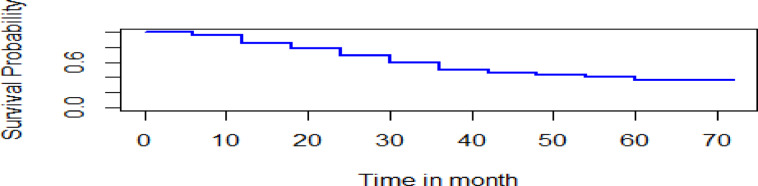
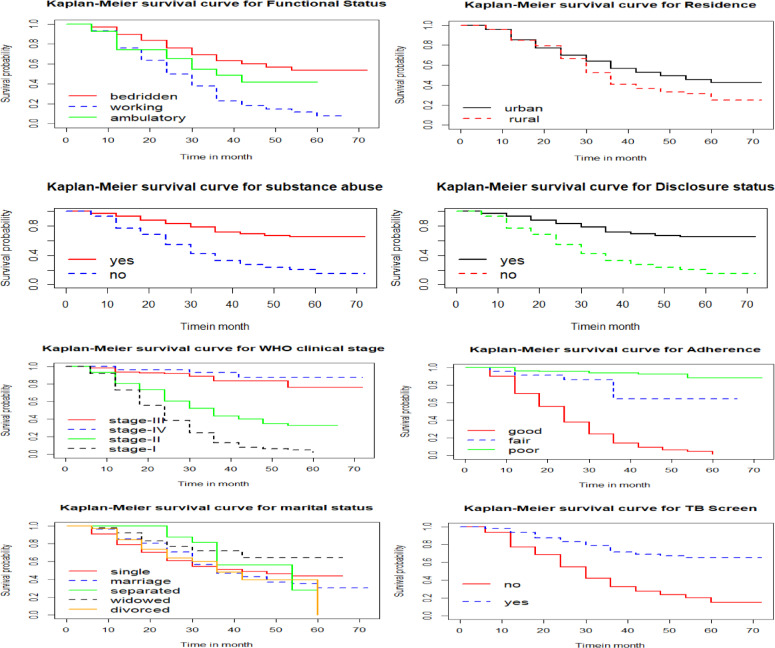
Ethiopia has the highest proportion of the HIV population receiving ART of any African country. The objective of this study was to identify survival analysis and predictors for hemoglobin level and time-to-default from HIV treatment among first-line female HIV-positive patients within the reproductive age group. Secondary data source conducted at the University of Gondar Comprehensive Specialized Hospital from September 2015 to March 2022. In this study, the generalized linear mixed model and the Cox PHs model were jointly used to get a wide range of information about female HIV data. The mean (standard deviation) of white blood cells and red blood cells was 6.11 (1.8) and 4.02 (1.26), respectively. Out of 201 study participants, 27.9% defaulted from treatment, and the remaining were considered censored. In this study, the association parameter (gamma_1) for hemoglobin level and default from HIV treatment is negative and statistically significant ([Formula: see text]) at the 5% level of significance. These findings suggested that the patient's association parameter had an inverse link with hemoglobin and treatment default. The result of the study also shows low red blood cell and white blood cells lead to low hemoglobin levels and a high hazard of defaulting. Likewise, patients under the categories of World Health Organization (WHO) clinical stage III and IV, ambulatory, bedridden, primary education, Opportunistic Infections (OIs), and substance abuse were at high hazard of being defaulters. Conversely, secondary and tertiary education and patients expressing diseases status to family members were low hazards for defaulters. In addition, WHO clinical stage III and IV patients, bedridden patients, primary educators, OIs, and substance abusers had low hemoglobin level concentrations, and tertiary education and disclosing the diseases to family members were high hemoglobin level concentrations. Healthcare workers in similar settings should pay more attention to clients related to hemoglobin levels and time to default from medication based on these important factors.
在所有非洲国家中,埃塞俄比亚接受抗逆转录病毒治疗(ART)的艾滋病毒感染者比例最高。本研究的目的是确定育龄期一线女性艾滋病毒阳性患者血红蛋白水平的生存分析及其与治疗违约时间的预测因素。数据来源于2015年9月至2022年3月在贡德尔大学综合专科医院开展的二次数据。在本研究中,广义线性混合模型和Cox比例风险模型被联合使用,以获取关于女性艾滋病毒数据的广泛信息。白细胞和红细胞的平均(标准差)分别为6.11(1.8)和4.02(1.26)。在201名研究参与者中,27.9%的人治疗违约,其余被视为截尾。在本研究中,血红蛋白水平与艾滋病毒治疗违约的关联参数(gamma_1)为负,且在5%的显著性水平上具有统计学意义([公式:见原文])。这些发现表明,患者的关联参数与血红蛋白和治疗违约呈反向关联。研究结果还表明,红细胞和白细胞水平低会导致血红蛋白水平低以及违约风险高。同样,世界卫生组织(WHO)临床III期和IV期、非卧床、卧床、小学教育程度、机会性感染(OIs)和药物滥用类别的患者违约风险高。相反,接受过中等和高等教育以及向家庭成员透露疾病状况的患者违约风险低。此外,WHO临床III期和IV期患者、卧床患者、小学教育程度者、OIs患者和药物滥用者血红蛋白水平浓度低,而高等教育程度以及向家庭成员透露疾病状况的患者血红蛋白水平浓度高。类似环境中的医护人员应基于这些重要因素,更多地关注与血红蛋白水平和停药时间相关的患者。