Lian Jianchun, Li Qianhui, Peng Cheng, Lin Tao, Du Hong, Tang Chaogui, Zhang Xiaoyun
Department of Clinical Laboratory, The Affiliated Huaian No.1 People's Hospital of Nanjing Medical University, Huaian, Jiangsu, China.
Department of Clinical Laboratory, The Second Affiliated Hospital of Soochow University, Suzhou, Jiangsu, China.
Front Cell Infect Microbiol. 2025 Jun 4;15:1569004. doi: 10.3389/fcimb.2025.1569004. eCollection 2025.
Carbapenem-resistant hypervirulent (CR-hvKP) poses a significant public health challenge. This study investigated the molecular epidemiology, antimicrobial resistance patterns, clinical characteristics, and risk factors of CR-hvKP infection in Huaian, China.
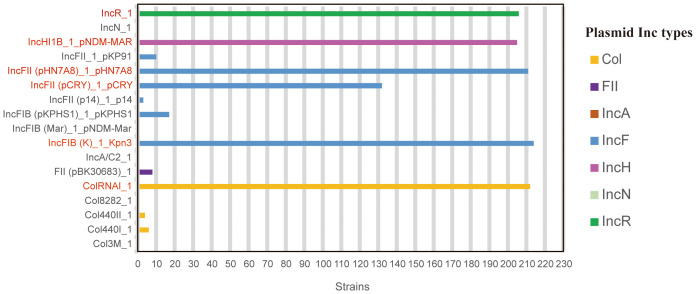
We retrospectively studied patients infected with carbapenem-resistant (CRKP) between November 2022 and September 2024. Whole-genome sequencing was used to detect carbapenemase, virulence, capsular serotype-related genes, and plasmid types in 374 CRKP isolates.
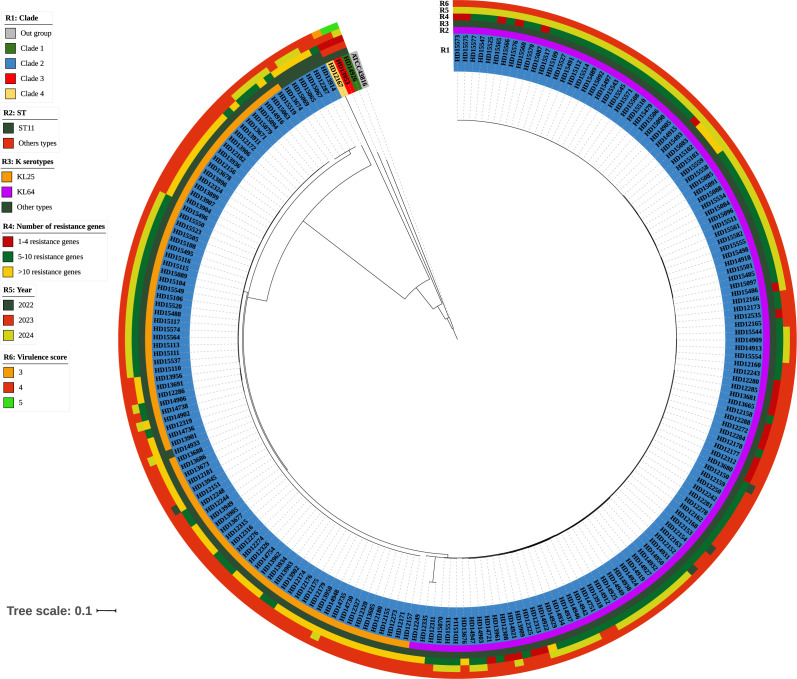
Among them, 57.49% (215/374) strains met the criteria for CR-hvKP. The most common type was blaKPC-2-producing ST11(98.60%, 212/215), whereas K64 (56.74%, 122/215) and KL25 (39.53%, 85/215) were the main capsular serotypes. The CR-hvKP strains showed significantly higher resistance to the tested antibiotics, except for ceftazidime/avibactam and colistin. Resistance rates of CR-hvKP to the three tested antibiotics (minocycline, cotrimoxazole, and amikacin) were higher than those of CRnon-hvKP. Phylogenetic analysis based on whole-genome single-nucleotide polymorphisms divided the 251 isolates into four independent branches, with branch 2 being the most prevalent, indicating high clonality among the strains. Multivariate analysis showed diabetes [odds ratio (OR) = 3.771] and surgery (OR =2.042) to be independent variables associated with CR-hvKP infection.
Notably, the ST11 lineage carrying blaKPC-2 has emerged as a dominant high-risk clone in Huaian. Given the wide distribution of these novel CR-hvKP isolates, global monitoring and stricter control measures should be implemented to prevent their further spread in hospital settings.
耐碳青霉烯类高毒力肺炎克雷伯菌(CR-hvKP)对公共卫生构成重大挑战。本研究调查了中国淮安CR-hvKP感染的分子流行病学、抗菌药物耐药模式、临床特征及危险因素。
我们回顾性研究了2022年11月至2024年9月期间感染耐碳青霉烯类肺炎克雷伯菌(CRKP)的患者。采用全基因组测序检测374株CRKP分离株中的碳青霉烯酶、毒力、荚膜血清型相关基因及质粒类型。
其中,57.49%(215/374)的菌株符合CR-hvKP标准。最常见的类型是产blaKPC-2的ST11(98.60%,212/215),而K64(56.74%,122/215)和KL25(39.53%,85/215)是主要的荚膜血清型。除头孢他啶/阿维巴坦和黏菌素外,CR-hvKP菌株对所检测抗生素的耐药性显著更高。CR-hvKP对三种检测抗生素(米诺环素、复方新诺明和阿米卡星)的耐药率高于非CR-hvKP。基于全基因组单核苷酸多态性的系统发育分析将251株分离株分为四个独立分支,其中分支2最为常见,表明菌株间克隆性高。多因素分析显示糖尿病[比值比(OR)=3.771]和手术(OR =2.042)是与CR-hvKP感染相关的独立变量。
值得注意的是,携带blaKPC-2的ST11谱系已成为淮安的主要高危克隆。鉴于这些新型CR-hvKP分离株分布广泛,应实施全球监测和更严格的控制措施,以防止其在医院环境中进一步传播。