Peng Cong, Shen Yan, Zhang Zhenyun, Chen Hongqun, Ye Shasha, Li Yuanyuan, Zhang Ying, Ren Qingqing
School of Education and Psychology, Hubei Engineering University, Xiaogan, People's Republic of China.
School of Computer and Information Science, Hubei Engineering University, Xiaogan, People's Republic of China.
Psychol Res Behav Manag. 2025 Jun 13;18:1403-1422. doi: 10.2147/PRBM.S525764. eCollection 2025.
Research has demonstrated a significant association between cross-generational coalitions and children's emotional well-being. However, the mechanisms underlying this relationship remain unclear, and prior studies have predominantly treated cross-generational coalitions as a singular construct, neglecting the varied impacts and pathways of different types of cross-generational coalitions on college students' depression.
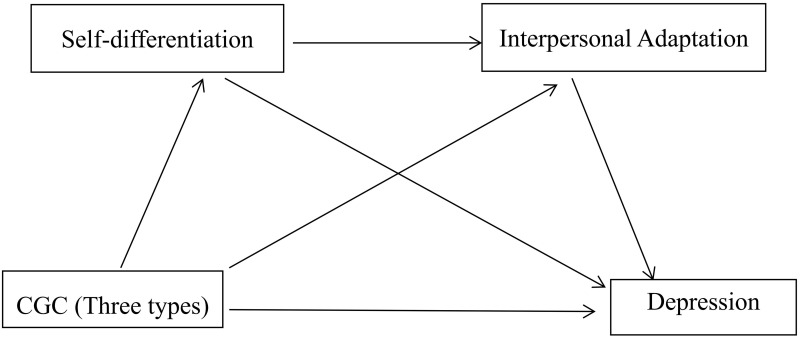
Grounded in family systems theory, this study investigates the relationships and distinct underlying mechanisms linking three forms of cross-generational coalitions (coalition with fathers, coalition with mothers, and unstable coalition) to depression among college students, focusing on the chain mediating roles of self-differentiation and interpersonal adaptation.
A total of 493 Chinese college students aged 17-25 years (55.2% male) completed anonymous questionnaires. The PROCESS macro Model 6 and bootstrap methods were employed to analyze the chain mediating effects of self-differentiation and interpersonal adaptation between cross-generational coalitions and college students' depression.
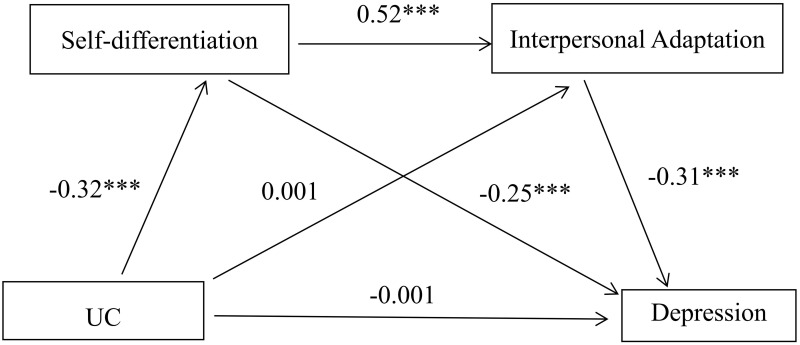
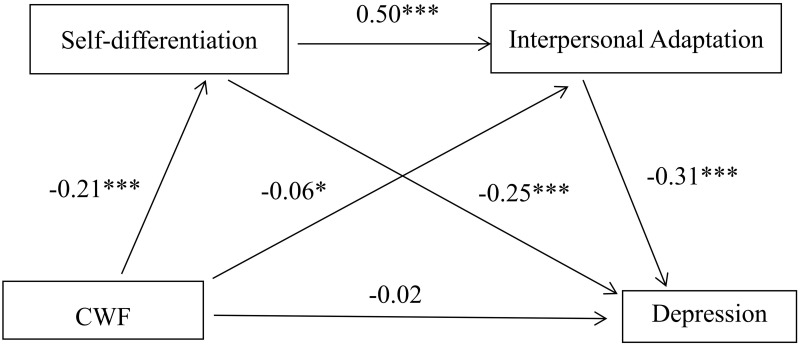
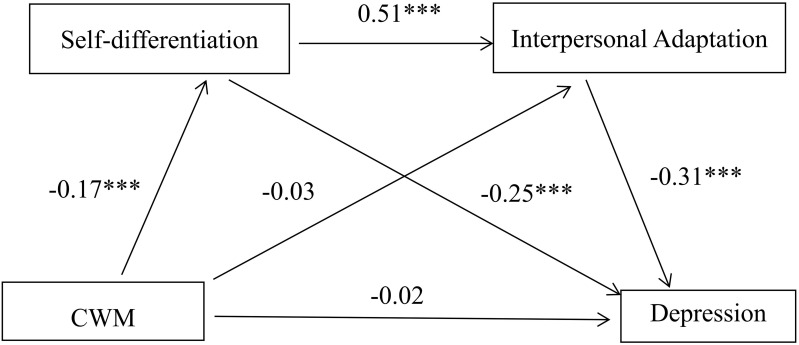
Each type of cross-generational coalition exhibited a significant indirect association with depression via the chain mediation of self-differentiation and interpersonal adaptation. Moreover, while all coalition types impacted college students' depression through the mediating effect of self-differentiation, only stable coalition with fathers influenced depression through the mediating effect of interpersonal adaptation.
This study highlights that three types of cross-generational coalitions can affect college students' depression through the chain mediation of self-differentiation and interpersonal adaptation. Notably, in comparison to coalition with mothers and unstable coalitions, coalition with fathers reveal distinct indirect pathways influencing depression. The study revealed the differential impacts of father-child and mother-child coalitions in a collectivist society, which significantly extend Bowenian family systems theory and attachment theory by elucidating the nuanced pathways through which cross-generational coalitions influence depression in college students. These findings deepen our understanding of how various forms of cross-generational coalitions serve as familial factors impacting the emotional well-being of Chinese college students.
研究表明跨代联盟与儿童的情绪健康之间存在显著关联。然而,这种关系背后的机制仍不清楚,并且先前的研究主要将跨代联盟视为一个单一的结构,忽视了不同类型的跨代联盟对大学生抑郁的不同影响和途径。
本研究以家庭系统理论为基础,调查三种形式的跨代联盟(与父亲的联盟、与母亲的联盟和不稳定联盟)与大学生抑郁之间的关系及不同的潜在机制,重点关注自我分化和人际适应的链式中介作用。
共有493名年龄在17 - 25岁之间的中国大学生(55.2%为男性)完成了匿名问卷。采用PROCESS宏模型6和Bootstrap方法分析自我分化和人际适应在跨代联盟与大学生抑郁之间的链式中介效应。
每种类型的跨代联盟通过自我分化和人际适应的链式中介与抑郁表现出显著的间接关联。此外,虽然所有联盟类型都通过自我分化的中介作用影响大学生的抑郁,但只有与父亲的稳定联盟通过人际适应的中介作用影响抑郁。
本研究强调三种类型的跨代联盟可通过自我分化和人际适应的链式中介影响大学生抑郁。值得注意的是,与和母亲的联盟及不稳定联盟相比,与父亲的联盟揭示了影响抑郁的独特间接途径。该研究揭示了在集体主义社会中父子联盟和母子联盟的不同影响,通过阐明跨代联盟影响大学生抑郁的细微途径,显著扩展了鲍文家庭系统理论和依恋理论。这些发现加深了我们对各种形式的跨代联盟如何作为影响中国大学生情绪健康的家庭因素的理解。