Zhou Shaobo, Li Na, Haishaer Dina, Zhao Hongmei
Department of Clinical Laboratory, China Medical University People's Hospital, The People's Hospital of Liaoning Province, Shenyang, China.
Department of Clinical Laboratory, The First Affiliated Hospital of Fujian Medical University, Fuzhou, China.
Discov Oncol. 2025 Jun 19;16(1):1158. doi: 10.1007/s12672-025-02983-5.
Lung cancer remains a leading global cause of mortality, with lung adenocarcinoma (LUAD) as the predominant histological subtype. Current serum biomarkers like carcinoembryonic antigen (CEA) lack specificity, necessitating novel diagnostic targets. Pentraxin 3 (PTX3), a homo-multimeric protein downregulated in malignancies, was evaluated for its diagnostic and prognostic roles in LUAD.
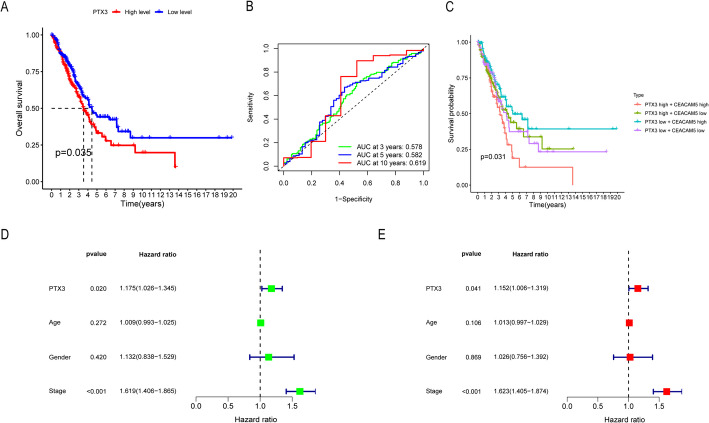
PTX3 expression was analyzed using TCGA/GEO datasets and clinical serum samples (97 LUAD vs. 40 controls). Diagnostic utility was assessed via ROC curves for PTX3, CEACAM5, and their combination. Prognostic value was determined by Kaplan-Meier and Cox regression. PTX3-associated differentially expressed genes (DEGs) were explored through functional enrichment, tumor microenvironment (TME) analysis, and drug sensitivity profiling.
The TCGA and GEO datasets revealed that PTX3 mRNA expression was significantly downregulated in LUAD, and the AUC values with PTX3 were > 0.7. Detection of CEACAM5 and PTX3 combined can improve diagnostic accuracy, and patients with high PTX3 level have shorter overall survival. Multivariate Cox analysis revealed that PTX3 is an independent predictor of overall survival. The result of ELISA further confirmed the low level of PTX3 protein. PTX3 is important in the functional analysis and TME of lung adenocarcinoma. In addition, the sensitivity of tumor cells to anti-cancer drugs is significantly correlated with the expression of PTX3.
PTX3 emerges as a dual biomarker for LUAD diagnosis and prognosis, with mechanistic ties to TME remodeling and therapeutic resistance, highlighting its potential for clinical translation.
肺癌仍然是全球主要的死亡原因,肺腺癌(LUAD)是主要的组织学亚型。目前的血清生物标志物如癌胚抗原(CEA)缺乏特异性,因此需要新的诊断靶点。五聚体蛋白3(PTX3)是一种在恶性肿瘤中表达下调的同多聚体蛋白,本研究评估了其在LUAD中的诊断和预后作用。
使用TCGA/GEO数据集和临床血清样本(97例LUAD患者与40例对照)分析PTX3表达。通过PTX3、CEACAM5及其组合的ROC曲线评估诊断效用。通过Kaplan-Meier和Cox回归确定预后价值。通过功能富集、肿瘤微环境(TME)分析和药物敏感性分析探索与PTX3相关的差异表达基因(DEG)。
TCGA和GEO数据集显示,LUAD中PTX3 mRNA表达显著下调,PTX3的AUC值>0.7。联合检测CEACAM5和PTX3可提高诊断准确性,PTX3水平高的患者总生存期较短。多变量Cox分析显示,PTX3是总生存期的独立预测因子。ELISA结果进一步证实了PTX3蛋白水平较低。PTX3在肺腺癌的功能分析和TME中起重要作用。此外,肿瘤细胞对抗癌药物的敏感性与PTX3的表达显著相关。
PTX3成为LUAD诊断和预后的双重生物标志物,与TME重塑和治疗耐药性存在机制联系,突出了其临床转化潜力。