Majewski Sebastian, Górska Katarzyna, Lewandowska Katarzyna B, Martusewicz-Boros Magdalena M, Sobiecka Małgorzata, Piotrowski Wojciech J
Department of Pneumology, Medical University of Lodz, Lodz, Poland.
Department of Internal Medicine, Pulmonary Diseases and Allergy, Medical University of Warsaw, Warsaw, Poland.
Front Pharmacol. 2025 Jun 5;16:1586197. doi: 10.3389/fphar.2025.1586197. eCollection 2025.
Persistence with antifibrotic medications in patients with idiopathic pulmonary fibrosis (IPF) is crucial for long-term outcomes. However, real-world data regarding treatment persistence patterns in IPF are scarce.
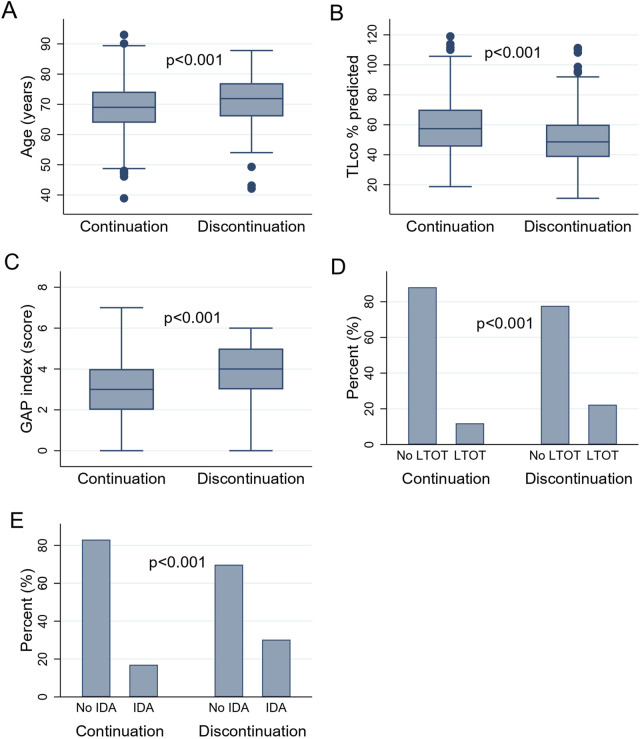
We conducted a analysis of two retrospective, real-world, multicenter observational studies (PolExPIR and PolExNIB) that collected clinical data on Polish patients with IPF managed at specialized centers between January 2017 and October 2021. We compared clinical variables between groups of patients who continued and discontinued antifibrotics and evaluated predictive factors for treatment discontinuation.
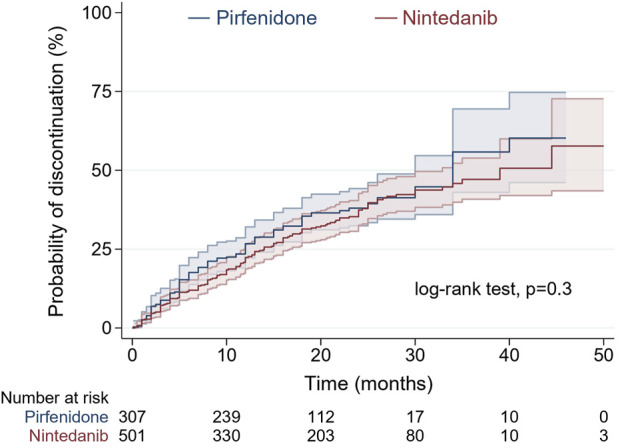
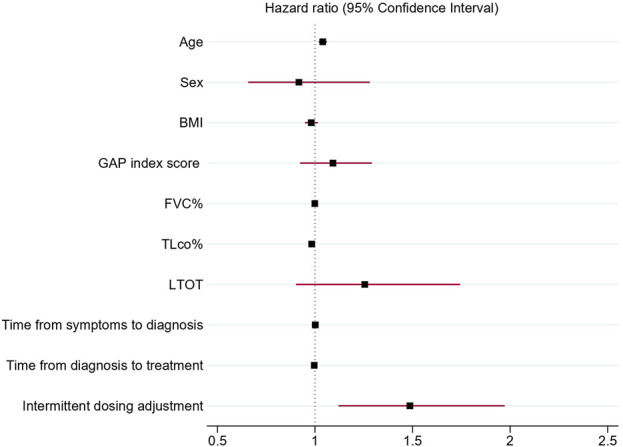
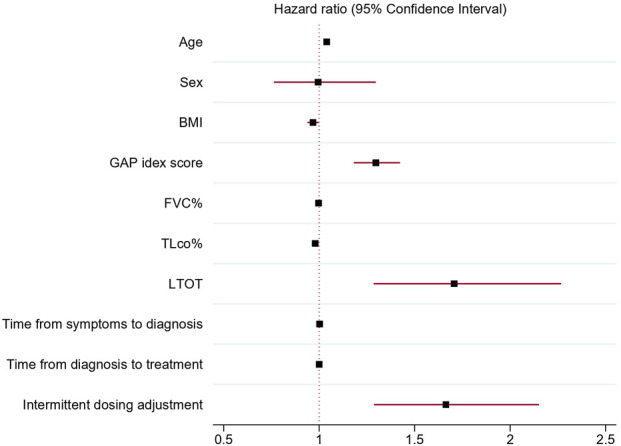
Overall, 808 patients were included in the analysis. Of these, 278 subjects (34.4%) discontinued therapy over a median follow-up of 16 (8-24) months. The proportion of patients discontinuing therapy was comparable between pirfenidone and nintedanib (37.5% vs. 32.5% respectively; p = 0.15). Additionally, no statistical difference was observed between antifibrotic agents in the distribution of time until treatment discontinuation (log-rank test, p = 0.3). Predictive factors associated with the probability of treatment discontinuation included age (hazard ratio [HR] 1.04; 95% confidence interval [CI] 1.02-1.05), body mass index (BMI, HR 0.97; 95% CI 0.94-0.99), transfer factor of the lung for carbon monoxide (TLco)% predicted (HR 0.98, 95% CI 0.97-0.99), Gender-Age-Physiology (GAP) index score (HR 1.3, 95% CI 1.18-1.42), use of long-term oxygen therapy (LTOT) (HR = 1.7, 95% CI 1.28-2.27) and intermittent dosing adjustment (HR 1.66, 95% CI 1.29-2.15).
In this large population-based cohort of patients with IPF, around one-third discontinued antifibrotics during a study follow-up with no difference in the rates and time to discontinuation between pirfenidone and nintedanib. Clinical predictive factors including age, BMI, TLco% predicted, GAP index score, use of LTOT and intermittent dosing adjustment were associated with the risk of treatment discontinuation.
特发性肺纤维化(IPF)患者坚持使用抗纤维化药物对长期预后至关重要。然而,关于IPF治疗坚持模式的真实世界数据却很匮乏。
我们对两项回顾性、真实世界、多中心观察性研究(PolExPIR和PolExNIB)进行了分析,这两项研究收集了2017年1月至2021年10月期间在波兰专门中心接受治疗的IPF患者的临床数据。我们比较了继续和停止使用抗纤维化药物的患者组之间的临床变量,并评估了治疗中断的预测因素。
总体而言,808例患者纳入分析。其中,278例受试者(34.4%)在中位随访16(8 - 24)个月期间停止治疗。吡非尼酮和尼达尼布治疗中断的患者比例相当(分别为37.5%和32.5%;p = 0.15)。此外,在治疗中断时间分布方面,抗纤维化药物之间未观察到统计学差异(对数秩检验,p = 0.3)。与治疗中断概率相关的预测因素包括年龄(风险比[HR] 1.04;95%置信区间[CI] 1.02 - 1.