Wan Xiaoju, Yu Min, Wu Xingwu, Huang Zhihui, Tan Jun
Reproductive Medicine Center, Jiangxi Maternal and Child Health Hospital, Nanchang, China.
Front Endocrinol (Lausanne). 2025 Jun 5;16:1598998. doi: 10.3389/fendo.2025.1598998. eCollection 2025.
Kuntai capsules, a traditional Chinese medicine, are speculated to improve the treatment outcomes of patients with ovarian reserve dysfunction (DOR), but existing evidence is limited.
To investigate the effects of Kuntai capsule pretreatment on the IVF/ICSI treatment outcomes of DOR patients with different ovarian stimulation regimens (PPOS, antagonists, and microstimulation).
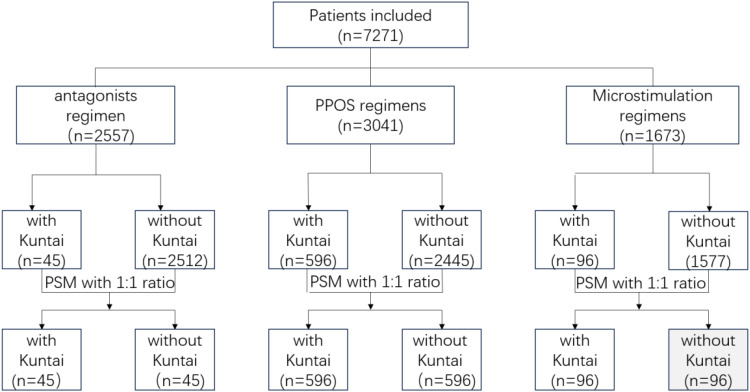
A retrospective cohort study design was used to include 7271 DOR patients who underwent IVF/ICSI between January 2015 and February 2025. After baseline data were balanced through propensity score matching (PSM), 1474 patients were ultimately included. The number of retrieved eggs, laboratory indicators, and clinical outcomes were compared between the group pretreated with Kuntai capsules and the group not pretreated with Kuntai capsules under three ovarian stimulation regimens, and confounding factors were controlled via a generalized estimating equation (GEE) model.
In the PPOS regimen, the number of retrieved eggs (without kuntai: 2.00 [1.00;4.00], with kuntai: 2.00 [1.00;3.00], p<0.001) and normal fertilized eggs (without kuntai:2.00 [1.00;3.00], with kuntai: 2.00 [1.00;2.00], p=0.004) in the Kuntai pretreatment group significantly decreased, but the embryo utilization rate increased (without kuntai:101 (69.2%), with kuntai: 79 (74.5%), p=0.012). There was no difference between the two groups in the antagonist regimen. The Kuntai group had a higher failure rate for egg retrieval in the microstimulation program (without kuntai: 0 (0.00%), with kuntai:6 (6.25%), p=0.029). Among the three regimens, Kuntai pretreatment did not significantly improve the clinical pregnancy rate, live birth rate, or other outcomes (all p>0.05). Age stratification analysis and GEE analysis did not reveal significant differences.
Pretreatment with Kuntai capsules did not significantly improve the number of retrieved eggs or clinical pregnancy outcomes in DOR patients under different ovarian stimulation regimens, and its application effect is limited. Further verification through prospective research is needed in the future.
坤泰胶囊作为一种中药,据推测可改善卵巢储备功能障碍(DOR)患者的治疗效果,但现有证据有限。
探讨坤泰胶囊预处理对不同卵巢刺激方案(PPOS、拮抗剂方案和微刺激方案)的DOR患者体外受精/卵胞浆内单精子注射(IVF/ICSI)治疗结局的影响。
采用回顾性队列研究设计,纳入2015年1月至2025年2月期间接受IVF/ICSI治疗的7271例DOR患者。通过倾向得分匹配(PSM)平衡基线数据后,最终纳入1474例患者。比较三种卵巢刺激方案下坤泰胶囊预处理组和未预处理组的取卵数、实验室指标和临床结局,并通过广义估计方程(GEE)模型控制混杂因素。
在PPOS方案中,坤泰预处理组的取卵数(未用坤泰:2.00[1.00;4.00],用坤泰:2.00[1.00;3.00],p<0.001)和正常受精卵数(未用坤泰:2.00[1.00;3.00],用坤泰:2.00[1.00;2.00],p=0.004)显著减少,但胚胎利用率提高(未用坤泰:101例(69.2%),用坤泰:79例(74.5%),p=0.012)。拮抗剂方案组两组间无差异。微刺激方案中坤泰组的取卵失败率较高(未用坤泰:0例(0.00%),用坤泰:6例(6.25%),p=0.029)。在三种方案中,坤泰预处理均未显著提高临床妊娠率、活产率或其他结局(所有p>0.05)。年龄分层分析和GEE分析均未显示出显著差异。
在不同卵巢刺激方案下,坤泰胶囊预处理未显著提高DOR患者的取卵数或临床妊娠结局,其应用效果有限。未来需要通过前瞻性研究进一步验证。