Lv Xiaoqian, Wei Qiang, Liu Xin, Gong Wei, Li Fan, Niu Yingjie, Jin Kai, Li Bichun, Zuo Qisheng
Key Laboratory of Animal Genetics, Breeding and Molecular Design of Jiangsu Province, College of Animal Science and Technology, Yangzhou University, Yangzhou, China; Joint International Research Laboratory of Agriculture and Agri-Product Safety of the Ministry of Education of China, Yangzhou University, Yangzhou, China.
Key Laboratory of Animal Genetics, Breeding and Molecular Design of Jiangsu Province, College of Animal Science and Technology, Yangzhou University, Yangzhou, China; Joint International Research Laboratory of Agriculture and Agri-Product Safety of the Ministry of Education of China, Yangzhou University, Yangzhou, China; Poultry Research Institute, Chinese Academy of Agricultural Science/Jiangsu Institute of Poultry Science, Yangzhou, China.
Poult Sci. 2025 Jun 12;104(9):105435. doi: 10.1016/j.psj.2025.105435.
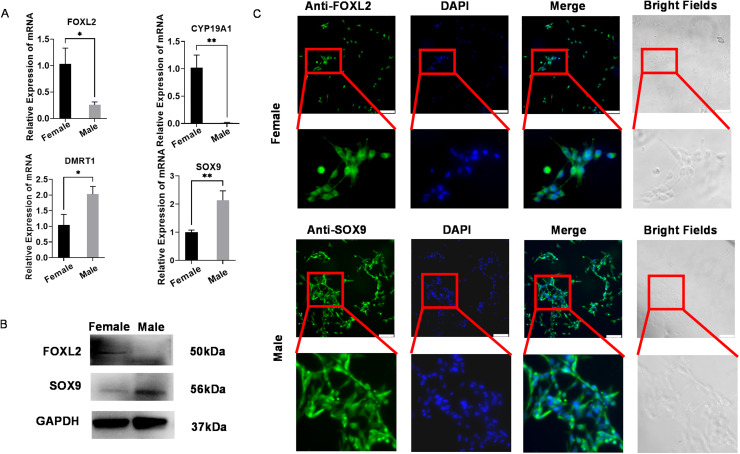
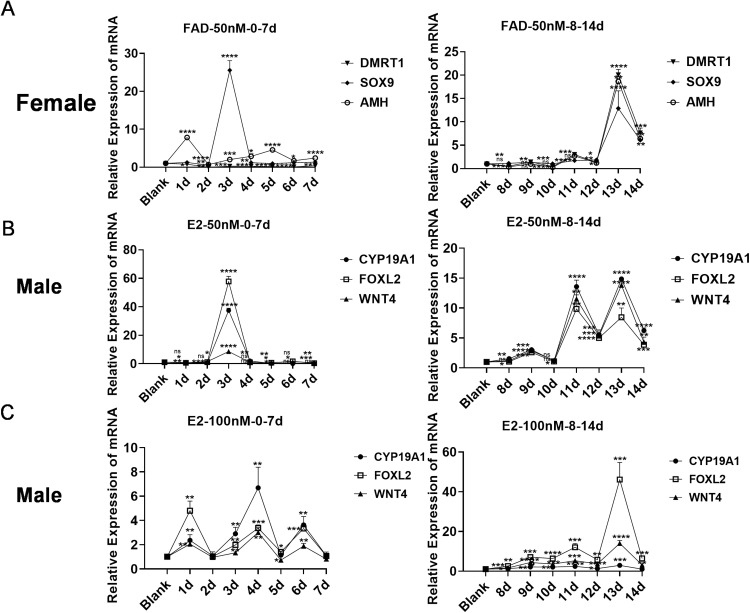
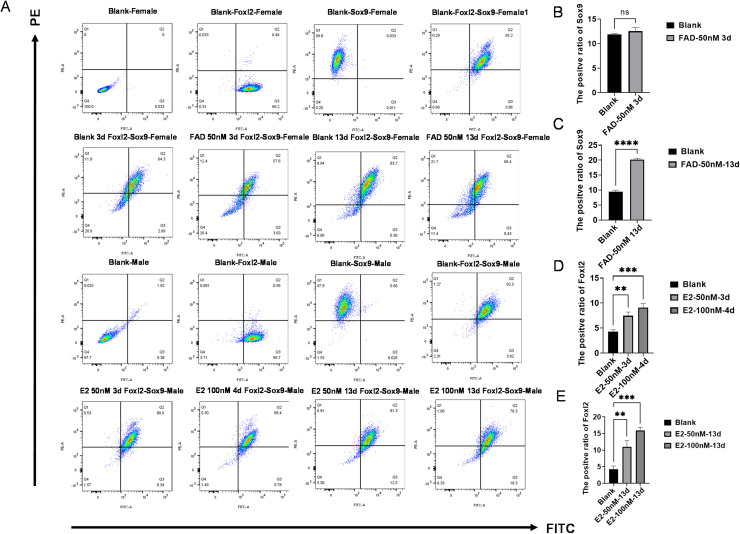
In chickens, sex determination is governed by genetic-hormonal interactions, but the dynamic interplay between sex hormones and receptor expression in gonadal somatic cells remains unclear. Here, we established an in vitro sex reversal model using embryonic chicken gonadal somatic cells (E18.5 days) to dissect temporal and dose-dependent regulatory mechanisms. Male (SOX9) and female (FOXL2) cells were isolated via two-step enzymatic digestion and maintained sex-specific markers in culture. Hormonal treatments revealed distinct phenotypic plasticity: Short-term (3 days) 50 nM fadrozole (FAD) in female cells upregulated male markers (SOX9, AMH; P < 0.001), while prolonged (13 days) exposure induced an intersex state with co-expression of male/female genes (P < 0.01). In male cells, 50 nM estradiol (E2) induced bisexual characteristics within 3 days (P < 0.0001), and 100 nM E2 triggered sex reversal by day 4 (CYP19A1, FOXL2, WNT4; P < 0.01), though extended treatment reverted to an intersex phenotype. Flow cytometry validated hormone-induced protein-level changes in sex-related genes. Receptor dynamics showed oscillatory patterns: In female cells, 50 nM FAD transiently activated ESR1 (0-7 days), inhibited ESR2/AR, and induced AR-dependent male gene expression at 8-13 days. In male cells, E2 (50/100 nM) repressed AR expression for 14 days while phase-activating ESR1/ESR2; early AR inhibition correlated with male gene peaks, whereas ESR1/ESR2 fluctuations drove female gene activation. These findings define temporal thresholds in avian sex determination, highlighting receptor-driven sexual plasticity. Elucidating this genetic-hormonal crosstalk provides a framework for optimizing avian sex control strategies.
在鸡中,性别决定受遗传 - 激素相互作用的调控,但性激素与性腺体细胞中受体表达之间的动态相互作用仍不清楚。在此,我们利用鸡胚胎性腺体细胞(E18.5天)建立了体外性别逆转模型,以剖析时间和剂量依赖性调控机制。通过两步酶消化分离出雄性(SOX9)和雌性(FOXL2)细胞,并在培养中维持性别特异性标记。激素处理揭示了不同的表型可塑性:雌性细胞中短期(3天)50 nM法倔唑(FAD)上调雄性标记(SOX9、抗缪勒氏管激素;P < 0.001),而长期(13天)暴露诱导出具有雄性/雌性基因共表达的雌雄间性状态(P < 0.01)。在雄性细胞中,50 nM雌二醇(E2)在3天内诱导出双性特征(P < 0.0001),100 nM E2在第4天引发性别逆转(细胞色素P450 19A1、FOXL2、WNT4;P < 0.01),尽管延长处理会恢复为雌雄间性表型。流式细胞术验证了激素诱导的性别相关基因蛋白水平变化。受体动态显示出振荡模式:在雌性细胞中,50 nM FAD短暂激活雌激素受体1(ESR1,0 - 7天),抑制雌激素受体2/雄激素受体(ESR2/AR),并在8 - 13天诱导AR依赖性雄性基因表达。在雄性细胞中,E2(50/100 nM)在14天内抑制AR表达,同时阶段性激活ESR1/ESR2;早期AR抑制与雄性基因峰值相关,而ESR1/ESR2波动驱动雌性基因激活。这些发现定义了鸟类性别决定中的时间阈值,突出了受体驱动的性可塑性。阐明这种遗传 - 激素相互作用为优化鸟类性别控制策略提供了框架。