• 文献检索
  • 文档翻译
  • 深度研究
  • 学术资讯
  • Suppr Zotero 插件Zotero 插件
  • 邀请有礼
  • 套餐&价格
  • 历史记录
应用&插件
Suppr Zotero 插件Zotero 插件浏览器插件Mac 客户端Windows 客户端微信小程序
定价
高级版会员购买积分包购买API积分包
服务
文献检索文档翻译深度研究API 文档MCP 服务
关于我们
关于 Suppr公司介绍联系我们用户协议隐私条款
关注我们

Suppr 超能文献

核心技术专利:CN118964589B侵权必究
粤ICP备2023148730 号-1Suppr @ 2026

文献检索

告别复杂PubMed语法,用中文像聊天一样搜索,搜遍4000万医学文献。AI智能推荐,让科研检索更轻松。

立即免费搜索

文件翻译

保留排版,准确专业,支持PDF/Word/PPT等文件格式,支持 12+语言互译。

免费翻译文档

深度研究

AI帮你快速写综述,25分钟生成高质量综述,智能提取关键信息,辅助科研写作。

立即免费体验

让结果指标产生影响:为何“对痴呆症患者重要的事情”对痴呆症研究人员至关重要?

Making outcome measures matter: Why should "what matters to people living with dementia" matter to dementia researchers?

作者信息

Reilly Siobhan T, Harding Andrew J E

机构信息

Centre for Applied Dementia Studies, Faculty of Health Studies, University of Bradford, Bradford, UK.

Centre for Ageing Research, Division of Health Research, Faculty of Health and Medicine, Lancaster University, Lancaster, UK.

出版信息

Alzheimers Dement. 2025 Jun;21(6):e70359. doi: 10.1002/alz.70359.

DOI:10.1002/alz.70359
PMID:40545551
原文链接:https://pmc.ncbi.nlm.nih.gov/articles/PMC12183116/
Abstract

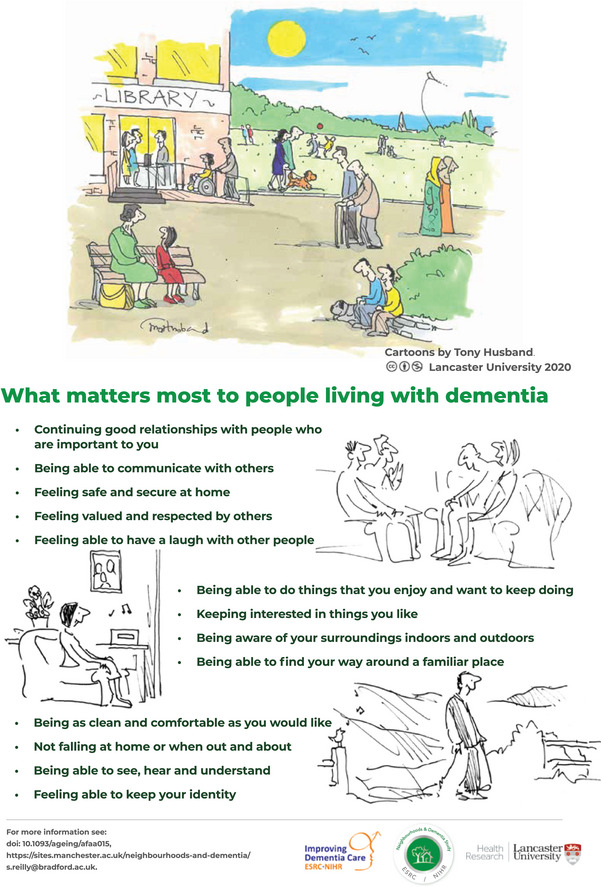
This article provides an overview of evidence to support a call to action for dementia researchers to ensure that "what matters to people living with dementia" should be at the heart of any decision-making around the choices and design of outcome measures. There have been sufficient reviews observing how the outcome measures that have been used in previous research have not been those that have been valued by people living with dementia or their carers. If researchers continue to use existing measures that are not valued by people living with dementia, they will waste limited research resources by using measures that are not sufficiently sensitive to detect changes that might be attributed to interventions. It is time for researchers to collaborate internationally to ensure that resources are invested in designing and validating new approaches for measurement of psychosocial outcomes for those living with dementia. HIGHLIGHTS: Outcome measures that have been used in previous research have not been those that have been valued by people living with dementia or their carers. Existing outcome measures have been shown not to be fit for purpose and tend to focus on symptom reduction or broad conceptualizations of quality of life. Dementia researchers will need to collaborate internationally to ensure that resources are invested in designing and validating new approaches for measurement of psychosocial outcomes for those living with dementia.

摘要

本文概述了相关证据,以支持呼吁痴呆症研究人员采取行动,确保“对痴呆症患者重要的事项”应成为围绕结果测量的选择和设计进行任何决策的核心。已有足够多的综述指出,以往研究中使用的结果测量并非痴呆症患者及其护理人员所重视的那些。如果研究人员继续使用痴呆症患者不重视的现有测量方法,他们将因使用对检测可能归因于干预措施的变化不够敏感的测量方法而浪费有限的研究资源。现在是研究人员进行国际合作的时候了,以确保资源用于设计和验证针对痴呆症患者心理社会结果测量的新方法。要点:以往研究中使用的结果测量并非痴呆症患者及其护理人员所重视的那些。现有的结果测量已被证明不适用,且往往侧重于症状减轻或对生活质量的宽泛概念化。痴呆症研究人员需要进行国际合作,以确保资源用于设计和验证针对痴呆症患者心理社会结果测量的新方法。
https://cdn.ncbi.nlm.nih.gov/pmc/blobs/3b0e/12183116/463547106543/ALZ-21-e70359-g002.jpg

相似文献

1
Making outcome measures matter: Why should "what matters to people living with dementia" matter to dementia researchers?让结果指标产生影响:为何“对痴呆症患者重要的事情”对痴呆症研究人员至关重要?
Alzheimers Dement. 2025 Jun;21(6):e70359. doi: 10.1002/alz.70359.
2
WITHDRAWN: Support for carers of people with Alzheimer's type dementia.撤回:对阿尔茨海默病型痴呆患者照料者的支持。
Cochrane Database Syst Rev. 2007 Jul 18(3):CD000454. doi: 10.1002/14651858.CD000454.
3
Support for carers of people with Alzheimer's type dementia.对阿尔茨海默病型痴呆患者照料者的支持。
Cochrane Database Syst Rev. 2000;1998(2):CD000454. doi: 10.1002/14651858.CD000454.
4
Adapting Safety Plans for Autistic Adults with Involvement from the Autism Community.在自闭症群体的参与下为成年自闭症患者调整安全计划。
Autism Adulthood. 2025 May 28;7(3):293-302. doi: 10.1089/aut.2023.0124. eCollection 2025 Jun.
5
The use of Open Dialogue in Trauma Informed Care services for mental health consumers and their family networks: A scoping review.创伤知情护理服务中使用开放对话模式为心理健康消费者及其家庭网络提供服务:范围综述。
J Psychiatr Ment Health Nurs. 2024 Aug;31(4):681-698. doi: 10.1111/jpm.13023. Epub 2024 Jan 17.
6
How lived experiences of illness trajectories, burdens of treatment, and social inequalities shape service user and caregiver participation in health and social care: a theory-informed qualitative evidence synthesis.疾病轨迹的生活经历、治疗负担和社会不平等如何影响服务使用者和照顾者参与健康和社会护理:一项基于理论的定性证据综合分析
Health Soc Care Deliv Res. 2025 Jun;13(24):1-120. doi: 10.3310/HGTQ8159.
7
Cost-effectiveness of using prognostic information to select women with breast cancer for adjuvant systemic therapy.利用预后信息为乳腺癌患者选择辅助性全身治疗的成本效益
Health Technol Assess. 2006 Sep;10(34):iii-iv, ix-xi, 1-204. doi: 10.3310/hta10340.
8
A qualitative systematic review of the role of families in supporting communication in people with dementia.一项关于家庭在支持痴呆症患者沟通方面作用的定性系统评价。
Int J Lang Commun Disord. 2022 Sep;57(5):1130-1153. doi: 10.1111/1460-6984.12738. Epub 2022 Jun 17.
9
Home treatment for mental health problems: a systematic review.心理健康问题的居家治疗:一项系统综述
Health Technol Assess. 2001;5(15):1-139. doi: 10.3310/hta5150.
10
Palliative care interventions in advanced dementia.晚期痴呆症的姑息治疗干预措施。
Cochrane Database Syst Rev. 2016 Dec 2;12(12):CD011513. doi: 10.1002/14651858.CD011513.pub2.

本文引用的文献

1
Meaningful to whom? Minimal clinically important differences and the priorities of individuals living with dementia for everyday function.对谁有意义?最小临床重要差异与痴呆症患者日常功能的优先事项。
Alzheimers Dement (N Y). 2025 Feb 19;11(1):e70052. doi: 10.1002/trc2.70052. eCollection 2025 Jan-Mar.
2
Learning From People With Dementia What Works Well for Well-Being: Interviews and Focus Groups.向痴呆症患者学习对幸福有益的方法:访谈与焦点小组。
Gerontologist. 2024 Sep 1;64(9). doi: 10.1093/geront/gnae077.
3
What matters most: Exploring the everyday lives of people with dementia.
最重要的是:探索痴呆症患者的日常生活。
Int J Geriatr Psychiatry. 2023 Aug;38(8):e5983. doi: 10.1002/gps.5983.
4
Social Health and Change in Cognitive Capability among Older Adults: Findings from Four European Longitudinal Studies.老年人的社会健康与认知能力变化:来自四项欧洲纵向研究的发现。
Gerontology. 2023;69(11):1330-1346. doi: 10.1159/000531969. Epub 2023 Jul 27.
5
Technical Review of Clinical Outcomes Assessments Across the Continuum of Alzheimer's Disease.阿尔茨海默病全病程临床结局评估的技术综述
Neurol Ther. 2023 Apr;12(2):571-595. doi: 10.1007/s40120-023-00443-2. Epub 2023 Feb 15.
6
Assessing What Matters to People Affected by Alzheimer's Disease: A Quantitative Analysis.评估对阿尔茨海默病患者重要的事项:一项定量分析。
Neurol Ther. 2023 Apr;12(2):505-527. doi: 10.1007/s40120-023-00445-0. Epub 2023 Feb 10.
7
Outcome measures for Alzheimer's disease: A global inter-societal Delphi consensus.阿尔茨海默病的结局评估指标:全球跨学会德尔菲共识。
Alzheimers Dement. 2023 Jun;19(6):2707-2729. doi: 10.1002/alz.12945. Epub 2023 Feb 7.
8
Recognition of social health: A conceptual framework in the context of dementia research.社会健康的认知:痴呆症研究背景下的概念框架。
Front Psychiatry. 2022 Dec 15;13:1052009. doi: 10.3389/fpsyt.2022.1052009. eCollection 2022.
9
Associations between social connections and cognition: a global collaborative individual participant data meta-analysis.社会关系与认知之间的关联:一项全球性合作的个体参与者数据荟萃分析。
Lancet Healthy Longev. 2022 Nov;3(11):e740-e753. doi: 10.1016/S2666-7568(22)00199-4. Epub 2022 Oct 20.
10
The Journeying through Dementia psychosocial intervention versus usual care study: a single-blind, parallel group, phase 3 trial.《痴呆症心理社会干预与常规护理研究:一项单盲、平行组、3 期试验》
Lancet Healthy Longev. 2022 Apr;3(4):e276-e285. doi: 10.1016/S2666-7568(22)00059-9. Epub 2022 Apr 4.