
美国献血者中与活动性梅毒感染相关的因素。
Factors associated with active syphilis infection in US blood donors.
作者信息
Avelino-Silva Vivian I, Bruhn Roberta L, Kaidarova Zhanna, Hindes Daniel, Notari Edward, Burke Donna, Kessler Debra A, Delvalle Carlos, Reik Rita, Ortiz Vilson, Fallon Sheri, Lanteri Marion C, Stramer Susan L, Hailu Benyam, Berger James J, Yang Hong, Whitaker Barbee, Custer Brian
机构信息
Vitalant Research Institute, San Francisco, California, USA.
Department of Epidemiology and Biostatistics, University of California San Francisco, San Francisco, California, USA.
出版信息
Transfusion. 2025 Aug;65(8):1460-1471. doi: 10.1111/trf.18313. Epub 2025 Jun 23.
BACKGROUND
Syphilis is increasing globally, with limited monitoring of risk factors in asymptomatic, low-risk populations. Here, we investigate contemporary demographic and behavioral risk factors associated with active syphilis infection (ASI) in US blood donors.
STUDY DESIGN AND METHODS
Beginning with donations in October 2020, four US blood centers implemented standardized risk factor interviews for ASI in blood donors as part of a larger case-control study. Logistic regression models were used to assess ASI associations with demographics and behaviors within 12 months before donation. A conceptual framework explored causal ASI pathways.
RESULTS
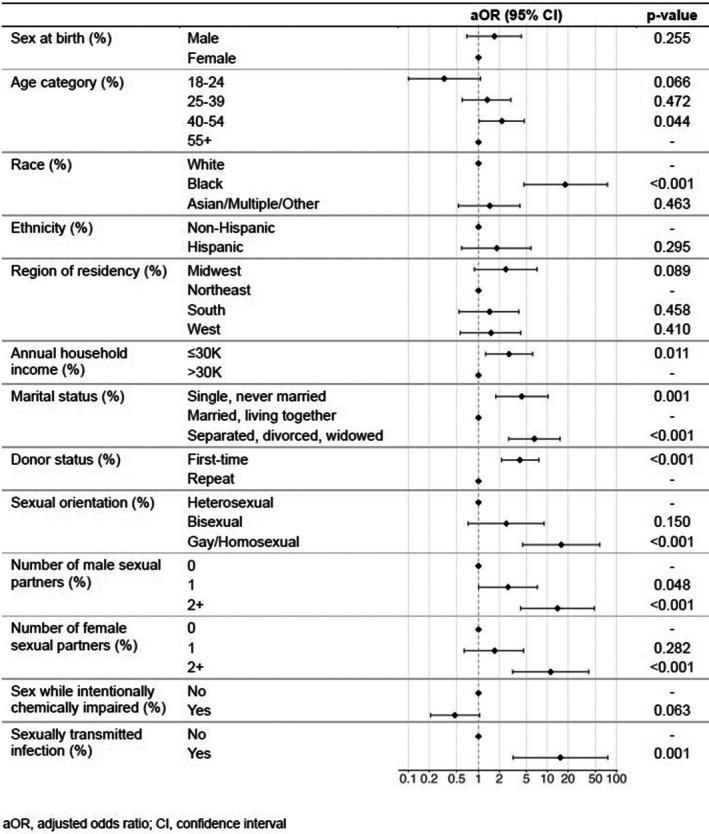
Responses were obtained from 369 ASI cases and 868 controls; from all eligible cases, the enrollment rate was 16%. Risk factors in the multivariable-adjusted model included age between 40 and 54 years old (compared to 55+), Black race (compared to White), lower income, single/never married and separated/divorced or widowed status (compared to married or living together), first-time donation, gay/homosexual sexual orientation, having ≥2 male or ≥2 female sexual partners in the 12 months before donation, and a history of sexually transmitted infection. The conceptual risk framework suggests that important determinants of ASI include complex variables and mediators that may have not been fully captured by the questionnaire and regression analyses.
DISCUSSION
Although not fully defining causal relationships with ASI, our findings establish a baseline for factors associated with ASI among US blood donors, which can be used to refine the donor history questionnaire following the implementation of individual risk assessment and further surveillance efforts.
背景
梅毒在全球范围内呈上升趋势,对无症状、低风险人群的风险因素监测有限。在此,我们调查了美国献血者中与活动性梅毒感染(ASI)相关的当代人口统计学和行为风险因素。
研究设计与方法
从2020年10月的献血开始,作为一项更大规模病例对照研究的一部分,美国四个血液中心对献血者进行了针对ASI的标准化风险因素访谈。使用逻辑回归模型评估在献血前12个月内ASI与人口统计学和行为之间的关联。一个概念框架探索了ASI的因果途径。
结果
获得了369例ASI病例和868例对照的回复;在所有符合条件的病例中,纳入率为16%。多变量调整模型中的风险因素包括40至54岁(与55岁以上相比)、黑人种族(与白人相比)、低收入、单身/从未结婚以及分居/离婚或丧偶状态(与已婚或同居相比)、首次献血、男同性恋/同性恋性取向、在献血前12个月内有≥2名男性或≥2名女性性伴侣以及性传播感染史。概念性风险框架表明,ASI的重要决定因素包括可能未被问卷和回归分析完全捕捉到的复杂变量和中介因素。
讨论
尽管没有完全确定与ASI的因果关系,但我们的研究结果为美国献血者中与ASI相关的因素建立了基线,可用于在实施个体风险评估和进一步监测工作后完善献血者病史问卷。


 Zotero 插件