Laguardia Simone, Piccioni Alessio, Alonso Vera Jorge Eduardo, Muqaddas Ali, Garcés Milko, Ambreen Sidra, Sharma Sarmishtha, Sabzvari Tara
Medicine and Surgery, Università degli Studi di Milano-Bicocca, Monza, ITA.
Medicine and Surgery, Università degli Studi di Roma "La Sapienza", Rome, ITA.
Cureus. 2025 May 23;17(5):e84682. doi: 10.7759/cureus.84682. eCollection 2025 May.
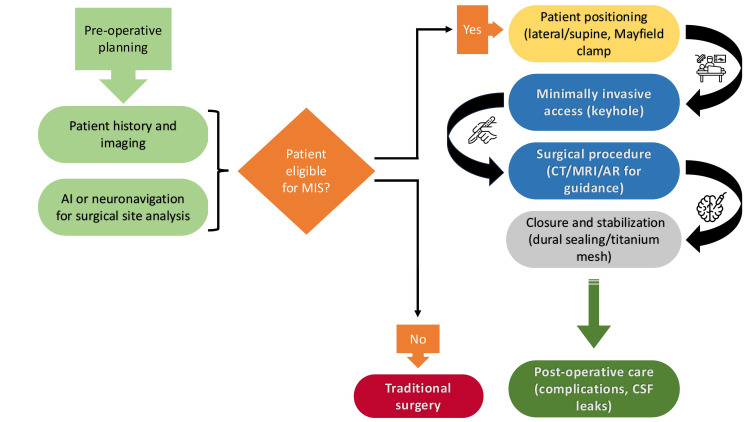
Minimally invasive neurosurgical techniques offer reduced surgical trauma, lower complication rates, and faster recovery compared to traditional open procedures. Approaches such as keyhole craniotomy, endoscopic skull base surgery, endovascular neurosurgery, and percutaneous spinal techniques have advanced the management of cranial and spinal pathologies. These methods aim to minimize tissue disruption, blood loss, and hospital stay while maintaining surgical efficacy. This narrative review explores their evolution, applications, and advantages in modern neurosurgery.
与传统的开放手术相比,微创神经外科技术具有手术创伤小、并发症发生率低和恢复快的优点。诸如锁孔开颅术、内镜颅底手术、血管内神经外科手术和经皮脊柱技术等方法推动了颅脑和脊柱疾病的治疗进展。这些方法旨在将组织破坏、失血和住院时间降至最低,同时保持手术效果。这篇叙述性综述探讨了它们在现代神经外科中的发展、应用和优势。