Abdalla Osama, Chahari Mahmood, Azami Milad, Ameli Amir, Salman Emre, Stanacevic Milutin, Willing Ryan, Towfighian Shahrzad
State University of New York at Binghamton, Binghamton, NY, United States of America.
University of Massachusetts Lowell, Lowell, MA, United States of America.
Smart Mater Struct. 2025 Jun 1;34(6):065030. doi: 10.1088/1361-665X/ade1ba. Epub 2025 Jun 19.
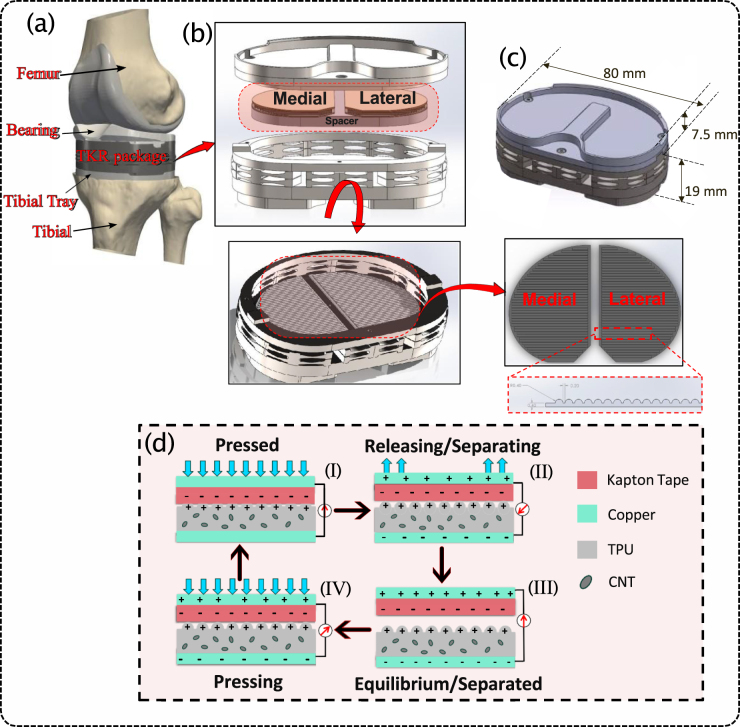
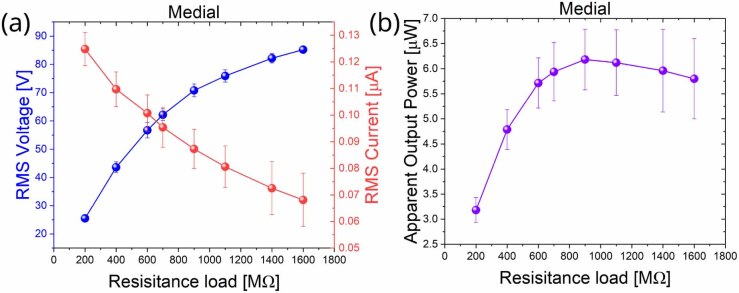
This study presents the development and characterization of a novel triboelectric nanogenerator (TENG) designed as a self-powered sensor for load monitoring in total knee replacement (TKR) implants. The triboelectric layers comprise a 3D-printed thermoplastic polyurethane (TPU) matrix with carbon nanotube (CNT) nanoparticles and kapton tape, sandwiched between two copper electrodes. To optimize sensor performance, the proposed CNT/TPU TENG sensor is fabricated with varying CNT concentrations and thicknesses, enabling a comprehensive analysis of how material composition and structural parameters influence energy harvesting efficiency. The 1% CNT/TPU composite demonstrates the highest power output among the tested samples. The solid CNT/TPU-based TENG generated the apparent output power of 4.1 W under a cyclic compressive load of 2100 N, measured across a 1.6 GΩ load resistance and over a nominal contact area of 15.9 cm, while the foam CNT/TPU film achieved a higher apparent output power of 6.9 W measured across a 0.9 GΩ load resistance with the same nominal area. The generated power is sufficient to operate a power management and ADC circuit based on our earlier work. The sensors exhibit a stable open-circuit voltage of 320 V for the foam layer and 275 V for the solid one. Sensitivities are 80.50 mV N ( N) and 24.60 mV N (> 1600 N) for foam CNT/TPU film, demonstrating the integrated sensor capability for wide-range force sensing on TKR implants. The foam CNT/TPU-based TENG maintained stable performance over 16 000 load cycles, confirming its potential for long-term use inside the TKR. Additionally, the dielectric constant of the CNT/TPU composite was found to increase with increasing CNT concentration. The proposed CNT/TPU TENG sensor offers a broad working range and robust energy-harvesting efficiency, making it appropriate for self-powered load sensing in biomedical applications.
本研究展示了一种新型摩擦纳米发电机(TENG)的开发与特性,该发电机被设计为一种自供电传感器,用于全膝关节置换(TKR)植入物中的负载监测。摩擦电层由含有碳纳米管(CNT)纳米颗粒的3D打印热塑性聚氨酯(TPU)基体和聚酰亚胺薄膜组成,夹在两个铜电极之间。为了优化传感器性能,所提出的CNT/TPU TENG传感器采用不同的CNT浓度和厚度制造,从而能够全面分析材料成分和结构参数如何影响能量收集效率。1% CNT/TPU复合材料在测试样品中表现出最高的功率输出。基于固体CNT/TPU的TENG在2100 N的循环压缩负载下,在1.6 GΩ的负载电阻上以及15.9 cm的标称接触面积上测得的表观输出功率为4.1 W,而泡沫CNT/TPU薄膜在相同标称面积下,在0.9 GΩ的负载电阻上测得的表观输出功率更高,为6.9 W。产生的功率足以基于我们早期的工作来运行一个电源管理和模数转换电路。对于泡沫层,传感器的开路电压稳定在320 V,对于固体层则为275 V。泡沫CNT/TPU薄膜的灵敏度在小于1600 N时为80.50 mV/N,在大于1600 N时为24.60 mV/N,展示了该集成传感器在TKR植入物上进行宽范围力传感的能力。基于泡沫CNT/TPU的TENG在16000次负载循环中保持稳定性能,证实了其在TKR内部长期使用的潜力。此外,发现CNT/TPU复合材料的介电常数随CNT浓度的增加而增大。所提出的CNT/TPU TENG传感器具有宽广的工作范围和强大的能量收集效率,使其适用于生物医学应用中的自供电负载传感。