Ananikas Konstantinos, Stavrakas Panagiotis, Kroupis Christos, Christou Evita Evangelia, Gotzaridis Stratos V, Dervenis Panagiotis, Papaconstantinou Dimitrios
St Paul's Eye Department, Royal Liverpool University Hospital Liverpool, W Derby St, Liverpool, L7 8YA, UK.
Department of Ophthalmology, School of Medicine, University of Patras, Patras, Greece.
Ther Adv Ophthalmol. 2025 Jun 21;17:25158414251350072. doi: 10.1177/25158414251350072. eCollection 2025 Jan-Dec.
Epiretinal membrane (ERM) formation following a successful rhegmatogenous retinal detachment (RRD) operation has been reported to occur in about 4%-15% of the cases. In this study, we collected vitreous samples from patients with RRD to identify whether the concentration of IL-6 is correlated with the presence of postoperative ERM. We aim is to identify whether the inflammatory cascade could be a potential key factor in the ERM pathogenesis.
This was a prospective single-centre study where 42 eyes were enrolled. All patients underwent 25G PPV. The vitreous sample was collected before the infusion line was opened so that the sample would not be diluted. Then, the sample was centrifuged at 5000 g for 15 min at 15°C. Afterwards, the supernatant fluid was transferred to an Eppendorf tube and stored at -40°C. Electrochemiluminescence immunoassay (ECLIA) was employed for the measurement of IL-6 concentration (pg/ml). All patients had optical coherence tomography (OCT) scans at the macula at 4 weeks, 3 months and 1 year after primary RRD repair to identify the presence of the ERM.
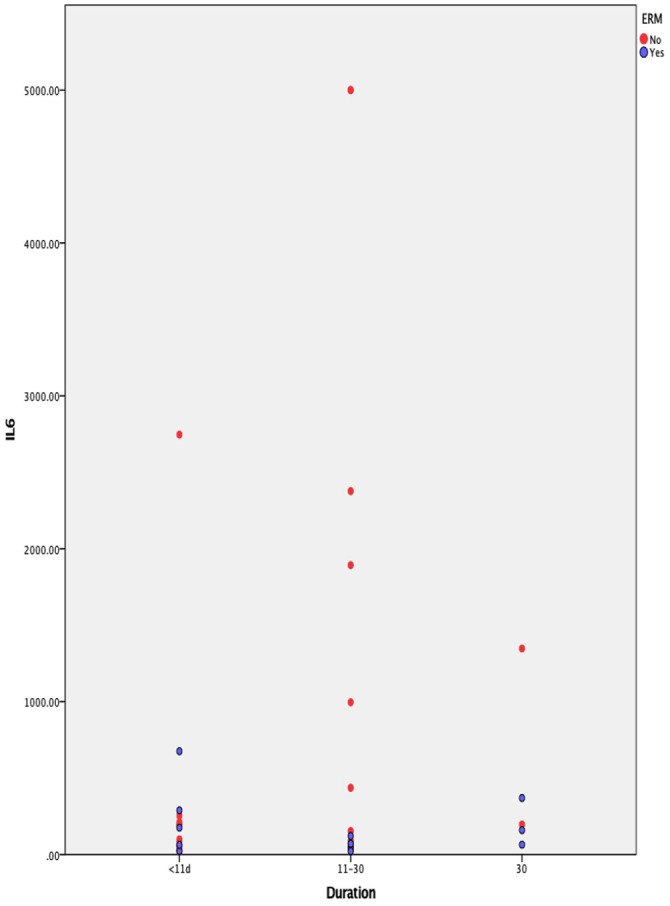
All patients had a follow-up of at least 12 months. The mean BCVA of all 42 eyes at the end of follow-up period was 0.24 ± 0.31 LogMar. The presence of ERM was identified in 28.6% ( = 12) of the patients, and the mean IL-6 concentration was 573.96 ± 1179.58 pg/ml. It appears that the patients who developed a post op ERM had an IL-6 mean concentration value of 173.96 ± 191.25 pg/ml, and the patients with no post op ERM had 733.97 ± 1364.04 pg/ml with -value = 0.04 < 0.05. Nevertheless, following a multivariate binary logistic regression model, the above results did not appear to be statistically significant.
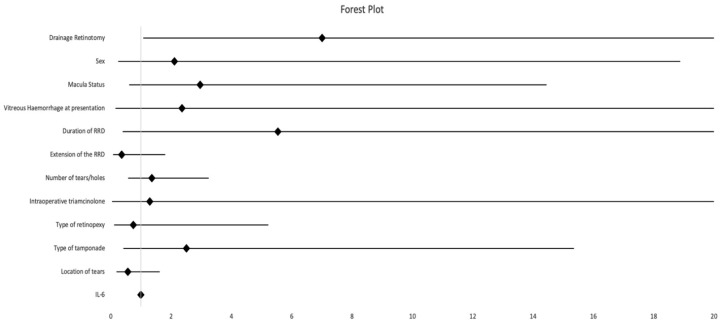
High concentration of IL-6 in the vitreous of eyes with RRD does not hold a significant role in the ERM pathogenesis. Our study identified the presence of a draining retinotomy as the most significant risk factor for ERM formation following a successful surgical RRD repair.
据报道,成功的孔源性视网膜脱离(RRD)手术后视网膜前膜(ERM)形成的发生率约为4%-15%。在本研究中,我们收集了RRD患者的玻璃体样本,以确定白细胞介素-6(IL-6)的浓度是否与术后ERM的存在相关。我们的目的是确定炎症级联反应是否可能是ERM发病机制中的一个潜在关键因素。
这是一项前瞻性单中心研究,纳入了42只眼。所有患者均接受25G玻璃体切割术(PPV)。在打开输液管之前收集玻璃体样本,以使样本不被稀释。然后,将样本在15°C下以5000g离心15分钟。之后,将上清液转移至Eppendorf管中,并储存在-40°C。采用电化学发光免疫分析(ECLIA)测量IL-6浓度(pg/ml)。所有患者在初次RRD修复后4周、3个月和1年时进行黄斑区光学相干断层扫描(OCT),以确定ERM的存在。
所有患者的随访时间至少为12个月。随访期末,42只眼的平均最佳矫正视力(BCVA)为0.24±0.31 LogMar。28.6%(n = 12)的患者发现有ERM,平均IL-6浓度为573.96±1179.58 pg/ml。似乎发生术后ERM的患者IL-6平均浓度值为173.96±191.25 pg/ml,未发生术后ERM的患者为733.97±1364.04 pg/ml,P值=0.04<0.05。然而,在多变量二元逻辑回归模型中,上述结果似乎无统计学意义。
RRD患者玻璃体中高浓度的IL-6在ERM发病机制中不起重要作用。我们的研究确定存在引流视网膜切开术是成功进行手术RRD修复后ERM形成的最显著危险因素。