Sehgal Kanika, Berry Parul, Tariq Raseen, Pardi Darrell S, Khanna Sahil
Division of Gastroenterology and Hepatology, Mayo Clinic, Rochester, MN, USA.
Department of Internal Medicine, Yale New Haven Hospital, New Haven, CT, USA.
Therap Adv Gastroenterol. 2025 Jun 21;18:17562848251346593. doi: 10.1177/17562848251346593. eCollection 2025.
infection (CDI) treated with bezlotoxumab (BEZ) has been demonstrated to have a lower recurrence rate than placebo in clinical trials. However, real-world data on BEZ's effectiveness remain limited and heterogeneous.
To evaluate the real-world effectiveness of BEZ in preventing CDI recurrence through a single-center retrospective cohort and a meta-analysis.
A retrospective cohort study and a meta-analysis.
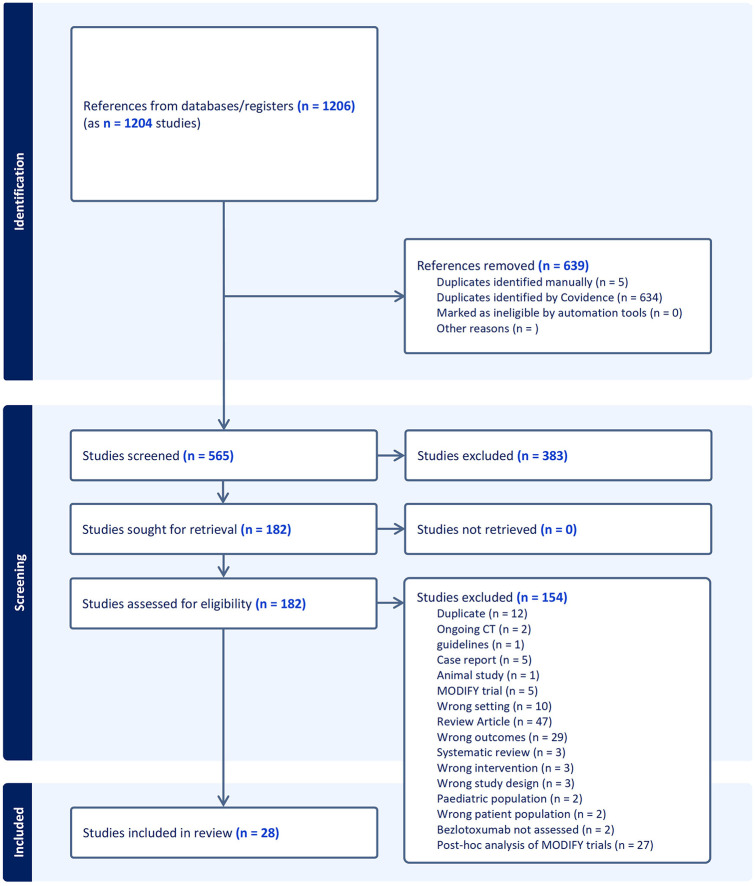
A retrospective study of patients treated with BEZ from 2017 to 2021 was performed at the Mayo Clinic. Demographics, CDI diagnostics, and several prespecified risk factors were analyzed. A literature search was conducted in August 2024 utilizing the Cochrane Central Register of Controlled Trials, Embase, Medline, Scopus, and Web of Science Core Collection. Studies reporting CDI resolution rates with BEZ were included. The random-effects model described by DerSimonian and Laird was used to calculate weighted pooled resolution rates (WPR) with 95% confidence intervals (CI). We assessed heterogeneity with the inconsistency index ( ) statistic.
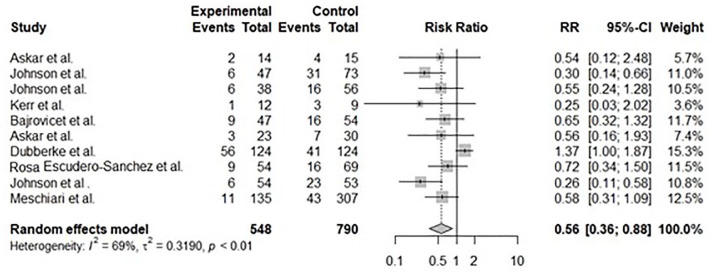
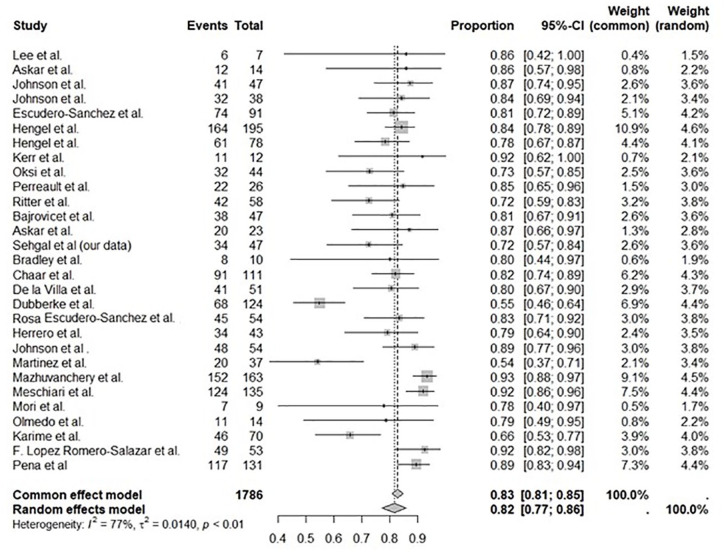
Across 28 studies and our retrospective cohort, 2639 CDI patients were analyzed. Among 1786 patients treated with BEZ, 1450 achieved clinical resolution (WPR: 81.6%, 95% CI 77.2-85.6%), with significant heterogeneity (² = 77.3%). In subgroup analysis, the pooled relative risk of recurrence was 0.56 (95% CI 0.36-0.88; < 0.01) for BEZ with SoC compared to SoC alone. A WPR of 83.3% (95% CI 75.5%-91.1%) for patients receiving BEZ with SoC was observed when compared with a WPR of 70.8% (95% CI 62.7%-78.8%) in patients receiving SoC alone on subgroup analysis. In our cohort of 47 patients, the CDI resolution rate was 72.3% (34/47).
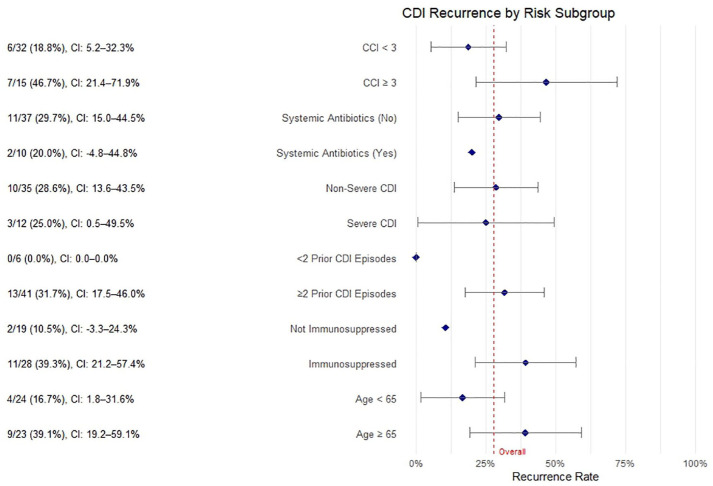
Our retrospective study and meta-analysis demonstrate the real-world efficacy of BEZ in reducing CDI recurrence. The higher recurrence rates in our cohort likely reflect the high-risk nature of the population, including a greater proportion of immunocompromised patients.
在临床试验中,接受贝佐妥昔单抗(BEZ)治疗的艰难梭菌感染(CDI)复发率低于安慰剂。然而,关于BEZ有效性的真实世界数据仍然有限且参差不齐。
通过单中心回顾性队列研究和荟萃分析评估BEZ预防CDI复发的真实世界有效性。
回顾性队列研究和荟萃分析。
在梅奥诊所对2017年至2021年接受BEZ治疗的患者进行回顾性研究。分析了人口统计学、CDI诊断以及几个预先设定的风险因素。2024年8月利用Cochrane对照试验中央登记册、Embase、Medline、Scopus和科学引文索引核心合集进行文献检索。纳入报告BEZ治疗CDI缓解率的研究。采用DerSimonian和Laird描述的随机效应模型计算加权合并缓解率(WPR)及95%置信区间(CI)。我们用不一致指数( )统计量评估异质性。
在28项研究和我们的回顾性队列中,共分析了2639例CDI患者。在1786例接受BEZ治疗的患者中,1450例实现临床缓解(WPR:81.6%,95%CI 77.2 - 85.6%),存在显著异质性(² = 77.3%)。在亚组分析中,与单纯标准治疗(SoC)相比,BEZ联合SoC治疗的复发合并相对风险为0.56(95%CI 0.36 - 0.88; < 0.01)。亚组分析显示,接受BEZ联合SoC治疗患者的WPR为83.3%(95%CI 75.5% - 91.1%),而单纯接受SoC治疗患者的WPR为70.8%(95%CI 62.7% - 78.8%)。在我们的47例患者队列中,CDI缓解率为72.3%(34/47)。
我们的回顾性研究和荟萃分析证明了BEZ在降低CDI复发方面的真实世界疗效。我们队列中较高的复发率可能反映了该人群的高风险性质,包括免疫功能低下患者比例较高。