Liu Lijun, Li Jiaman, Tang Yiwen, Chen Cheng, Yu Chan, Li Xiaofeng, Peng Li, Zheng Daikun
School of Public Health and Management, Chongqing Three Gorges Medical College, Chongqing, China.
Department of Basic Education, Chongqing Energy Industry Technician College, Chongqing, China.
Front Public Health. 2025 Jun 6;13:1587104. doi: 10.3389/fpubh.2025.1587104. eCollection 2025.
Global aging is one of the most significant social trends of the 21st century. Health-Related Quality of Life (HRQoL) is an important indicator not only for evaluating the effectiveness of medical interventions, public health policies, and disease management, but also for enhancing the health of the older adult. This study aimed to explore the mechanisms through which life events and social support affect the HRQoL of rural older adults, with the aim of promoting healthier aging in this population.
A stratified random sampling method was used to select rural older adult individuals from southeastern Henan Province, China. Data were collected using the Life Events Scale, the Social Support Scale (SSS), and the SF-8 Health Survey. T test and the analysis of variance were employed to compare characteristics differences in HRQoL. Pearson's correlation analysis was used to assess the relationships between life events, social support, and HRQoL. And a regression test was used for Moderating Effect analysis.
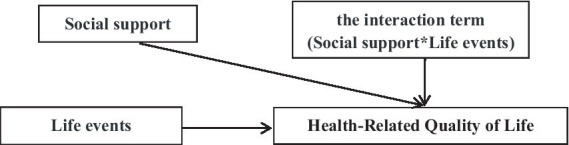
The participants in this questionnaire survey showed that Univariate analysis revealed statistically significant associations between age, education, chronic disease in HRQoL among the rural older adult. correlation analysis revealed significant negative correlations not only between life events and social support, but also between life events and HRQoL, while a significant positive correlation was found between social support and HRQoL. Regression analysis for moderating effects showed that life events negatively predicted HRQoL, while social support positively predicted HRQoL. The interaction term of the product life events and social support was also significant.
Our results confirm that life events and social support were significant predictors of the HRQOL among rural older adults, with social support acting as a moderating variable, and provide empirical evidence that enhancing social support systems and reducing negative life events are crucial for improving the health-related quality of life in rural older adult populations and achieving healthy aging.
全球老龄化是21世纪最显著的社会趋势之一。健康相关生活质量(HRQoL)不仅是评估医疗干预、公共卫生政策和疾病管理效果的重要指标,也是促进老年人健康的重要指标。本研究旨在探讨生活事件和社会支持影响农村老年人HRQoL的机制,以促进该人群更健康地老龄化。
采用分层随机抽样方法从中国河南省东南部选取农村老年个体。使用生活事件量表、社会支持量表(SSS)和SF-8健康调查收集数据。采用t检验和方差分析比较HRQoL的特征差异。采用Pearson相关分析评估生活事件、社会支持与HRQoL之间的关系。并使用回归检验进行调节效应分析。
本次问卷调查的参与者显示,单因素分析显示农村老年人的年龄、教育程度、慢性病与HRQoL之间存在统计学显著关联。相关分析显示,生活事件与社会支持之间、生活事件与HRQoL之间均存在显著负相关,而社会支持与HRQoL之间存在显著正相关。调节效应的回归分析表明,生活事件对HRQoL有负向预测作用,而社会支持对HRQoL有正向预测作用。生活事件与社会支持的交互项也具有显著性。
我们的结果证实,生活事件和社会支持是农村老年人HRQOL的重要预测因素,社会支持起调节变量的作用,并提供了实证证据,即加强社会支持系统和减少负面生活事件对于提高农村老年人群的健康相关生活质量和实现健康老龄化至关重要。