Bećirović Emir, Bećirović Minela, Šegalo Sabina, Bećirović Amir, Hadžić Semir, Ljuca Kenana, Papić Emsel, Ferhatbegović Lamija, Ejubović Malik, Jagodić Ejubović Amira, Kovčić Amila, Šljivo Armin, Begagić Emir
Department of Intensive Care, University Clinical Center Tuzla, Tuzla 75000, Bosnia and Herzegovina.
Department of Nephrology, University Clinical Center Tuzla, Tuzla 75000, Bosnia and Herzegovina.
World J Methodol. 2025 Jun 20;15(2):98143. doi: 10.5662/wjm.v15.i2.98143.
Non-ST segment elevation myocardial infarction (NSTEMI) poses significant challenges in clinical management due to its diverse outcomes. Understanding the prognostic role of hematological parameters and derived ratios in NSTEMI patients could aid in risk stratification and improve patient care.
To evaluate the predictive value of hemogram-derived ratios for major adverse cardiovascular events (MACE) in NSTEMI patients, potentially improving clinical outcomes.
A prospective, observational cohort study was conducted in 2021 at the Internal Medicine Clinic of the University Hospital in Tuzla, Bosnia and Herzegovina. The study included 170 patients with NSTEMI, who were divided into a group with MACE and a control group without MACE. Furthermore, the MACE group was subdivided into lethal and non-lethal groups for prognostic analysis. Alongside hematological parameters, an additional 13 hematological-derived ratios (HDRs) were monitored, and their prognostic role was investigated.
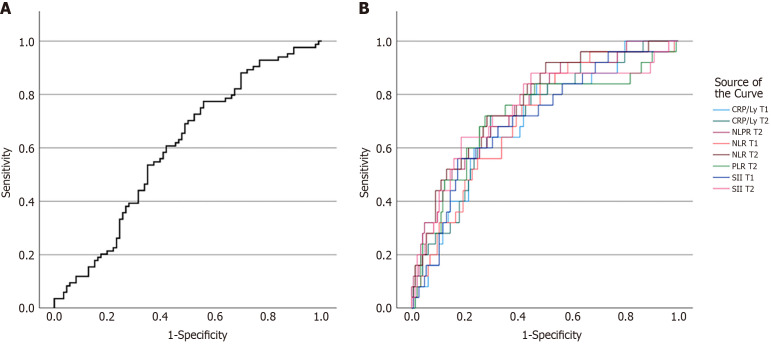
Hematological parameters did not significantly differ between non-ST segment elevation myocardial infarction (NSTEMI) patients with MACE and a control group at T1 and T2. However, significant disparities emerged in HDRs among NSTEMI patients with lethal and non-lethal outcomes post-MACE. Notably, neutrophil-to-lymphocyte ratio (NLR) and platelet-to-lymphocyte ratio (PLR) were elevated in lethal outcomes. Furthermore, C-reactive protein-to-lymphocyte ratio (CRP/Ly) at T1 (> 4.737) demonstrated predictive value [odds ratio (OR): 3.690, = 0.024]. Both NLR at T1 (> 4.076) and T2 (> 4.667) emerged as significant predictors, with NLR at T2 exhibiting the highest diagnostic performance, as indicated by an area under the curve of 0.811 (95%CI: 0.727-0.859) and OR of 4.915 (95%CI: 1.917-12.602, = 0.001), emphasizing its important role as a prognostic marker.
This study highlights the significant prognostic value of hemogram-derived indexes in predicting MACE among NSTEMI patients. During follow-up, NLR, PLR, and CRP/Ly offer important insights into the inflammatory processes underlying cardiovascular events.
非ST段抬高型心肌梗死(NSTEMI)因其多样的预后情况给临床管理带来了重大挑战。了解血液学参数及其衍生比值在NSTEMI患者中的预后作用有助于进行风险分层并改善患者护理。
评估血常规衍生比值对NSTEMI患者主要不良心血管事件(MACE)的预测价值,以潜在改善临床结局。
2021年在波斯尼亚和黑塞哥维那图兹拉大学医院内科诊所进行了一项前瞻性观察队列研究。该研究纳入了170例NSTEMI患者,这些患者被分为发生MACE的组和未发生MACE的对照组。此外,将发生MACE的组再细分为致死组和非致死组进行预后分析。除血液学参数外,还监测了另外13个血液学衍生比值(HDRs),并研究了它们的预后作用。
在T1和T2时,发生MACE的非ST段抬高型心肌梗死(NSTEMI)患者与对照组之间的血液学参数无显著差异。然而,在发生MACE后出现致死和非致死结局的NSTEMI患者中,HDRs存在显著差异。值得注意的是,致死结局患者的中性粒细胞与淋巴细胞比值(NLR)和血小板与淋巴细胞比值(PLR)升高。此外,T1时的C反应蛋白与淋巴细胞比值(CRP/Ly)(> 4.737)显示出预测价值[比值比(OR):3.690, = 0.024]。T1时(> 4.076)和T2时(> 4.667)的NLR均为显著预测指标,T2时的NLR诊断性能最高,曲线下面积为0.811(95%CI:0.727 - 0.859),OR为4.915(95%CI:1.917 - 12.602, = 0.001),强调了其作为预后标志物的重要作用。
本研究强调了血常规衍生指标在预测NSTEMI患者MACE方面的显著预后价值。在随访期间,NLR、PLR和CRP/Ly为心血管事件潜在的炎症过程提供了重要见解。