Feng Zhao Xun, Zhao Junyang, D'Souza Deion, Zhang Nan, Jin Mei, Gallie Brenda
Department of Ophthalmology, University of Ottawa, Ottawa, Canada.
Pediatric Oncology Center, Beijing Children's Hospital, Capital Medical University, Beijing, China.
Invest Ophthalmol Vis Sci. 2025 Jun 2;66(6):65. doi: 10.1167/iovs.66.6.65.
Optic nerve invasion (ONI) is an important risk factor for extraocular metastasis in retinoblastoma. This study evaluates the impact of pre-enucleation chemotherapy, delayed enucleation, and adjuvant chemotherapy on survival in patients with varying degree of ONI on histopathology.
A retrospective review of consecutive enucleated eyes with any degree of ONI from 29 Chinese treatment centers 2012-2017. Children with other high-risk histopathological features, extraocular disease at diagnosis or bilateral enucleation were excluded.
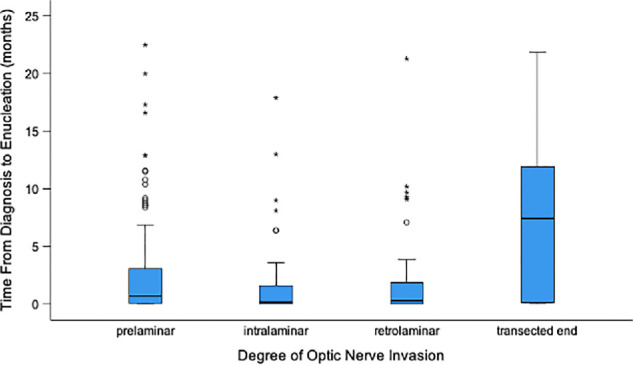
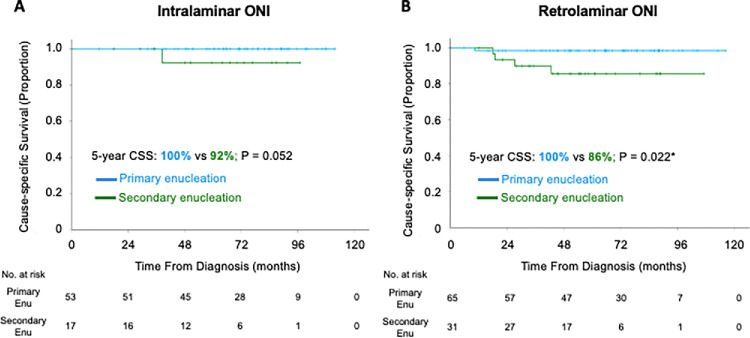
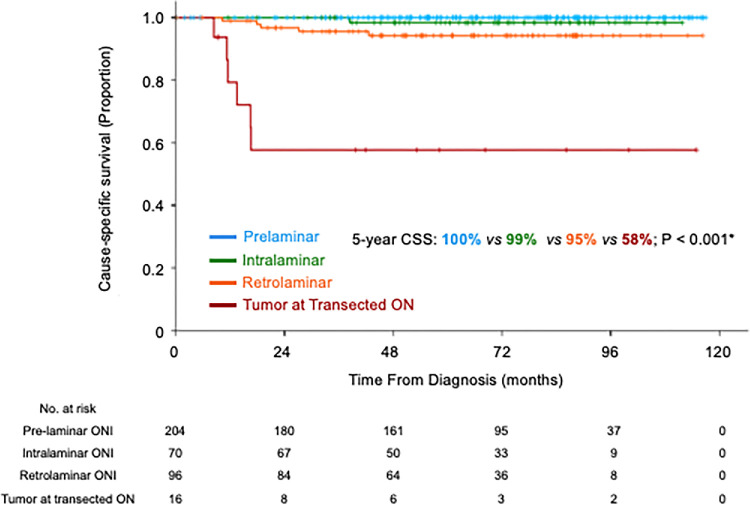
Among 2500 enucleated eyes, 386 eyes with isolated ONI (one eye per child) met the inclusion criteria: prelaminar (n = 204), intralaminar (n = 70), retrolaminar without tumor at transected optic nerve (n = 96), or retrolaminar with tumor at transected end (n = 16). Primary enucleation was performed in 59% of cases, whereas 41% underwent secondary enucleation after eye salvage therapies. Delayed enucleation beyond six months from diagnosis significantly increased the likelihood of tumor at optic nerve transection (21% vs. 2%; P < 0.001). The five-year cause-specific survival (CSS) was 96.7% overall: prelaminar (100%), intralaminar (98%), retrolaminar without transected end involvement (94%), or tumor at transected optic nerve (58%). Secondarily enucleated eyes with retrolaminar ONI without transected end involvement had lower CSS than those primarily enucleated (85.6% vs. 100%; P = 0.022). The five-year CSS was higher but not statistically significant, for eyes treated with or without adjuvant chemotherapy: intralaminar ONI (100% vs. 95.7%; P = 0.193), retrolaminar ONI without tumor at transected end (100% vs. 93.5; P = 0.413), and tumor at the transected end (80.0% vs. 45.0%; P = 0.192).
Timely enucleation reduces the risk of tumor involvement at optic nerve transection. Delay in enucleation by pre-enucleation chemotherapy may reduce the effectiveness of subsequent adjuvant chemotherapy.
视神经侵犯(ONI)是视网膜母细胞瘤眼外转移的重要危险因素。本研究评估眼球摘除术前化疗、延迟眼球摘除及辅助化疗对组织病理学上不同程度ONI患者生存率的影响。
对2012年至2017年来自29个中国治疗中心的所有程度ONI的连续眼球摘除病例进行回顾性研究。排除具有其他高危组织病理学特征、诊断时存在眼外疾病或双眼眼球摘除的儿童。
在2500例眼球摘除病例中,386例孤立性ONI(每个儿童一只眼)符合纳入标准:筛板前(n = 204)、筛板内(n = 70)、视神经横断处无肿瘤的筛板后(n = 96)或视神经横断端有肿瘤的筛板后(n = 16)。59%的病例进行了一期眼球摘除,而41%在眼球挽救治疗后进行了二期眼球摘除。诊断后延迟超过6个月进行眼球摘除显著增加了视神经横断处出现肿瘤的可能性(21%对2%;P < 0.001)。总体五年特异性病因生存率(CSS)为96.7%:筛板前(100%)、筛板内(98%)、视神经横断端未受累的筛板后(94%)或视神经横断处有肿瘤(58%)。视神经横断端未受累的筛板后ONI二期眼球摘除的CSS低于一期眼球摘除(85.6%对100%;P = 0.022)。接受或未接受辅助化疗的眼睛五年CSS较高,但无统计学意义:筛板内ONI(100%对95.7%;P = 0.193)、视神经横断端无肿瘤的筛板后ONI(100%对93.5;P = 0.413)和视神经横断端有肿瘤(80.0%对45.0%;P = 0.192)。
及时进行眼球摘除可降低视神经横断处肿瘤累及的风险。眼球摘除术前化疗导致的眼球摘除延迟可能会降低后续辅助化疗的效果。