Du Chunyu, Hu Yue, Xiao Xiao, Manshaii Farid, Liang Lirong, Chen Jun, Chen Guangming
College of Materials Science and Engineering, Shenzhen University, Shenzhen, 518055, People's Republic of China.
Department of Bioengineering, University of California, Los Angeles, CA, 90095, USA.
Nanomicro Lett. 2025 Jun 23;17(1):307. doi: 10.1007/s40820-025-01821-1.
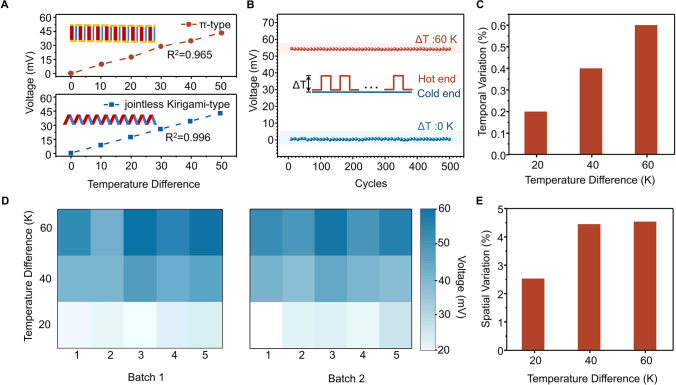
The development of bionic sensing devices with advanced physiological functionalities has attracted significant attention in flexible electronics. In this study, we innovatively develop an air-stable photo-induced n-type dopant and a sophisticated photo-induced patterning technology to construct high-resolution joint-free p-n integrated thermoelectric devices. The exceptional stability of the photo-induced n-type dopant, combined with our meticulously engineered joint-free device architecture, results in extremely low temporal and spatial variations. These minimized variations, coupled with superior linearity, position our devices as viable candidates for artificial thermoreceptors capable of sensing external thermal noxious stimuli. By integrating them into a robotic arm with a pain perception system, we demonstrate accurate pain responses to external thermal stimuli. The system accurately discerns pain levels and initiates appropriate protective actions across varying intensities. Our findings present a novel strategy for constructing high-resolution thermoelectric sensing devices toward precise biomimetic thermoreceptors.
具有先进生理功能的仿生传感装置的发展在柔性电子学领域引起了广泛关注。在本研究中,我们创新性地开发了一种空气稳定的光致n型掺杂剂和一种复杂的光致图案化技术,以构建高分辨率无结p-n集成热电装置。光致n型掺杂剂的卓越稳定性,结合我们精心设计的无结器件结构,导致极低的时间和空间变化。这些最小化的变化,再加上卓越的线性度,使我们的器件成为能够感知外部热有害刺激的人工热感受器的可行候选者。通过将它们集成到具有疼痛感知系统的机器人手臂中,我们展示了对外部热刺激的准确疼痛反应。该系统能够准确识别疼痛程度,并在不同强度下启动适当的保护行动。我们的研究结果为构建面向精确仿生热感受器的高分辨率热电传感装置提出了一种新策略。