Fish Lindsey E, Roberts Samantha C, Bennett Tellen D, Carlson Nichole E, Hamer Mika K, Kwan Bethany M, Russell Seth, Wogu Adane F, Wynia Matthew K, Ginde Adit A
Department of General Internal Medicine, Denver Health and Hospital, Denver, Colorado, United States of America.
Department of Medicine, Division of General Internal Medicine, University of Colorado School of Medicine, Aurora, Colorado, United States of America.
PLoS One. 2025 Jun 23;20(6):e0325991. doi: 10.1371/journal.pone.0325991. eCollection 2025.
COVID-19 patients have experienced worry, altered provider-patient interactions, and options to use novel treatments, initially with neutralizing monoclonal antibodies (mAbs). Limited research has been performed on these aspects of the COVID-19 outpatient experience.
This study aimed to evaluate the experiences of outpatients recently diagnosed with COVID-19, who were eligible for use of mAbs, during the diagnosis and treatment process based on sociodemographic and clinical factors.
This was a self-reported cohort study performed via telephone surveys. Participants included COVID-19 outpatients who met at least one emergency use criterion for mAbs during the first 120 days after a SARS-CoV-2 positive test. We analyzed survey results using multivariable logistic regression for non-scale outcomes and adjusted proportional odds logistic regression for scaled outcomes.
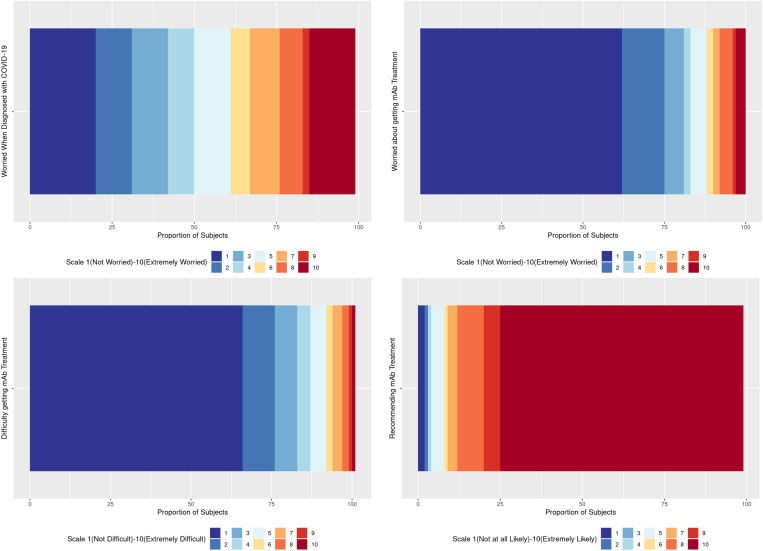
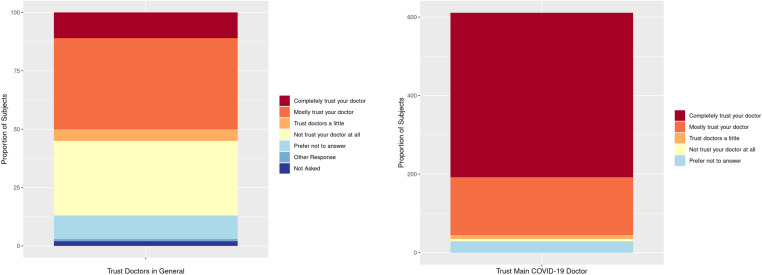
Greater worry about their COVID-19 diagnosis was reported by younger, female, and Hispanic patients and those with Medicaid insurance, two or more comorbid conditions, BMI > 25, and at least 2 COVID-19 vaccinations. Greater provider trust was reported by patients with ≥ 2 years of college education, one or more comorbid conditions, and one or more COVID-19 vaccinations; whereas less provider trust was reported by patients ages 45-64 years, with usual place of care in a walk-in clinic, and those without Commercial, Medicare, or Medicaid insurance. In patients who did not receive mAbs, patients with Medicaid and those without Commercial/Medicare insurance were among the factors that were less likely be offered mAbs by a provider.
This report describes factors associated with multiple aspects of outpatients' experience of COVID-19. This study demonstrated that there are important differences in the experience of outpatient COVID-19 patients based on sociodemographic factors and clinical factors, as well as where additional strategies are needed to improve this experience and associated outcomes.
新冠肺炎患者经历过担忧、医患互动改变,以及使用新型治疗方法的选择,最初是使用中和单克隆抗体(mAbs)。关于新冠肺炎门诊患者体验的这些方面,所开展的研究有限。
本研究旨在根据社会人口统计学和临床因素,评估近期被诊断为新冠肺炎且符合使用mAbs条件的门诊患者在诊断和治疗过程中的体验。
这是一项通过电话调查进行的自我报告队列研究。参与者包括在新冠病毒检测呈阳性后的前120天内符合至少一项mAbs紧急使用标准的新冠肺炎门诊患者。我们对非量表结果使用多变量逻辑回归分析调查结果,对量表结果使用调整后的比例优势逻辑回归分析。
年轻患者、女性患者、西班牙裔患者、有医疗补助保险的患者、有两种或更多合并症的患者、BMI>25的患者以及接种过至少2剂新冠肺炎疫苗的患者,对其新冠肺炎诊断更为担忧。接受过≥2年大学教育、有一项或多项合并症以及接种过一项或多项新冠肺炎疫苗的患者对医疗服务提供者的信任度更高;而年龄在45 - 64岁、在即时诊所接受常规治疗的患者以及没有商业保险、医疗保险或医疗补助保险的患者对医疗服务提供者的信任度较低。在未接受mAbs的患者中,有医疗补助保险的患者以及没有商业/医疗保险的患者是医疗服务提供者不太可能为其提供mAbs的因素之一。
本报告描述了与门诊患者新冠肺炎体验多个方面相关的因素。这项研究表明,基于社会人口统计学因素和临床因素,门诊新冠肺炎患者的体验存在重要差异,以及需要在哪些方面采取额外策略来改善这种体验及相关结果。