Li Chunling, Wu Mumin, Haiqing Huang
Cancer Hospital, College of Medicine, Shantou University, Shantou, China.
Front Med (Lausanne). 2025 Jun 9;12:1596100. doi: 10.3389/fmed.2025.1596100. eCollection 2025.
The purpose of this study was to the diagnostic value of conventional ultrasound (US), contrast-enhanced ultrasound (CEUS) and shear wave elastography (SWE) for identifying benign and malignant BI-RADS 4 breast lesions.
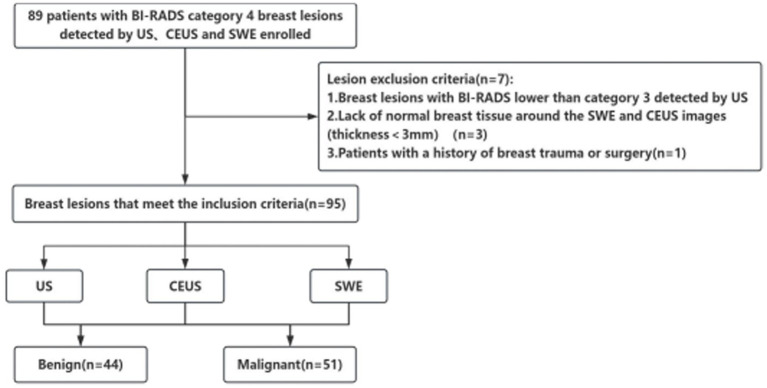
From February 2022 to November 2024, 95 patients aged 20 to 90 years with breast diseases, all of whom were female, were included. These lesions were diagnosed as BI-RADS 4 breast lesions by conventional ultrasound. All lesions were pathologically confirmed by surgical resection or tissue biopsy, and they were further evaluated by CEUS and SWE. The sensitivity, specificity, positive predictive value (PPV), negative predictive value (NPV), and accuracy of US, CEUS, and SWE were statistically analyzed, and ROC curves were generated. The diagnostic efficacy of US, US + SWE, US + CEUS, and US + CEUS + SWE were subsequently compared, with the pathology results used as the reference standard.
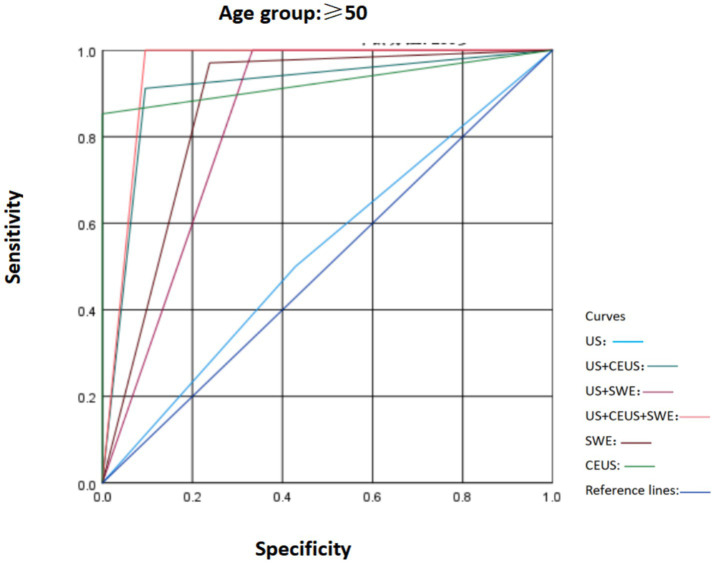
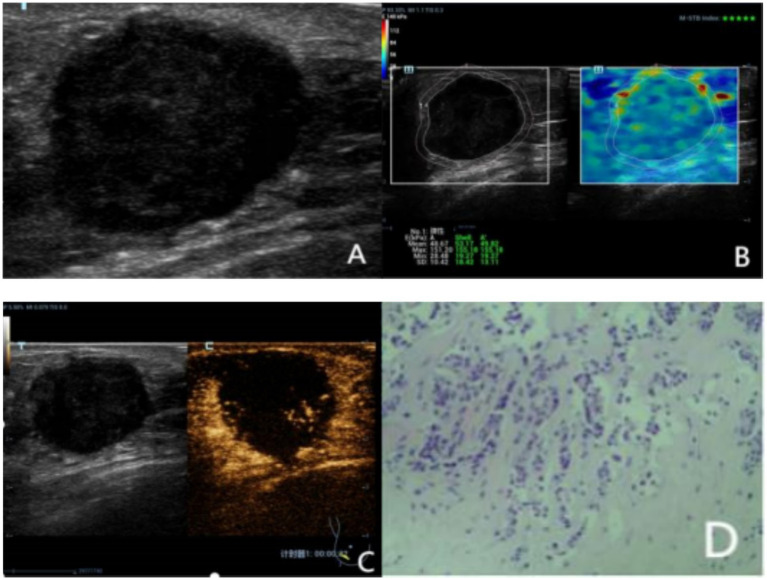
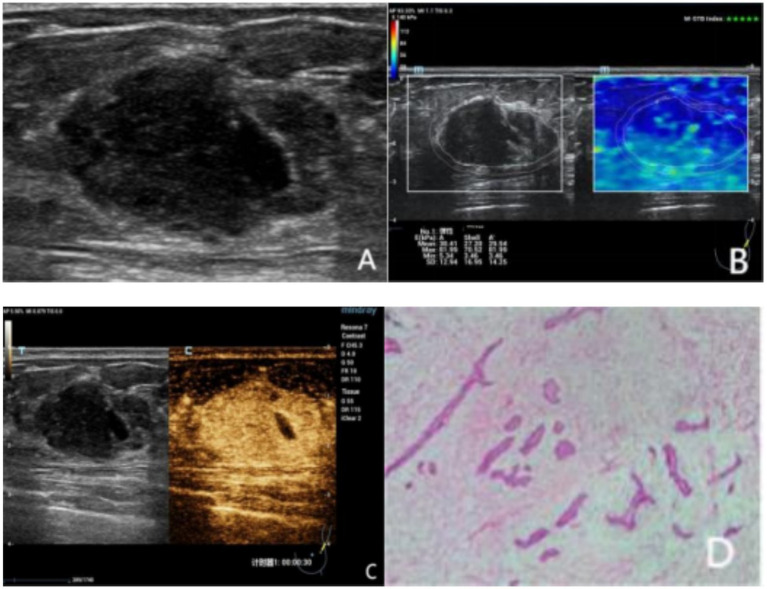
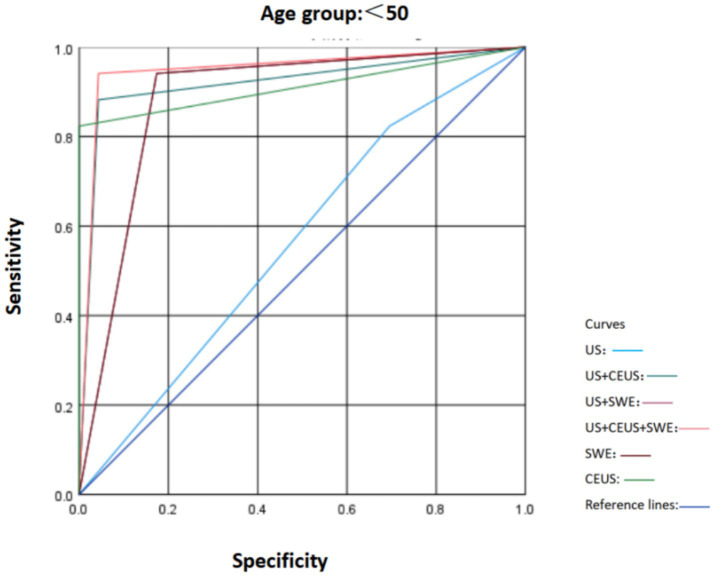
(1) Among the 95 BI-RADS 4 lesions, 44 (46.31%) were benign, and 51 (53.69%) were malignant. The sensitivity, specificity, PPV, NPV and accuracy of the BI-RADS classification via conventional US were 86.3, 72.7, 78.6, 82.1 and 80.0%, respectively. (2) The sensitivity, specificity, PPV, NPV, and accuracy of US combined with SWE in the diagnosis of breast nodules were 96.1, 79.5, 84.5, 94.6, and 88.4%, respectively. (3) The sensitivity, specificity, PPV, NPV, and accuracy of US combined with CEUS in the diagnosis of breast nodules were 84.3, 86.4, 87.8, 82.6, and 85.3%, respectively. (4) The areas under the ROC curve (AUCs) of US, US + SWE, and US + CEUS were 0.795, 0.877, and 0.917, respectively. Statistical methods were used to evaluate the US + CEUS + SWE method, and the results indicated excellent diagnostic performance. The AUC was 0.946, while the sensitivity, specificity, PPV, NPV, and accuracy were 90.7, 93.2, 94.2, 95.3, and 94.7%, respectively. In this this study, the AUCs of US, SWE, and CEUS were compared, and the results revealed that both SWE and CEUS could increase the AUC for breast lesion diagnosis with good diagnostic performance. These methods can increase the sensitivity, specificity and accuracy of the US examination when combined with conventional US. Moreover, the diagnostic performance for breast lesions was highest with the combined application of the three modalities, with a diagnostic AUC that was significantly higher than those of US alone, US + SWE and US + CEUS. The differences were significant ( < 0.05).
(1) CEUS and SWE provide diagnostic information about the microvascular perfusion and tissue stiffness of lesions, respectively, which can assist in the differentiation of benign from malignant breast tumors by conventional US and improve the sensitivity, specificity and accuracy of diagnosis, especially for US BI-RADS 4a breast lesions. (2) The combined use of CEUS and SWE in conventional US enhance the overall diagnostic performance with respect to breast lesions, with the best sensitivity and specificity and the highest diagnostic efficacy. The use of US + CEUS + SWE is beneficial for further differentiating benign and malignant breast lesions according to the US BI-RADS 4, thereby reducing unnecessary biopsies or surgeries.
本研究旨在探讨常规超声(US)、超声造影(CEUS)和剪切波弹性成像(SWE)对鉴别乳腺影像报告和数据系统(BI-RADS)4类乳腺病变良恶性的诊断价值。
纳入2022年2月至2024年11月95例年龄20至90岁的乳腺疾病患者,均为女性。这些病变经常规超声诊断为BI-RADS 4类乳腺病变。所有病变均经手术切除或组织活检病理证实,并进一步行CEUS和SWE评估。对US、CEUS和SWE的敏感性、特异性、阳性预测值(PPV)、阴性预测值(NPV)和准确性进行统计学分析,并绘制ROC曲线。随后以病理结果为参考标准,比较US、US + SWE、US + CEUS和US + CEUS + SWE的诊断效能。
(1)95例BI-RADS 4类病变中,良性44例(46.31%),恶性51例(53.69%)。常规US的BI-RADS分类的敏感性、特异性、PPV、NPV和准确性分别为86.3%、72.7%、78.6%、82.1%和80.0%。(2)US联合SWE诊断乳腺结节的敏感性、特异性、PPV、NPV和准确性分别为96.1%、79.5%、84.5%、94.6%和88.4%。(3)US联合CEUS诊断乳腺结节的敏感性、特异性、PPV、NPV和准确性分别为84.3%、86.4%、87.8%、82.6%和85.3%。(4)US、US + SWE和US + CEUS的ROC曲线下面积(AUC)分别为0.795、0.877和0.917。采用统计方法评估US + CEUS + SWE方法,结果显示其具有优异的诊断性能。AUC为0.946,敏感性、特异性、PPV、NPV和准确性分别为90.7%、93.2%、94.2%、95.3%和94.7%。本研究比较了US、SWE和CEUS的AUC,结果显示SWE和CEUS均可提高乳腺病变诊断的AUC,诊断性能良好。这些方法与常规US联合使用时可提高US检查的敏感性、特异性和准确性。此外,三种模式联合应用对乳腺病变的诊断性能最高,诊断AUC显著高于单独使用US、US + SWE和US + CEUS。差异有统计学意义(P < 0.05)。
(1)CEUS和SWE分别提供病变的微血管灌注和组织硬度的诊断信息,可辅助常规US鉴别乳腺肿瘤的良恶性,提高诊断的敏感性、特异性和准确性,尤其对于US BI-RADS 4a类乳腺病变。(2)在常规US中联合使用CEUS和SWE可提高乳腺病变的整体诊断性能,具有最佳的敏感性和特异性以及最高的诊断效能。使用US + CEUS + SWE有利于根据US BI-RADS 4进一步鉴别乳腺病变的良恶性,从而减少不必要的活检或手术。