
睡眠可防止大脑磷酸化蛋白质组破坏以保障生存。
Sleep prevents brain phosphoproteome disruption to safeguard survival.
作者信息
Ma Jing, Liu Juhang, Li Yu, Zhao Yikui, Tian Yu, Hu Bing, Yan Kaiyue, Li Ying, Ding Kaihang, Wang Xiangyu, Tian Huiwen, Si Wen, Liu Ketong, Zhang Huiran, Zhao Chongchong, Wang Guangfu, Wang Zhiqiang
机构信息
The HIT Center for Life Sciences, School of Life Science and Technology, Harbin Institute of Technology, Harbin, Heilongjiang, China.
出版信息
Cell Discov. 2025 Jun 24;11(1):58. doi: 10.1038/s41421-025-00809-w.
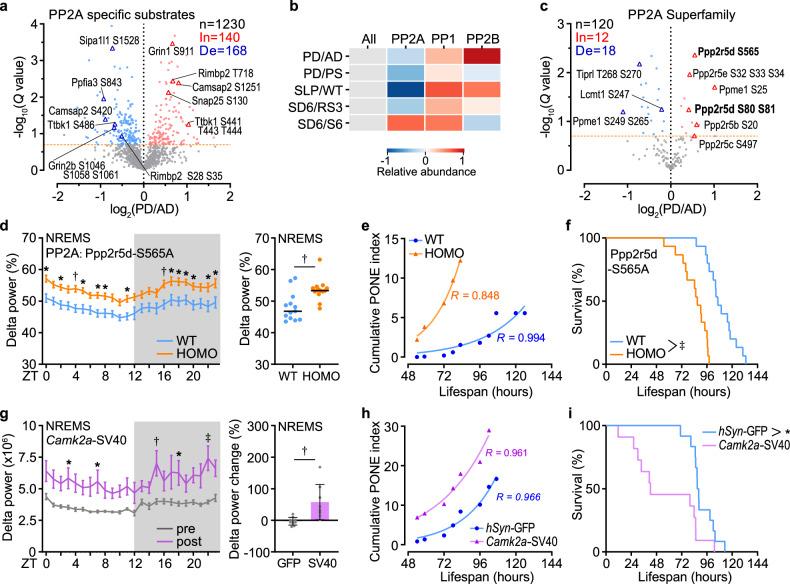
Prolonged sleep deprivation (Pr-SD) causes death in many species. While various mechanisms related to sleep regulation or this fatal consequence of sleep loss have been identified, the core molecular basis linking Pr-SD-induced lethality and sleep homeostasis remains unknown in mammals. A critical "point of no return (PONE)" status in Pr-SD subjects is highlighted in classic research, and characterizing PONE status could help uncover this mystery. Using a Pr-SD model and a reliable PONE status prediction method, we show that mice in PONE exhibit an inability to enter natural sleep, and significant disruptions in brain phosphoproteome, independent of deprivation time but closely linked to PONE status. Brain kinase or phosphatase dysfunction influences PONE status development and leads to corresponding sleep aberration concurrently. Daily 80-min recovery sleep significantly delays PONE onset and restores brain phosphoproteome. The harmful effects of excessive kinase activity on PONE development can be eliminated by combining recovery sleep and compensatory phosphatase expression. We conclude that sleep is crucial for maintaining brain phosphoproteome homeostasis, whose disruption may impact both Pr-SD-induced lethality and sleep regulation.
长期睡眠剥夺(Pr-SD)会导致许多物种死亡。虽然已经确定了与睡眠调节或这种睡眠丧失的致命后果相关的各种机制,但在哺乳动物中,将Pr-SD诱导的致死性与睡眠稳态联系起来的核心分子基础仍然未知。经典研究强调了Pr-SD受试者的一个关键“不归点(PONE)”状态,而对PONE状态的表征可能有助于揭开这个谜团。使用Pr-SD模型和可靠的PONE状态预测方法,我们发现处于PONE状态的小鼠无法进入自然睡眠,并且大脑磷酸化蛋白质组出现显著紊乱,这与剥夺时间无关,但与PONE状态密切相关。脑激酶或磷酸酶功能障碍会影响PONE状态的发展,并同时导致相应的睡眠异常。每天80分钟的恢复性睡眠会显著延迟PONE的出现,并恢复大脑磷酸化蛋白质组。通过结合恢复性睡眠和补偿性磷酸酶表达,可以消除激酶活性过高对PONE发展的有害影响。我们得出结论,睡眠对于维持大脑磷酸化蛋白质组的稳态至关重要,其破坏可能会影响Pr-SD诱导的致死性和睡眠调节。


 Zotero 插件