Avice Guillaume, Mißbach-Karmrodt Helge, Vayrac Félix, Reitner Joachim
Université Paris Cité, Institut de Physique du Globe de Paris, CNRS, F-75005 Paris, France.
Geobiology Working Group, University of Cologne, DE 50923 Cologne, Nordrhein-Westfalen, Germany.
ACS Earth Space Chem. 2025 May 21;9(6):1367-1376. doi: 10.1021/acsearthspacechem.4c00356. eCollection 2025 Jun 19.
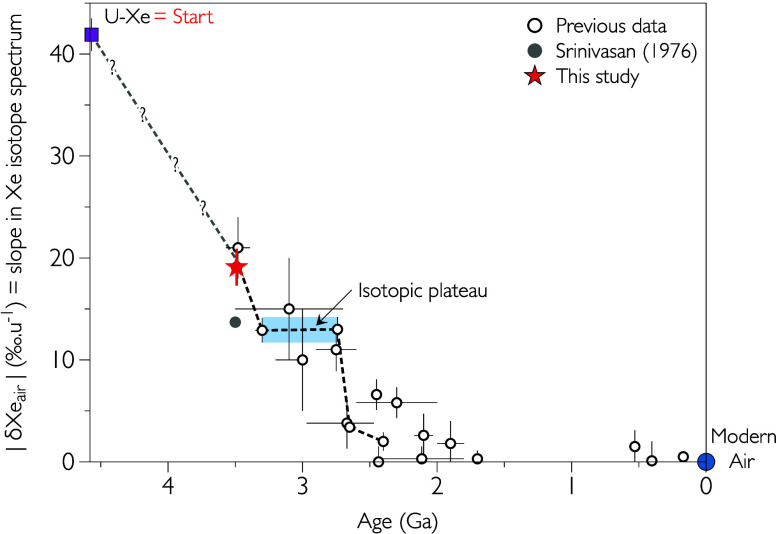
Following the evolution of the composition of the atmosphere informs on the entire geological evolution of our planet. The discovery that Archean atmospheric xenon was isotopically fractionated compared to modern atmospheric xenon paved the way for using this noble gas as a tracer of hydrogen escape on the primitive Earth. The curve of the evolution of the isotopic composition of atmospheric xenon remains, however, poorly defined. Recent studies proposed that the evolution was discontinuous with brief episodes of escape and fractionation of xenon separated by up to several 100 Ma long pauses. Similarly, some major unknowns remain regarding the progressive depletion of xenon in the atmosphere due to the proposed escape mechanism. In this study, we report the noble gas elemental ratios and isotopic compositions of noble gases released from a ca. 3.48 Ga old barite sample from the Dresser Formation (North Pole, Australia) by stepwise crushing in high vacuum. All samples released xenon enriched in light isotopes relative to heavy isotopes compared to modern atmospheric xenon but with various degrees of isotopic fractionation. Krypton is enriched in heavy isotopes relative to light isotopes in some crushed samples. After correction for Kr and Xe loss, results show that 3.48 Ga ago atmospheric xenon was fractionated by -19.1 ± 1.8‰ per atomic mass unit (u). This value is more negative than that reported previously for 3.3 Ga old atmospheric xenon. A new curve for the evolution of the isotopic composition of atmospheric xenon is proposed. Xenon is also enriched relative to Kr in the gas released from the measured samples. While this is consistent with the scenario of a progressive selective escape of xenon from the Archean atmosphere, the exact abundance of Xe in the paleoatmosphere remains elusive.
追踪大气成分的演变有助于了解我们星球的整个地质演化过程。与现代大气氙相比,太古宙大气氙在同位素上存在分馏现象,这一发现为将这种稀有气体用作原始地球上氢逃逸的示踪剂铺平了道路。然而,大气氙同位素组成的演化曲线仍定义不清。最近的研究表明,这种演化是不连续的,氙的逃逸和分馏的短暂阶段被长达数亿年的停顿隔开。同样,由于所提出的逃逸机制,大气中氙的逐渐消耗仍存在一些重大未知因素。在本研究中,我们报告了通过在高真空下逐步粉碎来自澳大利亚北极地区德雷瑟组约34.8亿年前重晶石样品释放出的稀有气体的元素比率和同位素组成。与现代大气氙相比,所有样品释放出的氙相对于重同位素富含轻同位素,但具有不同程度的同位素分馏。在一些粉碎样品中,氪相对于轻同位素富含重同位素。校正氪和氙的损失后,结果表明,34.8亿年前大气氙每原子质量单位(u)的分馏为-19.1±1.8‰。该值比先前报道的33亿年前大气氙的值更负。提出了大气氙同位素组成演化的新曲线。在所测样品释放的气体中,氙相对于氪也有所富集。虽然这与太古宙大气中氙逐渐选择性逃逸的情况一致,但古大气中氙的确切丰度仍然难以捉摸。