Zeiser Robert, Russo Domenico, Ram Ron, Hashmi Shahrukh K, Chakraverty Ronjon, Middeke Jan Moritz, Musso Maurizio, Giebel Sebastian, Uzay Ant, Langmuir Peter, Hamad Nada, Burock Karin, Gowda Maanasa, Stefanelli Tommaso, Lee Stephanie J, Teshima Takanori, Locatelli Franco
Department of Medicine I, Faculty of Medicine, Medical Center, University of Freiburg, Freiburg, Germany.
Unit of Blood Diseases and Bone Marrow Transplantation, University of Brescia, ASST Spedali Civili di Brescia, Brescia, Italy.
J Clin Oncol. 2025 Jun 25;43(23):JCO2402477. doi: 10.1200/JCO-24-02477.
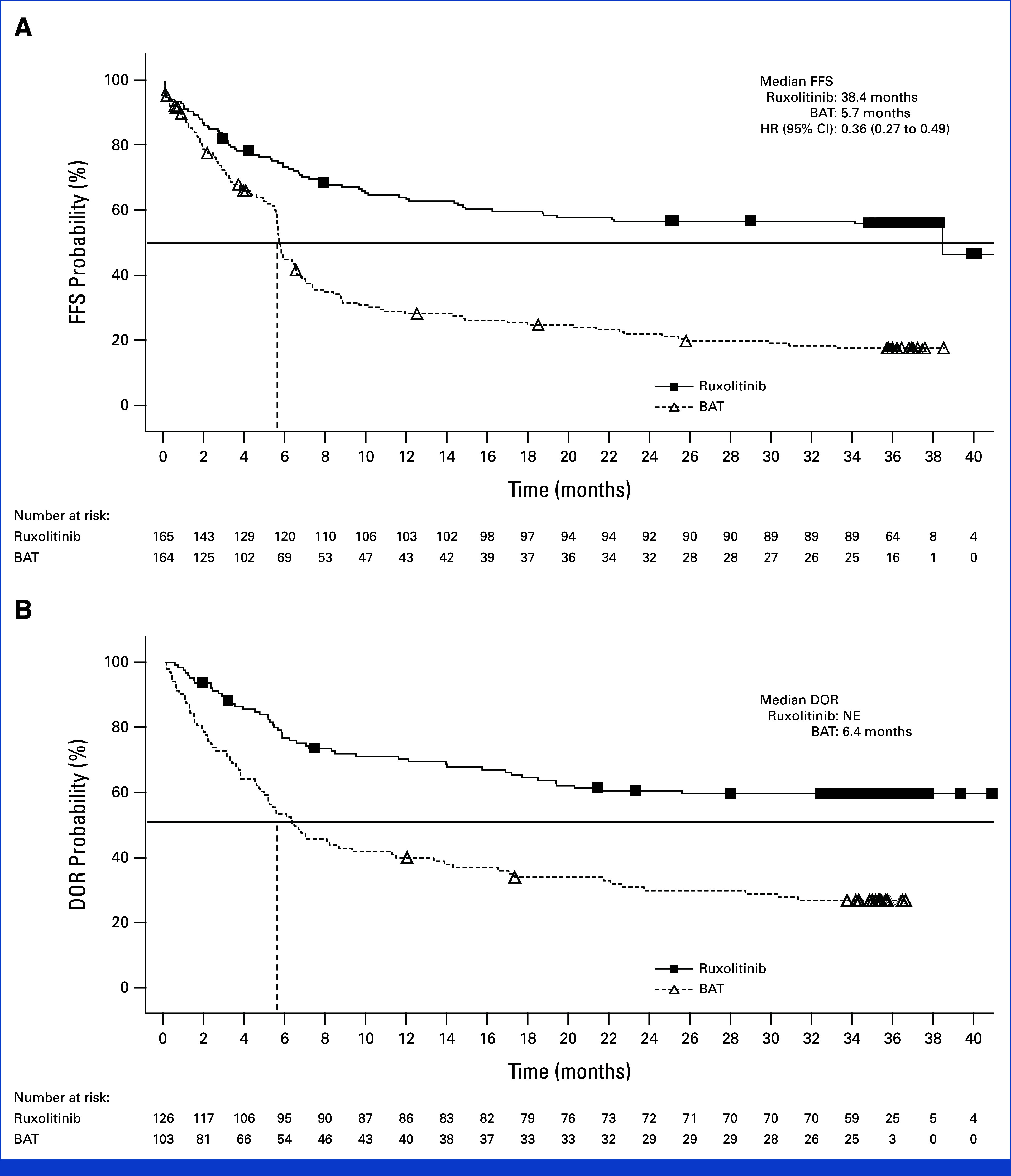
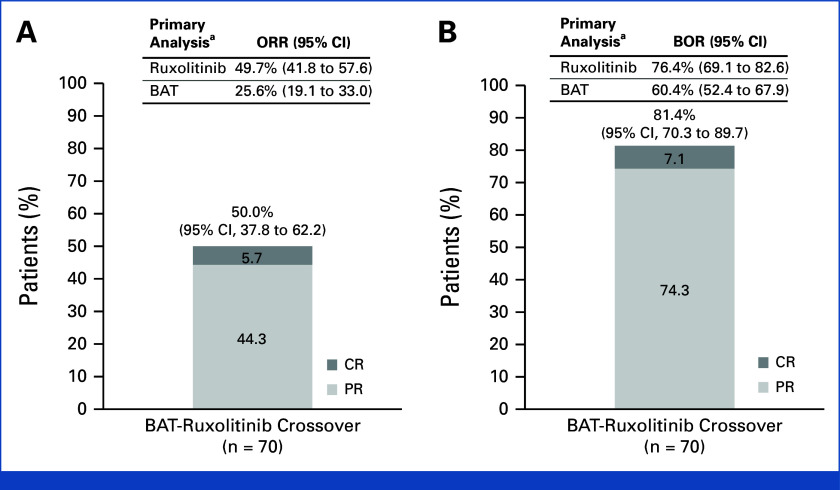
In REACH3 (ClinicalTrials.gov identifier: NCT03112603), ruxolitinib was investigated versus best available therapy (BAT) for 3 years in patients with steroid-refractory/dependent chronic graft-versus-host-disease (SR/D-cGVHD). Patients received ruxolitinib (10 mg twice daily) or BAT for 24 weeks; thereafter (weeks 24-156), patients continued randomized treatment, entered long-term survival follow-up, or crossed over from BAT to ruxolitinib. In 329 randomly assigned patients (ruxolitinib: 165; BAT: 164), the median failure-free survival (FFS) was 38.4 months for ruxolitinib versus 5.7 months for BAT (hazard ratio, 0.36 [95% CI, 0.27 to 0.49]). Median duration of response (DOR) was not reached for ruxolitinib versus 6.4 months for BAT. Ruxolitinib-treated patients had a higher probability of FFS (ruxolitinib: 56.5%; BAT: 18.2%) and maintaining a response (ruxolitinib: 59.6%; BAT: 26.7%) at 36 months. Median overall survival was not reached. Nonrelapse mortality and malignancy relapse/recurrence events were low. In 70 patients who crossed over to ruxolitinib, the overall response rate (50.0%) at week 24 and best overall response (81.4%) during the crossover period were consistent with the primary analysis of randomly assigned patients. No new safety signals were observed. Ruxolitinib provided longer FFS and DOR than BAT, demonstrating sustained efficacy and manageable safety over 3 years of follow-up in patients with SR/D-cGVHD.
在REACH3研究(ClinicalTrials.gov标识符:NCT03112603)中,对鲁索替尼与最佳可用疗法(BAT)治疗类固醇难治性/依赖性慢性移植物抗宿主病(SR/D-cGVHD)患者3年的疗效进行了研究。患者接受鲁索替尼(每日两次,每次10 mg)或BAT治疗24周;此后(第24至156周),患者继续接受随机治疗、进入长期生存随访或从BAT交叉至鲁索替尼治疗。在329例随机分组的患者中(鲁索替尼组:165例;BAT组:164例),鲁索替尼组的无失败生存期(FFS)中位数为38.4个月,而BAT组为5.7个月(风险比,0.36 [95% CI,0.27至0.49])。鲁索替尼组未达到中位缓解持续时间(DOR),而BAT组为6.4个月。接受鲁索替尼治疗的患者在36个月时FFS概率更高(鲁索替尼组:56.5%;BAT组:18.2%),且维持缓解的概率更高(鲁索替尼组:59.6%;BAT组:26.7%)。总生存期中位数未达到。非复发死亡率和恶性肿瘤复发/再发事件较低。在70例交叉至鲁索替尼治疗的患者中,第24周时的总体缓解率(50.0%)和交叉期内的最佳总体缓解率(81.4%)与随机分组患者的初步分析结果一致。未观察到新的安全信号。与BAT相比,鲁索替尼可提供更长的FFS和DOR,在对SR/D-cGVHD患者进行3年的随访中显示出持续的疗效和可控的安全性。