Zhu Siyu, Tong Yunmeng, Huang Jiaqian, He Yuzhu, Fu Wenqi, Zang Yaran, Liu Huiying
School of Stomatology, Dalian Medical University, No. 9 West Section, Lvshun South Road, Dalian 116044, China.
Dalian Key Laboratory of Immune and Oral Development & Regeneration, Dalian Medical University, Dalian 116044, China.
Biomedicines. 2025 Jun 12;13(6):1454. doi: 10.3390/biomedicines13061454.
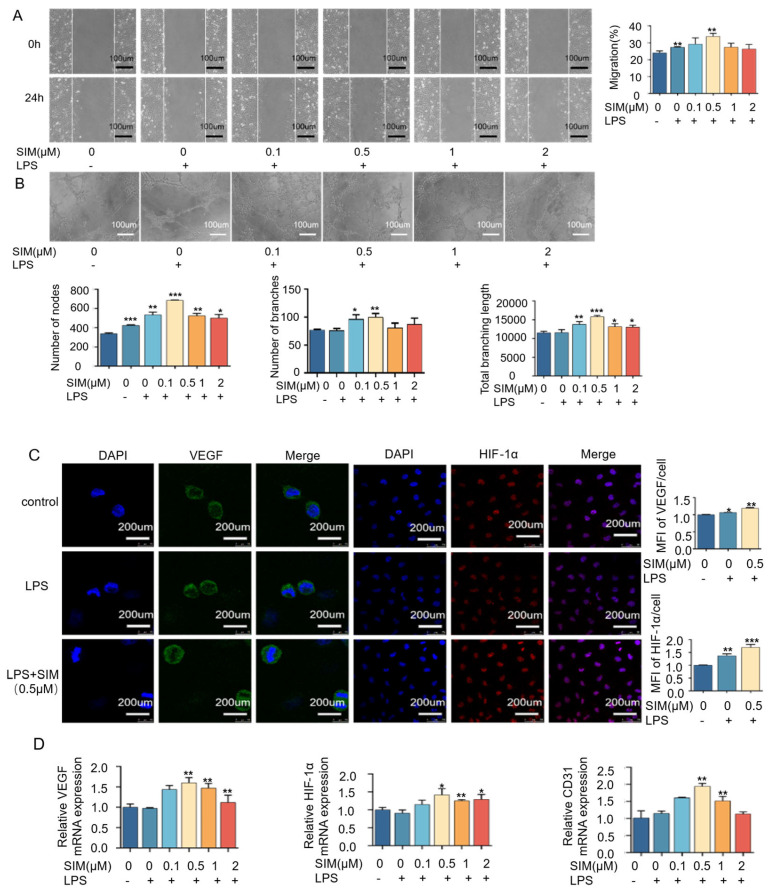
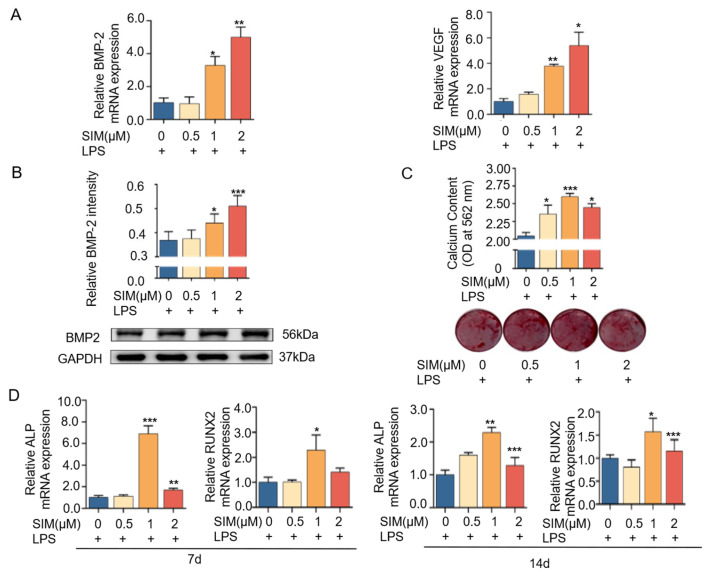
The immune response is essential for bone regeneration, and macrophages in the immune microenvironment contribute to bone metabolism and angiogenesis. Emerging evidence demonstrates that simvastatin is a promising candidate for bone repair and promotes bone formation both in vitro and in vivo. However, the effect of simvastatin on macrophages and the following outcomes are still unclear. This study aimed to investigate the potential immunomodulatory effect of simvastatin on M1 macrophages and its subsequent impact on osteogenesis and angiogenesis. Cell viability was assessed by CCK-8. Osteogenic and angiogenic markers were evaluated by RT-qPCR, Western blotting, and immunofluorescence. M1 macrophage phenotype was analyzed by flow cytometry. Osteogenesis was examined by histological staining, and angiogenic capacity was assessed using functional assays. The present study found that simvastatin decreased M1 macrophage markers (CD86) and stimulated M1 macrophages to express high levels of pro-regenerative cytokines (BMP-2 and VEGF). In addition, simvastatin promoted osteogenic differentiation in MC3T3-E1 cells and angiogenic gene expression in HUVECs. Importantly, simvastatin enhanced the osteogenic capacity of MC3T3-E1 and the angiogenic potential of HUVECs by inhibiting M1 macrophage polarization in vitro. We demonstrated that simvastatin could confer favorable bone immunomodulatory properties and influence the crosstalk behavior between immune cells and osteoblasts and vascular endothelial cells to promote bone healing.
免疫反应对骨再生至关重要,免疫微环境中的巨噬细胞有助于骨代谢和血管生成。新出现的证据表明,辛伐他汀是骨修复的一个有前景的候选药物,在体外和体内均能促进骨形成。然而,辛伐他汀对巨噬细胞的作用及其后续结果仍不清楚。本研究旨在探讨辛伐他汀对M1巨噬细胞的潜在免疫调节作用及其对成骨和血管生成的后续影响。通过CCK-8评估细胞活力。通过RT-qPCR、蛋白质免疫印迹和免疫荧光评估成骨和血管生成标志物。通过流式细胞术分析M1巨噬细胞表型。通过组织学染色检查成骨情况,并使用功能测定评估血管生成能力。本研究发现,辛伐他汀降低了M1巨噬细胞标志物(CD86),并刺激M1巨噬细胞表达高水平的促再生细胞因子(BMP-2和VEGF)。此外,辛伐他汀促进了MC3T3-E1细胞的成骨分化和人脐静脉内皮细胞(HUVECs)中血管生成基因的表达。重要的是,辛伐他汀通过在体外抑制M1巨噬细胞极化增强了MC3T3-E1的成骨能力和HUVECs的血管生成潜力。我们证明,辛伐他汀可以赋予良好的骨免疫调节特性,并影响免疫细胞与成骨细胞和血管内皮细胞之间的串扰行为,以促进骨愈合。