Brambila-Tapia Aniel Jessica Leticia, Brambila-Tostado Ignacio, Ortega-Medellín Martha Patricia, Ramírez-Cerón Giovanna Georgina
Departamento de Psicología Básica, Centro Universitario de Ciencias de la Salud (CUCS), Universidad de Guadalajara, Sierra Mojada #950, Colonia Independencia, Guadalajara 44340, Jalisco, Mexico.
Doctorado en Derechos Humanos, Centro Universitario de Tonalá (CUTONALÁ), Universidad de Guadalajara, Guadalajara 44340, Jalisco, Mexico.
Behav Sci (Basel). 2025 May 24;15(6):723. doi: 10.3390/bs15060723.
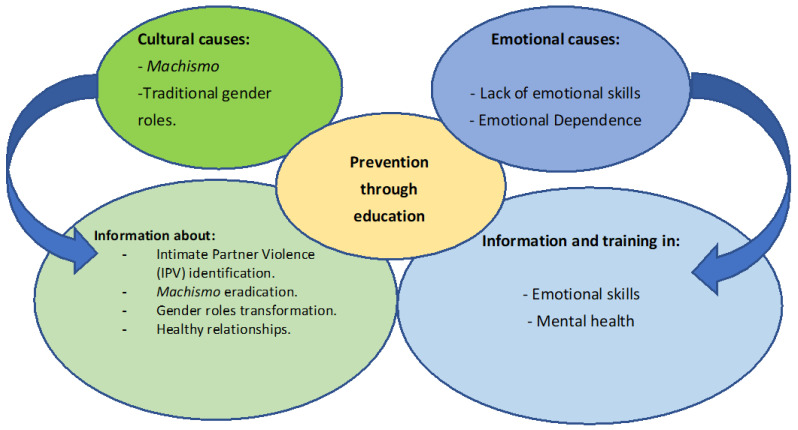
Intimate partner violence (IPV) is the main cause of violence against women, especially in Mexico. However, the causes, consequences, and solutions related to IPV have not been well understood in this population. A total of five focus groups that included Mexican women who were victims of IPV were conducted to understand the causes, consequences, and solutions related to IPV, and a thematic analysis was performed. A total of 32 participants were included, with a median (range) age of 35 (24-70). The main causes mentioned by the participants were (a) cultural ones, among which , transgenerational violence, and cultural norms and gender roles were the main categories; (b) emotional causes, among which the lack of emotional abilities and emotional dependence were the main categories; and (c) educative causes, among which the lack of information about mental health, emotional abilities, IPV, and healthy relationships was reported. The main consequences mentioned were (a) psychological; (b) physical; (c) economic; (d) family-related, including impacts on children; and (e) legal, in relation to IPV complaints and children's custody. Finally, the main solutions mentioned by the participants were (a) prevention through education, including educational programs to address mental health, IPV information, healthy relationships, and training in emotional skills; (b) cultural transformation; and (c) institutional strengthening, with this last solution including improving public policies, improving legal advice, and training for legal authorities. In conclusion, the causes, consequences, and solutions related to IPV were varied and included many instances; therefore, its prevention and solution should be performed at the inter-institutional and community levels, in which the promotion of emotional skills should play a fundamental role.
亲密伴侣暴力(IPV)是针对妇女暴力行为的主要原因,在墨西哥尤其如此。然而,该国人群对与亲密伴侣暴力相关的原因、后果及解决办法尚未有充分了解。研究开展了总共五个焦点小组,成员包括遭受亲密伴侣暴力的墨西哥女性,以了解与亲密伴侣暴力相关的原因、后果及解决办法,并进行了主题分析。总共纳入了32名参与者,年龄中位数(范围)为35岁(24 - 70岁)。参与者提到的主要原因包括:(a)文化原因,其中代际暴力、文化规范和性别角色是主要类别;(b)情感原因,其中情感能力缺失和情感依赖是主要类别;(c)教育原因,其中报告了心理健康、情感能力、亲密伴侣暴力及健康关系方面信息的匮乏。提到的主要后果包括:(a)心理方面;(b)身体方面;(c)经济方面;(d)与家庭相关,包括对子女的影响;(e)法律方面,涉及亲密伴侣暴力投诉及子女监护权。最后,参与者提到的主要解决办法包括:(a)通过教育进行预防,包括开展心理健康、亲密伴侣暴力信息、健康关系方面的教育项目以及情感技能培训;(b)文化变革;(c)机构强化,最后这一解决办法包括完善公共政策、改善法律咨询以及对法律当局进行培训。总之,与亲密伴侣暴力相关的原因、后果及解决办法多种多样且包含多种情况;因此,其预防和解决应在机构间和社区层面开展,其中情感技能的提升应发挥重要作用。