Liu Hui, Cheng Jie, Peng Kaicheng, Chen Lin, Kong Zhenxuan, Zhao Yan, Luo Zhengxiu
Department of Respiratory Medicine, Children's Hospital of Chongqing Medical University, National Clinical Research Center for Child Health and Disorders, Ministry of Education Key Laboratory of Child Development and Disorders, Chongqing Key Laboratory of Child Rare Diseases in Infection and Immunity, Chongqing 400014, China.
Emergency Department, Children's Hospital of Chongqing Medical University, National Clinical Research Center for Child Health and Disorders, Ministry of Education Key Laboratory of Child Development and Disorders, Chongqing Key Laboratory of Child Rare Diseases in Infection and Immunity, Chongqing 400014, China.
Children (Basel). 2025 Jun 16;12(6):785. doi: 10.3390/children12060785.
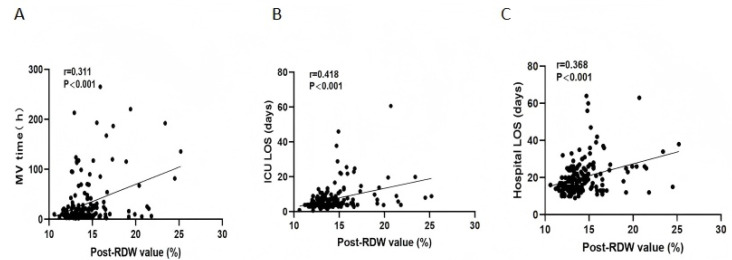
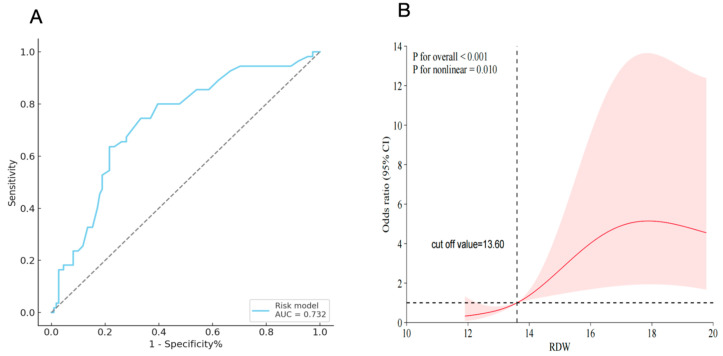
Red cell distribution width (RDW) has emerged as a prognostic biomarker in various clinical contexts. This retrospective study evaluated the predictive utility of RDW for cardiopulmonary bypass-associated acute lung injury (CPB-ALI) in pediatric patients undergoing cardiac surgery. A total of 166 children were enrolled and classified into CPB-ALI and non-ALI groups. Preoperative and postoperative RDW values were analyzed. Postoperative RDW was significantly higher in the CPB-ALI group (15.40% vs. 13.78%, < 0.001). Multivariate logistic regression identified postoperative RDW as an independent predictor of CPB-ALI (OR: 1.35, 95% CI: 1.10-1.64, = 0.003). Receiver operating characteristic analyses yielded an AUC of 0.732, and restricted cubic spline analyses revealed a nonlinear association between RDW and CPB-ALI risks ( < 0.001). Higher postoperative RDW levels were positively correlated with prolonged mechanical ventilation duration, ICU stay, and total hospital stay ( < 0.001 for all). These findings suggest that postoperative RDW is a cost-effective and accessible biomarker for the early identification of CPB-ALI and may inform individualized perioperative management in pediatric cardiac surgery.
红细胞分布宽度(RDW)已成为各种临床情况下的一种预后生物标志物。这项回顾性研究评估了RDW对接受心脏手术的儿科患者体外循环相关急性肺损伤(CPB-ALI)的预测效用。总共纳入了166名儿童,并将其分为CPB-ALI组和非ALI组。分析术前和术后的RDW值。CPB-ALI组术后RDW显著更高(15.40%对13.78%,<0.001)。多因素逻辑回归确定术后RDW是CPB-ALI的独立预测因素(OR:1.35,95%CI:1.10-1.64,=0.003)。受试者工作特征分析得出的AUC为0.732,受限立方样条分析显示RDW与CPB-ALI风险之间存在非线性关联(<0.001)。术后RDW水平较高与机械通气时间延长、ICU住院时间和总住院时间呈正相关(所有均<0.001)。这些发现表明,术后RDW是用于早期识别CPB-ALI的一种经济有效且易于获取的生物标志物,可能为儿科心脏手术的个体化围手术期管理提供依据。