
血液学参数与早发冠心病:一项基于3366名参与者的回顾性病例对照研究。
Hematological parameters and early-onset coronary artery disease: a retrospective case-control study based on 3366 participants.
作者信息
Wang Huan, Li Hui, Wang Yan, Zhao Cong, Tian Qing-Wu, Wang Qing, He Guo-Wei, Lun Li-Min, Xuan Chao
机构信息
Department of Clinical Laboratory, The Affiliated Hospital of Qingdao University, Qingdao, China.
Health Management Institute, The Affiliated Hospital of Qingdao University, Qingdao, China.
出版信息
Ther Adv Chronic Dis. 2023 Jan 18;14:20406223221142670. doi: 10.1177/20406223221142670. eCollection 2023.
BACKGROUND
Thrombosis and inflammation are crucial elements in the pathogenesis of cardiovascular disease. Hematological parameters elucidate information involving the inflammatory and blood coagulation processes.
OBJECTIVES
The current study explored the association of hematological parameters with EOCAD to identify specific risk factors.
DESIGN
A single-center retrospective case-control study was conducted with 1693 coronary artery disease patients and 1693 controls.
METHODS
Hematological parameters were examined through an automated analyzer.
RESULTS
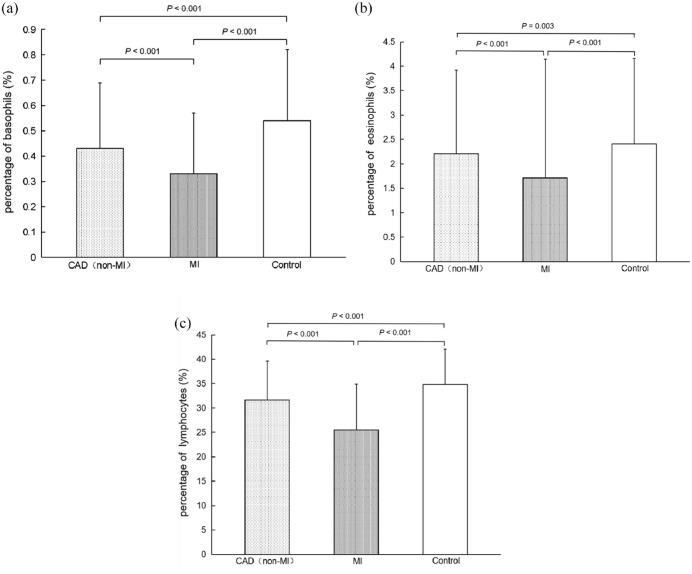
The basophil percentage was significantly reduced in EOCAD (0.43 ± 0.26, < 0.001) and MI (0.33 ± 0.24, < 0.001) groups compared with controls (0.54 ± 0.28). The eosinophil percentage was also significantly lower in EOCAD (2.21 ± 1.71, < 0.001) and MI (1.71 ± 2.44, < 0.001) groups compared with controls (2.41 ± 1.75). The lymphocyte percentage in patients of EOCAD and MI and controls was 31.65 ± 7.93, 25.48 ± 9.43, and 34.82 ± 7.28, respectively. A significant difference was observed among the groups ( < 0.001). Except for the mean corpuscular hemoglobin (MCH), other red blood cell (RBC) parameters significantly differed between EOCAD patients and controls. The red blood cell distribution width (RDW), hematocrit (HCT), RBC count, mean corpuscular hemoglobin concentration (MCHC), mean corpuscular volume (MCV), and hemoglobin level were associated with EOCAD prevalence after adjusting for baseline differences. Platelet volume distribution width (PDW) also correlated with EOCAD prevalence (OR = 1.087, 95% CI: 1.044-1.131).
CONCLUSIONS
Hematological parameters are closely associated with EOCAD. Moreover, leukocyte parameters correlated with the presence and severity of the disease. In addition, erythrocyte parameters were associated with the disease presence but not with the disease severity. Among the platelet parameters, only PDW was related to the disease presence.
背景
血栓形成和炎症是心血管疾病发病机制中的关键因素。血液学参数可阐明涉及炎症和凝血过程的信息。
目的
本研究探讨血液学参数与早发冠心病(EOCAD)的关联,以确定特定危险因素。
设计
进行了一项单中心回顾性病例对照研究,纳入1693例冠心病患者和1693例对照。
方法
通过自动分析仪检测血液学参数。
结果
与对照组(0.54±0.28)相比,EOCAD组(0.43±0.26,<0.001)和心肌梗死(MI)组(0.33±0.24,<0.001)的嗜碱性粒细胞百分比显著降低。与对照组(2.41±1.75)相比,EOCAD组(2.21±1.71,<0.001)和MI组(1.71±2.44,<0.001)的嗜酸性粒细胞百分比也显著降低。EOCAD组、MI组和对照组患者的淋巴细胞百分比分别为31.65±7.93、25.48±9.43和34.82±7.28。各组间观察到显著差异(<0.001)。除平均红细胞血红蛋白含量(MCH)外,EOCAD患者与对照组之间的其他红细胞(RBC)参数存在显著差异。在校正基线差异后,红细胞分布宽度(RDW)、血细胞比容(HCT)﹑红细胞计数、平均红细胞血红蛋白浓度(MCHC)、平均红细胞体积(MCV)和血红蛋白水平与EOCAD患病率相关。血小板体积分布宽度(PDW)也与EOCAD患病率相关(OR = 1.087,95%CI:1.044 - 1.131)。
结论
血液学参数与EOCAD密切相关。此外,白细胞参数与疾病的存在和严重程度相关。此外,红细胞参数与疾病存在相关,但与疾病严重程度无关。在血小板参数中,只有PDW与疾病存在相关。
 Zotero 插件