Özdemir Erman, Özdemir Pınar, Yadigar Serap, Yalın Serkan Feyyaz, Parmaksız Ergün, Sarıkaya Şükran, Özdemir Erdoğan, Altıparmak Mehmet Rıza
Pendik State Hospital, 34890 İstanbul, Turkey.
Dr Lütfi Kırdar Kartal Eğitim ve Araştırma Hastanesi, 34865 İstanbul, Turkey.
J Clin Med. 2025 Jun 9;14(12):4081. doi: 10.3390/jcm14124081.
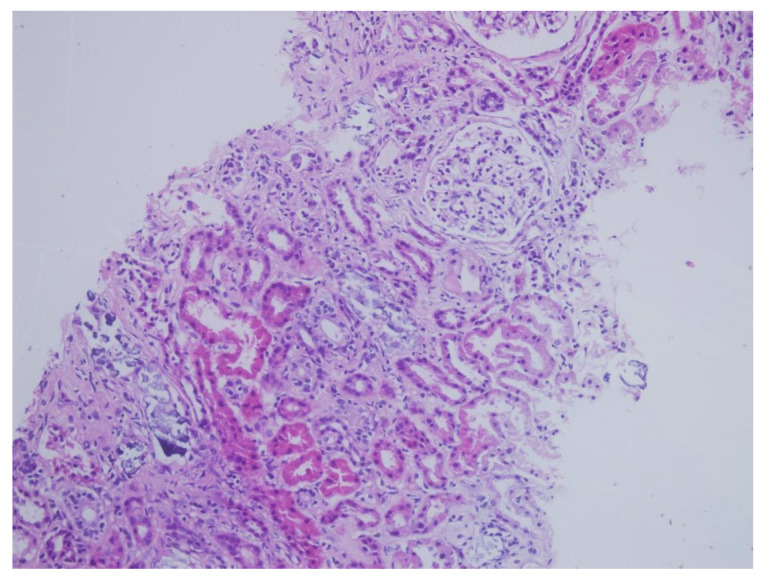
Acute phosphate nephropathy (APN) is an underrecognized cause of acute kidney injury (AKI), typically associated with the use of oral sodium phosphate (OSP)-based bowel preparations. It is characterized by calcium phosphate crystal deposition within the renal tubules and may result in permanent renal impairment. Despite known risks, phosphate-containing solutions are still widely used without sufficient risk stratification. We retrospectively evaluated 517 native kidney biopsies performed in our nephrology clinic between 2017 and 2022. Among these, 12 patients with unexplained AKI and recent colonoscopy history were identified. In nine cases, non-specific tubular deposits on routine staining prompted further histochemical analysis. All had a history of recent OSP-based bowel cleansing. The use of von Kossa staining confirmed calcium phosphate deposition, consistent with APN. Out of 517 kidney biopsies performed during the study period, 9 patients were diagnosed with APN based on histopathological findings following recent colonoscopy and OSP-based bowel cleansing. The mean age was 58.7 years, and three were female. Hypertension was present in seven patients, diabetes mellitus in three, and epilepsy in two; one patient had no comorbidities. Baseline renal function was normal (mean serum creatinine 0.86 mg/dL) and increased to 1.76 mg/dL at three months post-exposure. All biopsies revealed tubulointerstitial calcium phosphate deposits and interstitial inflammation; mesangial hypercellularity was observed in five cases, tubular atrophy in three, and acute tubular necrosis in one. All samples stained positive with von Kossa staining. Over time, all patients developed chronic kidney disease, and one progressed to end-stage renal disease requiring dialysis. In patients presenting with unexplained AKI and recent OSP-based bowel preparation, APN should be considered in the differential diagnosis. When routine histology is inconclusive, definitive diagnosis may require special histochemical staining. Risk-based restrictions on phosphate-containing agents are warranted to reduce preventable kidney injury.
急性磷酸盐肾病(APN)是急性肾损伤(AKI)的一个未被充分认识的病因,通常与使用基于口服磷酸钠(OSP)的肠道准备剂有关。其特征是磷酸钙晶体在肾小管内沉积,可能导致永久性肾功能损害。尽管存在已知风险,但含磷酸盐溶液仍在没有充分风险分层的情况下被广泛使用。我们回顾性评估了2017年至2022年期间在我们肾脏病诊所进行的517例自体肾活检。其中,确定了12例原因不明的AKI且近期有结肠镜检查史的患者。在9例病例中,常规染色显示的非特异性肾小管沉积物促使进行进一步的组织化学分析。所有患者都有近期基于OSP的肠道清洁史。使用冯·科萨染色证实了磷酸钙沉积,符合APN。在研究期间进行的517例肾活检中,9例患者在近期结肠镜检查和基于OSP的肠道清洁后,根据组织病理学结果被诊断为APN。平均年龄为58.7岁,3例为女性。7例患者有高血压,3例有糖尿病,2例有癫痫;1例患者无合并症。基线肾功能正常(平均血清肌酐0.86mg/dL),暴露后三个月升至1.76mg/dL。所有活检均显示肾小管间质磷酸钙沉积和间质炎症;5例观察到系膜细胞增多,3例有肾小管萎缩,1例有急性肾小管坏死。所有样本冯·科萨染色均呈阳性。随着时间的推移,所有患者都发展为慢性肾脏病,1例进展为需要透析的终末期肾病。对于出现原因不明的AKI且近期进行了基于OSP的肠道准备的患者,鉴别诊断时应考虑APN。当常规组织学检查结果不明确时,明确诊断可能需要特殊的组织化学染色。有必要基于风险对含磷酸盐制剂进行限制,以减少可预防的肾损伤。