Suárez-Cortés Tatiana, Herrera Itxaso
Research, Development and Innovation Department (R&D+I Department), FAES Farma, Av. Autonomía 10, 48940 Leioa, Spain.
Neuro-Ophthalmology Department and Pediatric Ophthalmology, Miranza Clínica Begoña, 48006 Bilbao, Spain.
J Clin Med. 2025 Jun 11;14(12):4147. doi: 10.3390/jcm14124147.
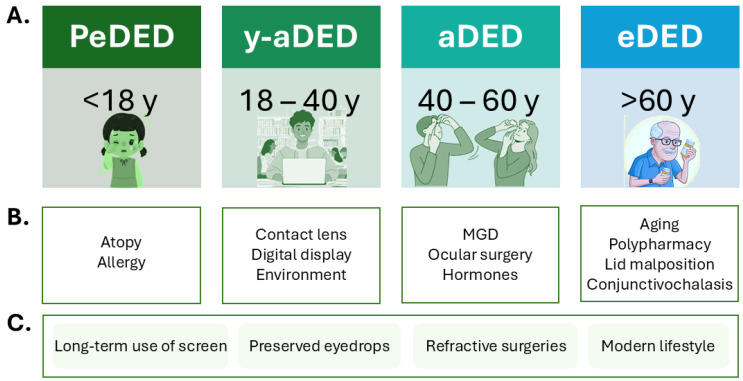
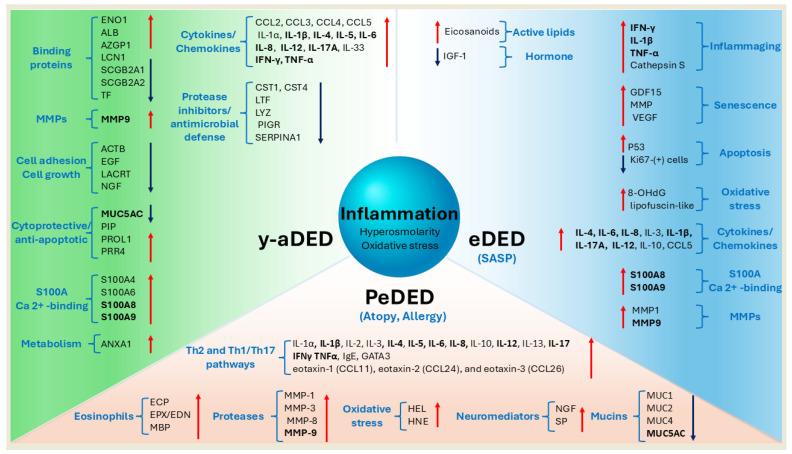
Dry eye disease (DED) is a common, multifactorial disorder of the ocular surface. Although DED can affect individuals at any age, its prevalence, clinical manifestations, underlying mechanisms, and optimal management strategies differ considerably across the lifespan. In children, symptoms are frequently associated with atopy and allergic disorders and environmental factors, whereas in young adults, digital device usage and contact lens wear are the predominant contributors. In older adults, systemic diseases and polypharmacy significantly elevate the risk of DED. Across all age groups, tear film instability, decreased tear production, and chronic inflammation are central pathogenic features. Key tear biomarkers, such as pro-inflammatory cytokines, have been widely linked to disease development. Cathepsin S and tumor necrosis factor-alpha have recently been implicated in age-related DED. A nuanced understanding of these age-related differences is crucial for improving diagnostic accuracy and tailoring interventions to specific patient populations. This review synthesizes current evidence on DED across age groups, focusing on prevalence, risk factors, pathophysiology, molecular mechanisms, coexisting conditions, biomarkers, and treatment options. Finally, it highlights critical unmet clinical needs in the management of age-related DED.
干眼病(DED)是一种常见的、多因素导致的眼表疾病。尽管干眼病可影响任何年龄段的个体,但其患病率、临床表现、潜在机制以及最佳管理策略在整个生命周期中存在很大差异。在儿童中,症状常与特应性和过敏性疾病以及环境因素相关,而在年轻人中,数字设备使用和隐形眼镜佩戴是主要的致病因素。在老年人中,全身性疾病和多种药物联合使用会显著增加患干眼病的风险。在所有年龄组中,泪膜不稳定、泪液分泌减少和慢性炎症是主要的致病特征。关键的泪液生物标志物,如促炎细胞因子,已被广泛认为与疾病发展有关。组织蛋白酶S和肿瘤坏死因子-α最近被认为与年龄相关性干眼病有关。对这些年龄相关差异的细致理解对于提高诊断准确性和针对特定患者群体制定干预措施至关重要。本综述综合了各年龄组干眼病的现有证据,重点关注患病率、危险因素、病理生理学、分子机制、并存疾病、生物标志物和治疗选择。最后,它强调了在年龄相关性干眼病管理中尚未满足的关键临床需求。