Pontikos Nikolas, Woof William A, Lin Siying, Ghoshal Biraja, Mendes Bernardo S, Veturi Advaith, Nguyen Quang, Javanmardi Behnam, Georgiou Michalis, Hustinx Alexander, Ibarra-Arellano Miguel A, Moghul Ismail, Liu Yichen, Pfau Kristina, Pfau Maximilian, Shah Mital, Yu Jing, Al-Khuzaei Saoud, Wagner Siegfried K, Daich Varela Malena, Cabral de Guimarães Thales Antonio, Sen Sagnik, Naik Gunjan, Sumodhee Dayyanah, Fu Dun Jack, Kabiri Nathaniel, Furman Jennifer, Liefers Bart, Lee Aaron Y, De Silva Samantha R, Marques Caio, Motta Fabiana, Fujinami-Yokokawa Yu, Hardcastle Alison J, Arno Gavin, Lorenz Birgit, Herrmann Philipp, Fujinami Kaoru, Sallum Juliana, Madhusudhan Savita, Downes Susan M, Holz Frank G, Balaskas Konstantinos, Webster Andrew R, Mahroo Omar A, Krawitz Peter M, Michaelides Michel
University College London Institute of Ophthalmology, University College London, London, UK.
Moorfields Eye Hospital, London, UK.
Nat Mach Intell. 2025;7(6):967-978. doi: 10.1038/s42256-025-01040-8. Epub 2025 Jun 18.
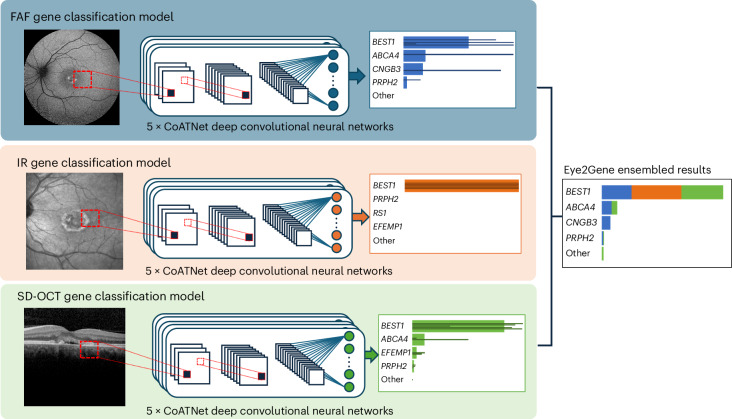
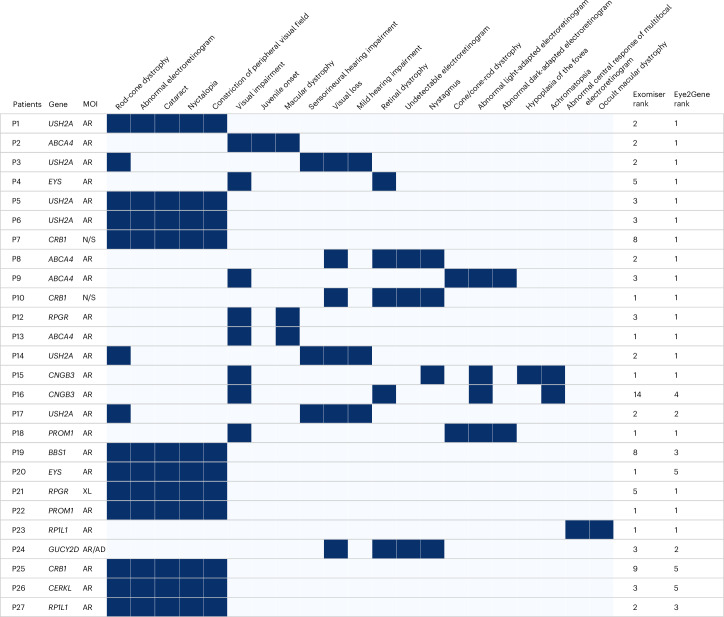
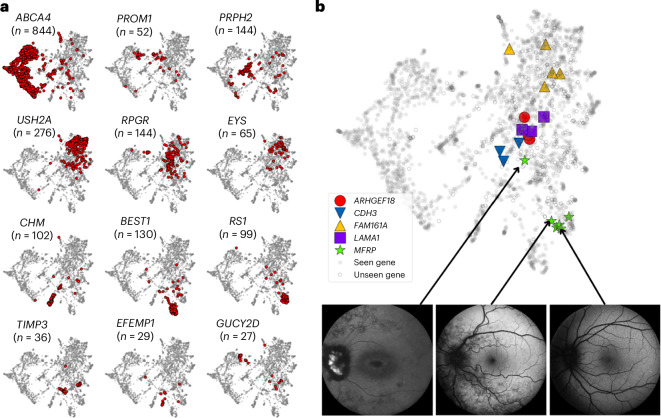
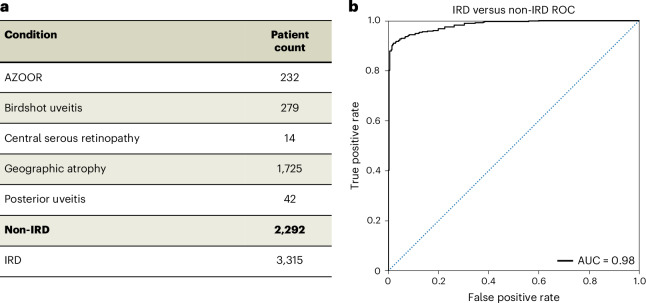
Rare eye diseases such as inherited retinal diseases (IRDs) are challenging to diagnose genetically. IRDs are typically monogenic disorders and represent a leading cause of blindness in children and working-age adults worldwide. A growing number are now being targeted in clinical trials, with approved treatments increasingly available. However, access requires a genetic diagnosis to be established sufficiently early. Critically, the timely identification of a genetic cause remains challenging. We demonstrate that a deep learning algorithm, Eye2Gene, trained on a large multimodal imaging dataset of individuals with IRDs ( = 2,451) and externally validated on data provided by five different clinical centres, provides better-than-expert-level top-five accuracy of 83.9% for supporting genetic diagnosis for the 63 most common genetic causes. We demonstrate that Eye2Gene's next-generation phenotyping can increase diagnostic yield by improving screening for IRDs, phenotype-driven variant prioritization and automatic similarity matching in phenotypic space to identify new genes. Eye2Gene is accessible online (app.eye2gene.com) for research purposes.
遗传性视网膜疾病(IRDs)等罕见眼病在基因诊断方面具有挑战性。IRDs通常是单基因疾病,是全球儿童和工作年龄成年人失明的主要原因。现在越来越多的IRDs正在进行临床试验,获批的治疗方法也越来越多。然而,获得治疗需要尽早进行基因诊断。至关重要的是,及时确定基因病因仍然具有挑战性。我们证明,一种深度学习算法Eye2Gene,在一个由2451名患有IRDs的个体组成的大型多模态成像数据集上进行训练,并在五个不同临床中心提供的数据上进行外部验证,对于支持63种最常见基因病因的基因诊断,其前五名准确率达到83.9%,优于专家水平。我们证明,Eye2Gene的下一代表型分析可以通过改进IRDs筛查、表型驱动的变异优先级排序以及在表型空间中进行自动相似性匹配以识别新基因,从而提高诊断率。Eye2Gene可在线访问(app.eye2gene.com)用于研究目的。