
评估新冠疫情对西非感染艾滋病毒儿童和青少年开始接受抗逆转录病毒治疗(ART)及病毒载量检测的影响:一项中断时间序列分析
Assessing the effects of the COVID-19 pandemic on new ART initiation and viral load access among children and adolescents living with HIV in West Africa: an interrupted time series analysis.
作者信息
Konu Yao Rodion, Malateste Karen, Desmonde Sophie, Dahourou Désiré, Amorissani-Folquet Madeleine, Sylla Mariam, Yonaba Caroline, Tossa-Bagnan Lehila, Dame Joycelyn, Ekouevi Didier Koumavi, Leroy Valériane
机构信息
Département de Santé Publique, Université de Lomé, Lomé, Togo.
Université de Bordeaux, Institut National de la Recherche Médicale (Inserm) UMR 1219, Institut de Recherche pour le Développement (IRD) EMR 271, Bordeaux Population Health Centre, Bordeaux, France.
出版信息
Front Public Health. 2025 Jun 11;13:1487302. doi: 10.3389/fpubh.2025.1487302. eCollection 2025.
BACKGROUND
Before the COVID-19 pandemic, the pediatric continuum of HIV care lagged behind that of adults. The present study aimed to describe the effects of the COVID-19 pandemic on access to HIV care among children and adolescents (0-19 years) living with HIV (CALHIV) in five West African countries.
METHODS
Within this observational multicenter study, we conducted an interrupted time series analysis by including all antiretroviral therapy (ART)-naive CALHIV newly enrolled between 2018 and 2021. Two monthly documented outcomes were analyzed, namely, the number of ART initiators and the number of viral load (VL) tests performed. We fitted Poisson segmented regression models to estimate immediate changes at pandemic onset and per-pandemic trends through incidence rate ratios (IRRs) with 95% confidence intervals (CIs).
RESULTS
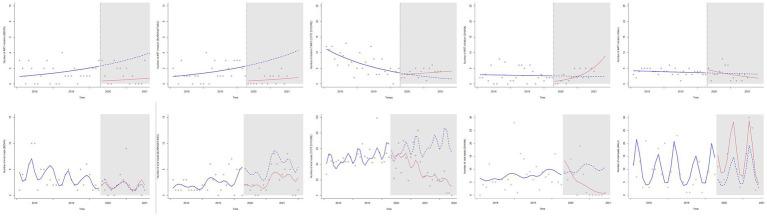
Immediately after the start of the pandemic, the average number of ART initiations decreased by 83.8% in Burkina Faso (IRR: 0.162; [95%CI: 0.043-0.609]) and 70.9% in Ghana (IRR: 0.291 [0.171-0.494]). Similarly, the number of VL tests performed decreased by 51% in Burkina Faso (IRR: 0.409 [0.253-0.662]). There were no significant trends in the number of ART initiations during the pandemic, except in Ghana (IRR: 1.146 [1.073-1.224]). The number of VL tests performed monthly in clinics in Côte d'Ivoire and Ghana decreased during the pandemic.
CONCLUSION
ART initiation and VL testing activities were maintained in the majority of West African pediatric clinics, despite the COVID-19 pandemic and subsequent crisis. HIV care continuum monitoring in CALHIV should be maintained during the postpandemic period to identify and mitigate potential lasting effects.
背景
在新冠疫情之前,儿科艾滋病毒连续护理服务落后于成人。本研究旨在描述新冠疫情对五个西非国家感染艾滋病毒的儿童和青少年(0至19岁)获得艾滋病毒护理的影响。
方法
在这项观察性多中心研究中,我们纳入了2018年至2021年间新登记的所有未接受抗逆转录病毒治疗(ART)的感染艾滋病毒儿童和青少年,进行了中断时间序列分析。分析了两个每月记录的结果,即开始接受抗逆转录病毒治疗的人数和进行病毒载量(VL)检测的次数。我们拟合了泊松分段回归模型,通过发病率比(IRR)和95%置信区间(CI)来估计疫情开始时的即时变化和疫情期间的趋势。
结果
疫情开始后,布基纳法索开始接受抗逆转录病毒治疗的平均人数立即下降了83.8%(发病率比:0.162;[95%置信区间:0.043 - 0.609]),加纳下降了70.9%(发病率比:0.291 [0.171 - 0.494])。同样,布基纳法索进行病毒载量检测的次数下降了51%(发病率比:0.409 [0.253 - 0.662])。除加纳外,疫情期间开始接受抗逆转录病毒治疗的人数没有显著趋势(发病率比:1.146 [1.073 - 1.224])。在疫情期间,科特迪瓦和加纳诊所每月进行病毒载量检测的次数有所下降。
结论
尽管新冠疫情及随后的危机,大多数西非儿科诊所仍维持了抗逆转录病毒治疗的启动和病毒载量检测活动。在疫情后时期,应持续监测感染艾滋病毒儿童和青少年的艾滋病毒护理连续性,以识别和减轻潜在的长期影响。
 Zotero 插件