Niranjan M R, Srinivasa Sanjay, Gupta Vibhanshu, Bhalla Anil K, Gaikwad Ankush, Wangikar Prajakta, Suryawanshi Sachin, Gajbe Priti
Department of Nephrology, Mysore Medical College and Research Institute, Mysore 570001, Karnātaka, India.
Department of Nephrology, Dr. Sanjay's Center for Kidney and Diabetes, Bengaluru 560064, Karnātaka, India.
World J Nephrol. 2025 Jun 25;14(2):100117. doi: 10.5527/wjn.v14.i2.100117.
Hyperphosphatemia (HP) is a common complication in an advanced stage of chronic kidney disease (CKD) and is associated with cardiovascular issues, metabolic bone abnormalities and worsening of secondary hyperparathyroidism. Most patients on dialysis require phosphate binders to control HP. Sucroferric oxyhydroxide (SO) (Dynulta) is a calcium-free, polynuclear iron (III) based oral phosphate binder, for the treatment of HP. In this phase IV, open-label, single-arm, multi-center, 12-week, SOLO CKD study evaluated efficacy and safety of Dynulta in Indian CKD patients undergoing hemodialysis.
To investigate the efficacy, safety and tolerability of SO Chewable Tablet (Dynulta) in patients with CKD on hemodialysis.
Hyperphosphatemic patients on hemodialysis and fulfilling eligibility criteria were included in the study for at least 12 weeks and received SO 1500 mg chewable tablet per day. The key endpoint was change in mean serum phosphorus levels after 12 weeks. Data were analysed using analysis of variance, Paired test, Wilcoxon test, and post-hoc comparisons, with < 0.05 considered statistically significant, using Graph Pad software.
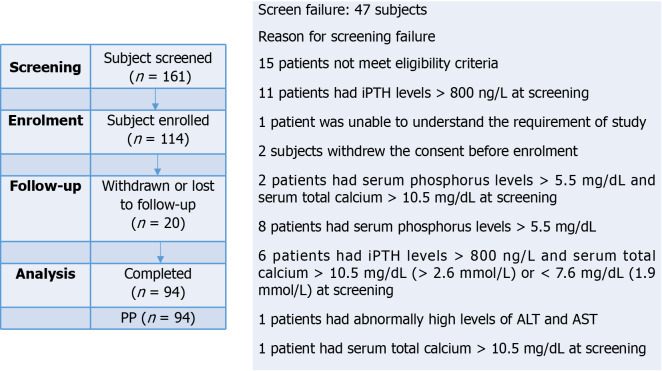
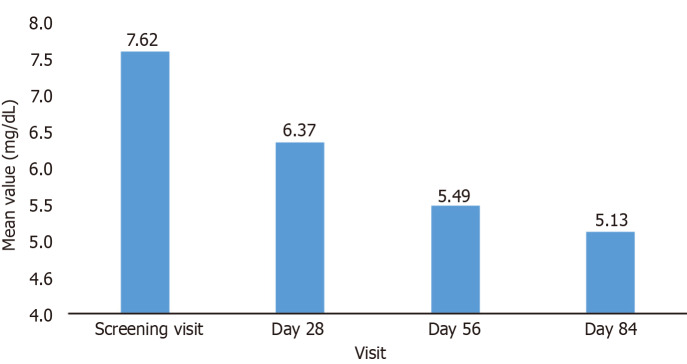
A total of 114 patients were enrolled and 94 patients completed the study. The mean ± SD serum phosphorous level was reduced from 7.62 mg/dL ± 2.02 mg/dL at baseline to 5.13 mg/dL ± 1.88 mg/dL after 12 weeks of treatment. At each follow-up visit, the reduction in mean serum phosphorous levels was statistically significant ( value < 0.05) compared to baseline, confirming the efficacy of SO. A total of 33.33% of patients experienced adverse events (AEs). The most frequently reported AEs were pyrexia, nasopharyngitis and headache, which were considered unlikely to be related to the study drug treatment. No serious AEs was reported during the study period and no patients discontinued treatment due to AEs.
This first real-world study in Indian CKD patients on hemodialysis shows SO as a safe, and effective monotherapy for HP, though its small sample size limits generalizability.
高磷血症(HP)是慢性肾脏病(CKD)晚期的常见并发症,与心血管问题、代谢性骨异常及继发性甲状旁腺功能亢进的恶化相关。大多数透析患者需要使用磷结合剂来控制高磷血症。蔗糖铁氧氢氧化物(SO)(商品名Dynulta)是一种无钙的、基于多核铁(III)的口服磷结合剂,用于治疗高磷血症。在这项IV期、开放标签、单臂、多中心、为期12周的SOLO CKD研究中,评估了Dynulta在接受血液透析的印度CKD患者中的疗效和安全性。
研究SO咀嚼片(Dynulta)在接受血液透析的CKD患者中的疗效、安全性和耐受性。
符合入选标准的血液透析高磷血症患者纳入研究至少12周,每天服用1500mg SO咀嚼片。主要终点是12周后血清磷平均水平的变化。使用方差分析、配对检验、Wilcoxon检验和事后比较对数据进行分析,P<0.05被认为具有统计学意义,使用Graph Pad软件。
共纳入114例患者,94例患者完成研究。治疗12周后,血清磷平均水平从基线时的7.62mg/dL±2.02mg/dL降至5.13mg/dL±1.88mg/dL。在每次随访时,与基线相比,血清磷平均水平的降低具有统计学意义(P值<0.05),证实了SO的疗效。共有33.33%的患者发生不良事件(AE)。最常报告的AE是发热、鼻咽炎和头痛,这些被认为不太可能与研究药物治疗有关。研究期间未报告严重AE,也没有患者因AE而停药。
这项针对接受血液透析的印度CKD患者的首次真实世界研究表明,SO作为一种治疗高磷血症的安全、有效的单一疗法,尽管其样本量小限制了普遍性。