Su Duo, Li Lu, Xie Hao, Ai Lingli, Wang Yuqing, Yang Bo, Zhou Dongsheng, Hu Lingfei, Yang Huiying
State Key Laboratory of Pathogen and Biosecurity, Academy of Military Medical Sciences, Beijing, China.
Reproductive Genetics Center, Bethune International Peace Hospital, Shijiazhuang, China.
Front Immunol. 2025 Jun 11;16:1574246. doi: 10.3389/fimmu.2025.1574246. eCollection 2025.
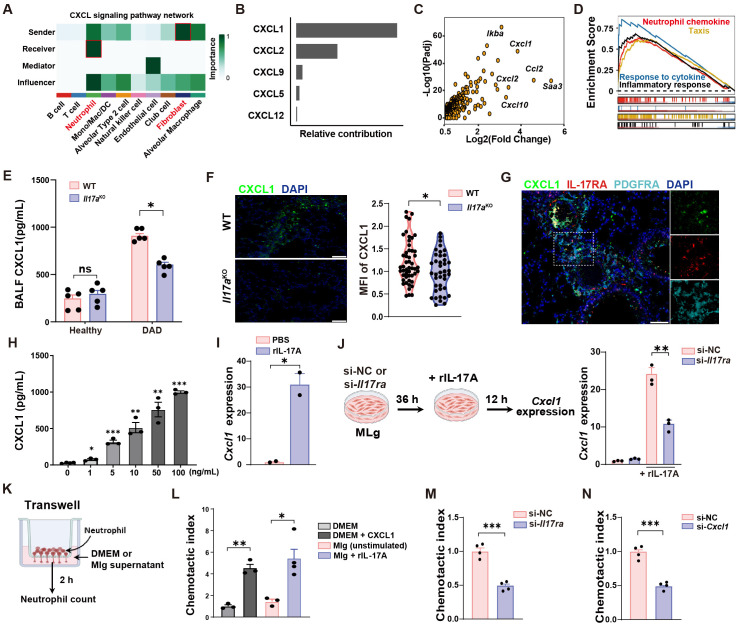
Diffuse alveolar damage (DAD), a lethal manifestation of acute lung injury, remains a critical public health concern due to the absence of targeted therapies. However, the underlying cellular and molecular mechanisms responsible for immunopathology during DAD progression are largely undefined. Here, by integrating single cell RNA sequencing, functional assays, and genetic/pharmacological interventions in a mouse model of ricin-induced DAD, we revealed a significant accumulation of neutrophil with an activated phenotype that plays a critical role in immunopathology. We observed the formation of neutrophil extracellular traps (NETs) during DAD, which further intensified inflammation and tissue injury. IL-17A signaling activity was upregulated in DAD-affected lungs, while IL-17A deficiency or functional blockade significantly attenuated neutrophil recruitment, NET generation, and tissue damage. Mechanically, IL-17A stimulates lung resident fibroblasts to produce the neutrophil chemoattractant CXCL1. Notably, type 3 innate lymphoid cells (ILC3) emerged as the dominant source of IL-17A, highlighting a triad of interactions among ILC3, fibroblast, and neutrophil in DAD pathogenesis. This finding delineates a pathogenic IL-17A-neutrophil-NET axis that amplifies lung immunopathology after ricin-induced DAD, a deeper understanding of these relationships may pave the way for mitigate DAD immunopathology and other lung inflammatory disorders.
弥漫性肺泡损伤(DAD)是急性肺损伤的一种致命表现,由于缺乏靶向治疗方法,它仍然是一个严重的公共卫生问题。然而,在DAD进展过程中导致免疫病理学的潜在细胞和分子机制在很大程度上尚不清楚。在这里,通过在蓖麻毒素诱导的DAD小鼠模型中整合单细胞RNA测序、功能测定以及基因/药理学干预,我们发现具有活化表型的中性粒细胞显著积累,其在免疫病理学中起关键作用。我们观察到在DAD过程中中性粒细胞胞外陷阱(NETs)的形成,这进一步加剧了炎症和组织损伤。在受DAD影响的肺中,IL-17A信号活性上调,而IL-17A缺乏或功能阻断显著减弱中性粒细胞募集、NET生成和组织损伤。从机制上讲,IL-17A刺激肺驻留成纤维细胞产生中性粒细胞趋化因子CXCL1。值得注意的是,3型天然淋巴细胞(ILC3)成为IL-17A的主要来源,突出了ILC3、成纤维细胞和中性粒细胞在DAD发病机制中的三重相互作用。这一发现描绘了一条致病性IL-17A-中性粒细胞-NET轴,该轴在蓖麻毒素诱导的DAD后放大了肺部免疫病理学,对这些关系的更深入理解可能为减轻DAD免疫病理学和其他肺部炎症性疾病铺平道路。