Huang Kuan-Chih, Lin Ting-Tse, Lin Lung-Chun, Lin Lian-Yu, Wu Cho-Kai
Division of Cardiology, Department of Internal Medicine, National Taiwan University Hospital Hsinchu Branch, Hsinchu, Taiwan; Department of Internal Medicine, College of Medicine, National Taiwan University, Taipei, Taiwan.
Department of Internal Medicine, College of Medicine, National Taiwan University, Taipei, Taiwan; Division of Cardiology, Department of Internal Medicine, National Taiwan University College of Medicine and Hospital, Taipei, Taiwan.
JACC Adv. 2025 Jun 25;4(8):101905. doi: 10.1016/j.jacadv.2025.101905.
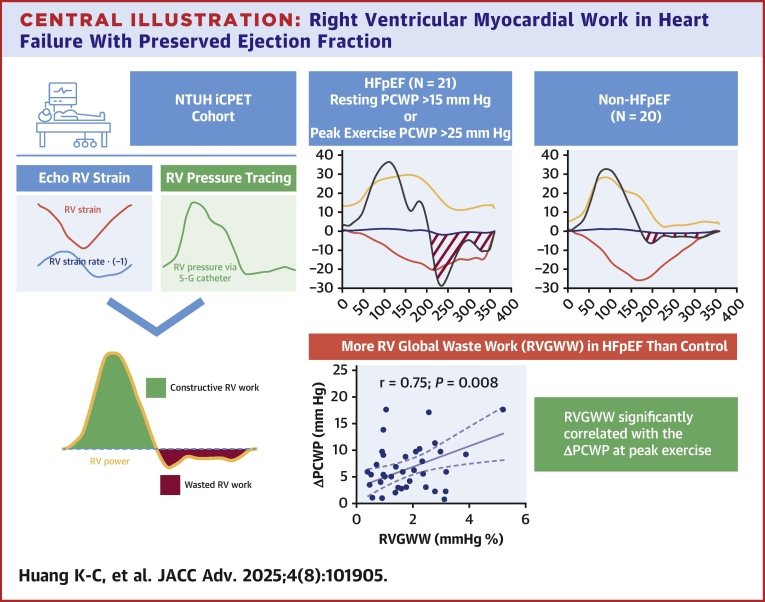
Symptoms of heart failure with preserved ejection fraction (HFpEF) are closely related to exercise-induced elevation in pulmonary capillary wedge pressure (PCWP). However, the diagnostic role of right ventricular (RV) myocardial work in HFpEF remains unclear.
The purpose of this study was to evaluate the diagnostic utility of RV myocardial work in HFpEF and their correlation with PCWP during exercise.
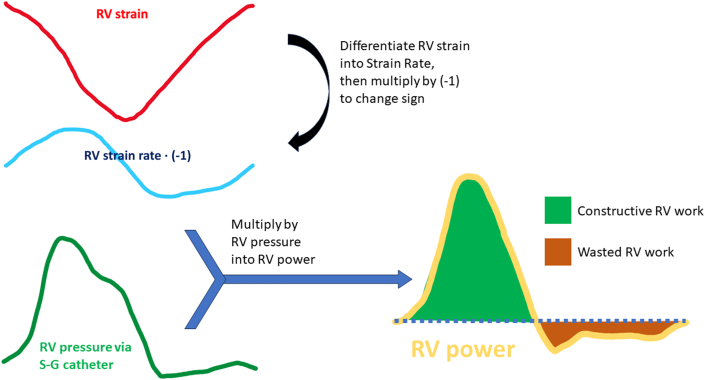
Patients with unexplained dyspnea underwent invasive cardiopulmonary exercise tests to identify HFpEF. Echocardiography assessed left and right ventricular parameters. RV myocardial work was calculated using strain rate and pressure curves, matched with electrocardiography data. RV global constructive work, RV global work index, RV global wasted work (RVGWW), and RV global work efficiency (RVGWE) were analyzed.
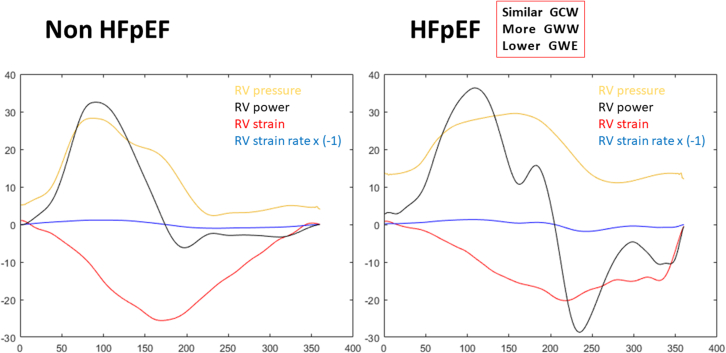
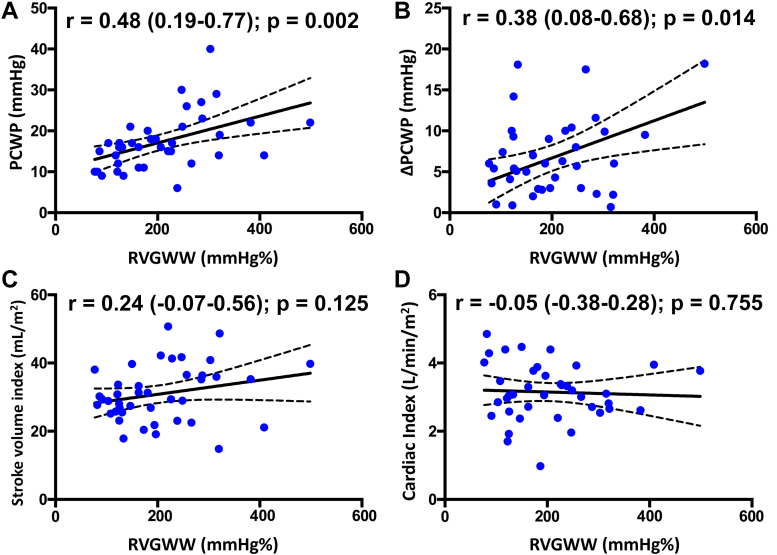
Forty-one patients with adequate data were enrolled, with 21 diagnosed with HFpEF. No significant differences in various echocardiographic parameters were found between HFpEF and non-HFpEF groups, except higher postexercise PCWP and mean pulmonary artery pressure in HFpEF patients. HFpEF patients had higher RVGWW and lower RVGWE. RVGWW and RVGWE demonstrated superior diagnostic performance for HFpEF compared to other echocardiographic parameters, with areas under the receiver operating characteristic curve of 0.85 (95% CI: 0.73-0.97) and 0.83 (95% CI: 0.70-0.96), respectively. RV global constructive work (r = 0.504; P = 0.001) and RVGWW (r = 0.621; P < 0.001) correlated with postexercise ΔPCWP and exercise PCWP, with RVGWW independently associated with both after adjustment for confounding factors.
RVGWW is a novel predictive parameter that provides a better explanation of RV performance regarding postexercise ΔPCWP than other standard echocardiographic parameters in HFpEF.
射血分数保留的心力衰竭(HFpEF)症状与运动引起的肺毛细血管楔压(PCWP)升高密切相关。然而,右心室(RV)心肌做功在HFpEF中的诊断作用仍不明确。
本研究旨在评估RV心肌做功在HFpEF中的诊断效用及其与运动期间PCWP的相关性。
对原因不明的呼吸困难患者进行有创心肺运动试验以确定HFpEF。超声心动图评估左、右心室参数。使用应变率和压力曲线并结合心电图数据计算RV心肌做功。分析右心室整体建设性做功、右心室整体做功指数、右心室整体无效做功(RVGWW)和右心室整体做功效率(RVGWE)。
纳入41例数据充足的患者,其中21例被诊断为HFpEF。HFpEF组和非HFpEF组之间的各种超声心动图参数无显著差异,但HFpEF患者运动后PCWP和平均肺动脉压较高。HFpEF患者的RVGWW较高,RVGWE较低。与其他超声心动图参数相比,RVGWW和RVGWE对HFpEF具有更好的诊断性能,受试者工作特征曲线下面积分别为0.85(95%CI:0.73-0.97)和0.83(95%CI:0.70-0.96)。右心室整体建设性做功(r = 0.504;P = 0.001)和RVGWW(r = 0.621;P < 0.001)与运动后ΔPCWP和运动PCWP相关,校正混杂因素后,RVGWW与两者均独立相关。
RVGWW是一个新的预测参数,与其他标准超声心动图参数相比,它能更好地解释HFpEF中运动后ΔPCWP时的右心室功能。