Vallée Alexandre, Feki Anis, Josseran Loic, Ayoubi Jean-Marc
Department of Epidemiology and Public Health, Foch Hospital, Paris, France.
Department of Gynecology and Obstetrics, University Hospital of Fribourg, Fribourg, Switzerland.
Tob Induc Dis. 2025 Jun 26;23. doi: 10.18332/tid/203429. eCollection 2025.
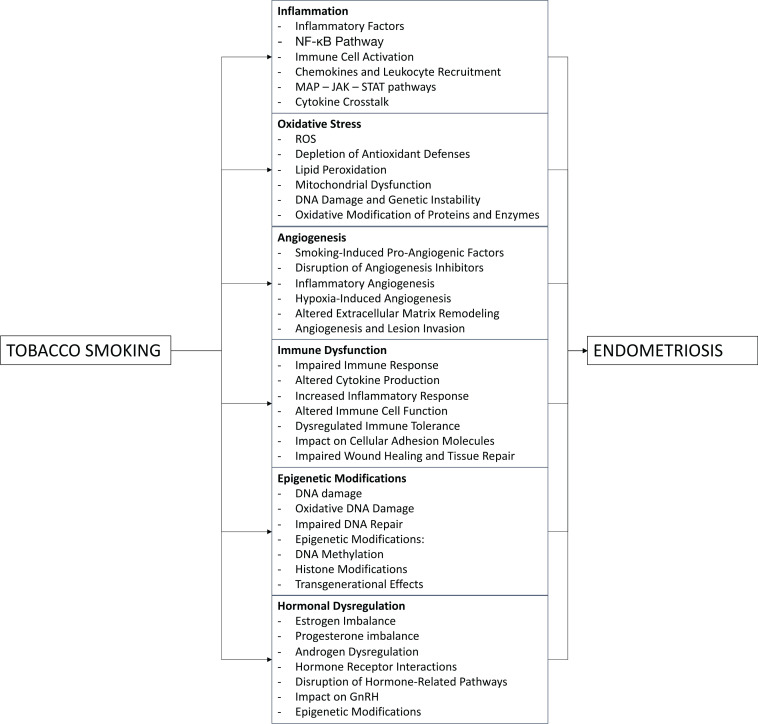
Endometriosis is a chronic gynecological disorder affecting 6-10% of women of reproductive age. While its etiology is multifactorial, growing evidence suggests that tobacco smoking may contribute to its development and progression through inflammatory, oxidative, and hormonal mechanisms. This narrative review examines the relationship between tobacco smoking and endometriosis, integrating molecular insights to clarify potential biological pathways and highlight areas for future research. A search was conducted in PubMed/MEDLINE and Web of Science, including only original research articles published in English. Studies on both human and animal models were considered, without restrictions on participant age, to provide a comprehensive overview of tobacco-related mechanisms in endometriosis. Tobacco smoke components, such as nicotine and polycyclic aromatic hydrocarbons, can initiate and sustain an inflammatory response, leading to the release of pro-inflammatory cytokines and recruitment of immune cells. Tobacco smoking also induces oxidative stress, disrupting cellular functions and damaging DNA. Moreover, it can cause hormonal dysregulation and interfere with hormone-related signaling pathways. Epigenetic modifications, including DNA methylation and histone modifications, can also be induced by tobacco smoking. These changes affect the expression of genes involved in inflammation, cell proliferation, and hormone signaling, contributing to the pathogenesis of endometriosis. Future research should prioritize longitudinal studies with objective biomarkers to strengthen causal inference. Studies integrating omics approaches can further clarify tobacco-induced molecular alterations in endometriosis. Public health policies should incorporate targeted smoking prevention and cessation programs for women at risk.
子宫内膜异位症是一种慢性妇科疾病,影响6%至10%的育龄妇女。虽然其病因是多因素的,但越来越多的证据表明,吸烟可能通过炎症、氧化和激素机制促进其发展和进展。这篇叙述性综述探讨了吸烟与子宫内膜异位症之间的关系,整合分子见解以阐明潜在的生物学途径,并突出未来研究的领域。在PubMed/MEDLINE和科学网进行了检索,仅纳入以英文发表的原创研究文章。考虑了对人类和动物模型的研究,对参与者年龄没有限制,以全面概述子宫内膜异位症中与烟草相关的机制。烟草烟雾成分,如尼古丁和多环芳烃,可引发并维持炎症反应,导致促炎细胞因子的释放和免疫细胞的募集。吸烟还会诱导氧化应激,扰乱细胞功能并损害DNA。此外,它可导致激素失调并干扰激素相关信号通路。吸烟还可诱导表观遗传修饰,包括DNA甲基化和组蛋白修饰。这些变化影响参与炎症、细胞增殖和激素信号传导的基因表达,促进子宫内膜异位症的发病机制。未来的研究应优先进行具有客观生物标志物的纵向研究,以加强因果推断。整合组学方法的研究可以进一步阐明吸烟在子宫内膜异位症中引起的分子改变。公共卫生政策应纳入针对高危女性的有针对性的吸烟预防和戒烟计划。