Bodunde Elizabeth O, McCarthy Fergus P, O'connor Karen, Matvienko-Sikar Karen, Khashan Ali S
School of Public Health, University College Cork, Cork, Ireland.
INFANT Research Centre, University College Cork, Cork, Ireland.
PLoS One. 2025 Jun 27;20(6):e0327129. doi: 10.1371/journal.pone.0327129. eCollection 2025.
Limited evidence exists on the association between mode of birth and long-term depression and/or severe anxiety in mothers. We aimed to examine the association between mode of birth and depression and/or severe anxiety by 14 years postpartum.
We used data from the Millennium Cohort Study. Data on mode of birth were collected when mothers were 9 months postpartum, and categorized as spontaneous vaginal birth (VB), assisted VB, induced VB, emergency cesarean section (CS), planned CS, and CS after induction. Depression/severe anxiety were collected as one variable and self reported by mothers at 9 months, 3, 5, 7, 11, and 14 years postpartum based on a doctor diagnosis. The primary outcome measure was a diagnosis of depression/severe anxiety up to 14 years postpartum. We used multivariable logistic regression models to estimate crude and adjusted odds ratios (OR) for the association between mode of birth and depression/severe anxiety by 14 years postpartum.
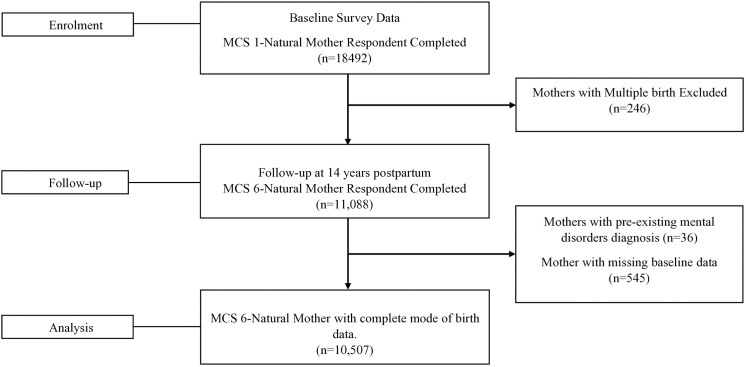
There were 10,507 singleton mothers included in our analyses. Fully adjusted odds ratio (aOR)for the association between mode of birth and depression/severe anxiety by 14 years postpartum was induced VB, (aOR, 1.13 [95% CI], 1.01-2.28), assisted VB (aOR, 1.03 [95% CI], 0.89-1.19), Emergency CS, (aOR, 1.08 [95% CI], 0.92-1.27), planned CS (aOR, 1.09 [95% CI], 0.93-1.27), and CS after induction (aOR, 1.08 [95% CI], 0.91-1.28). Fully adjusted models did not report any significant association between mode of birth and depression/severe anxiety at other postpartum time points.
The present findings provide support for association between induction of labor and the risk of long-term depression/severe anxiety by 14 years postpartum. The findings provide no evidence to support association between other modes of birth and maternal depression/anxiety.
关于分娩方式与母亲长期抑郁和/或严重焦虑之间的关联,现有证据有限。我们旨在研究产后14年时分娩方式与抑郁和/或严重焦虑之间的关联。
我们使用了千禧队列研究的数据。分娩方式的数据在母亲产后9个月时收集,并分为自然阴道分娩(VB)、辅助阴道分娩、引产阴道分娩、急诊剖宫产(CS)、计划剖宫产以及引产术后剖宫产。抑郁/严重焦虑作为一个变量,由母亲在产后9个月、3年、5年、7年、11年和14年根据医生诊断自行报告。主要结局指标是产后14年内的抑郁/严重焦虑诊断。我们使用多变量逻辑回归模型来估计产后14年时分娩方式与抑郁/严重焦虑之间关联的粗比值比(OR)和调整后比值比。
我们的分析纳入了10,507名单胎母亲。产后14年时,引产阴道分娩与抑郁/严重焦虑之间关联的完全调整后比值比(aOR)为1.13(95%置信区间[CI],1.01 - 2.28),辅助阴道分娩为1.03(95% CI,0.89 - 1.19),急诊剖宫产为1.08(95% CI,0.92 - 1.27),计划剖宫产为1.09(95% CI,0.93 - 1.27),引产术后剖宫产为1.08(95% CI,0.91 - 1.28)。完全调整模型未报告在其他产后时间点分娩方式与抑郁/严重焦虑之间存在任何显著关联。
目前的研究结果支持引产与产后14年长期抑郁/严重焦虑风险之间的关联。研究结果没有证据支持其他分娩方式与母亲抑郁/焦虑之间的关联。