Liu Jian, Neupane Pawan, Cheng Jianlin
Department of Electrical Engineering & Computer Science, NextGen Precision Health, University of Missouri, Columbia, Missouri, 65211, United States of America.
Res Sq. 2025 Jun 20:rs.3.rs-6845168. doi: 10.21203/rs.3.rs-6845168/v1.
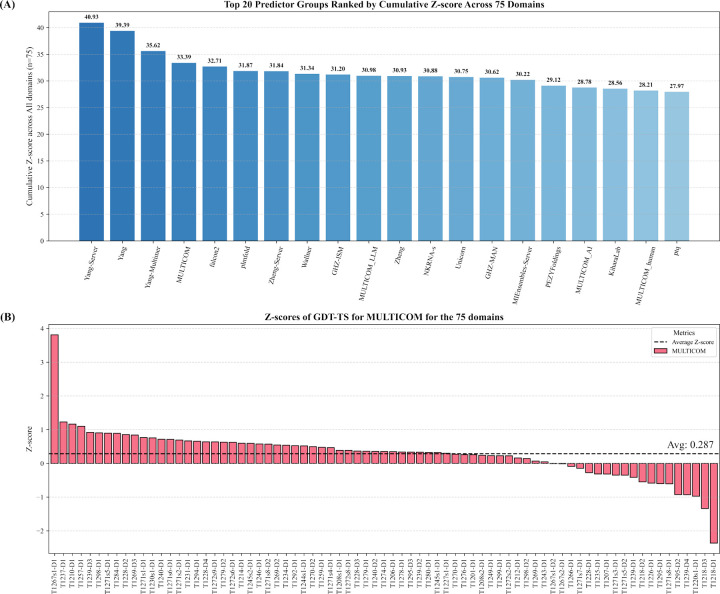
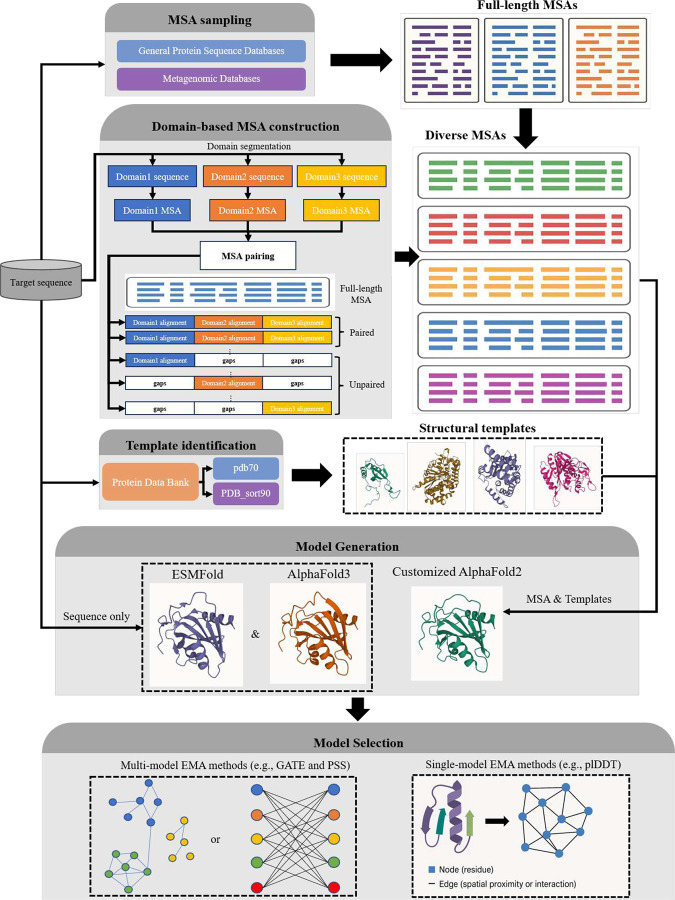
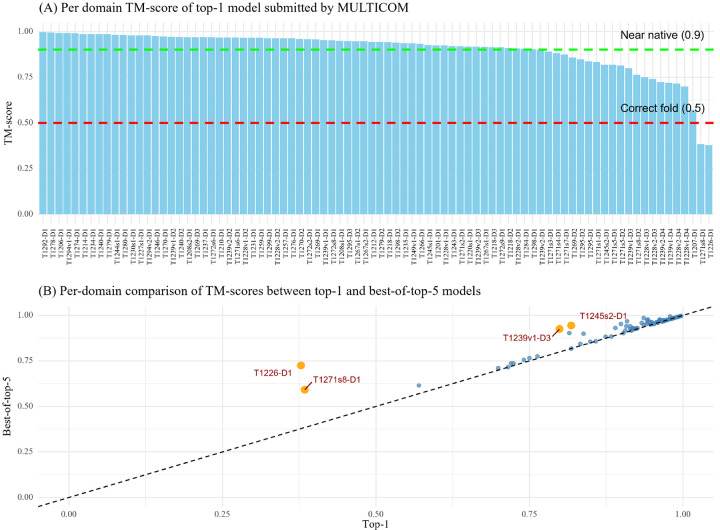
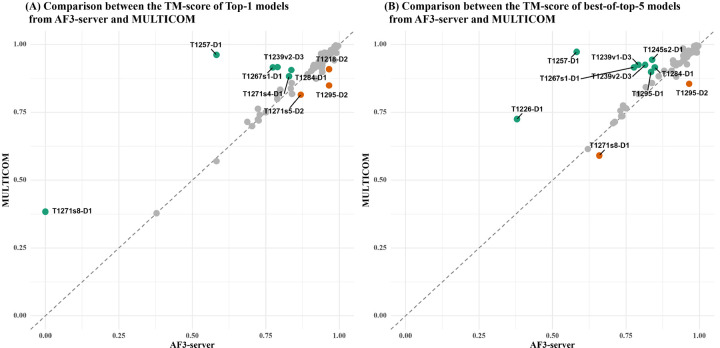
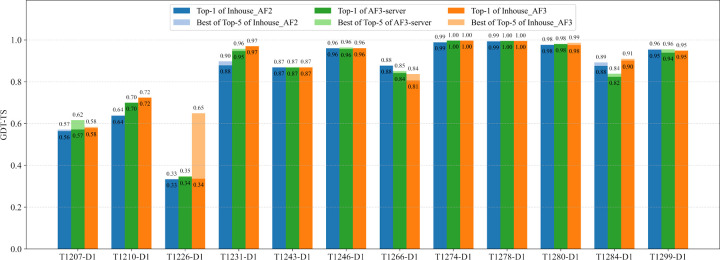
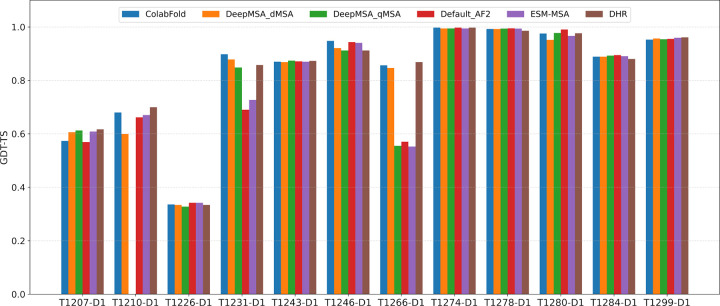
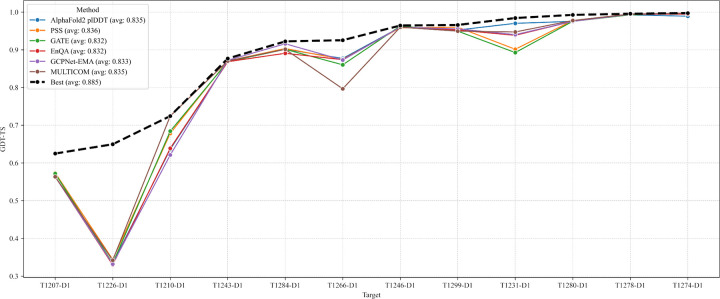
AlphaFold2 and AlphaFold3 have revolutionized protein structure prediction by enabling high-accuracy tertiary structure predictions for most single-chain proteins (monomers). However, obtaining high-quality predictions for some hard protein targets with shallow or noisy multiple sequence alignments (MSAs) and complicated multi-domain architectures remains challenging. Here, we present MULTICOM4, an integrative protein structure prediction system that uses diverse MSA generation, large-scale model sampling, and an ensemble model quality assessment (QA) strategy of combining individual QA methods to improve model generation and ranking of AlphaFold2 and AlphaFold3. In the 16th Critical Assessment of Techniques for Protein Structure Prediction (CASP16), our predictors built on MULTICOM4 ranked among the top performers out of 120 predictors in tertiary structure prediction and outperformed a standard AlphaFold3 predictor. The average TM-score of our best performing predictor MULTCOM's top-1 prediction for 84 CASP16 domain is 0.902. It achieved high accuracy (TM-score > 0.9) for 73.8% of the 84 domains and correct fold predictions (TM-score > 0.5) for 97.6% domains in terms of top-1 prediction. In terms of best-of-top-5 prediction, it predicted correct folds for all the domains. The results show that MSA engineering through the use of different protein sequence databases, alignment tools, and domain segmentation as well as extensive model sampling are the key to generate accurate and correct structural models. Additionally, using multiple complementary QA methods and model clustering can improve the robustness and reliability of model ranking.
AlphaFold2和AlphaFold3通过能够对大多数单链蛋白质(单体)进行高精度的三级结构预测,彻底改变了蛋白质结构预测。然而,对于一些具有浅或噪声多序列比对(MSA)以及复杂多结构域架构的难预测蛋白质靶点,获得高质量预测仍然具有挑战性。在这里,我们展示了MULTICOM4,这是一种集成蛋白质结构预测系统,它使用多样的MSA生成、大规模模型采样以及结合个体质量评估(QA)方法的集成模型质量评估策略,以改进AlphaFold2和AlphaFold3的模型生成和排名。在第16届蛋白质结构预测技术关键评估(CASP16)中,我们基于MULTICOM4构建的预测器在120个三级结构预测器中名列前茅,并且优于标准的AlphaFold3预测器。我们表现最佳的预测器MULTCOM对84个CASP16结构域的top-1预测的平均TM分数为0.902。就top-1预测而言,它在84个结构域中的73.8%实现了高精度(TM分数>0.9),在97.6%的结构域中实现了正确的折叠预测(TM分数>0.5)。就top-5最佳预测而言,它对所有结构域都预测出了正确的折叠。结果表明,通过使用不同的蛋白质序列数据库、比对工具和结构域分割进行MSA工程以及广泛的模型采样是生成准确和正确结构模型的关键。此外,使用多种互补的QA方法和模型聚类可以提高模型排名的稳健性和可靠性。