Mackey Tim, Nali Matthew, Larsen Meng Zhen, Li Zhuoran, Li Jiawei, Yang Joshua
Global Health Program, Department of Anthropology, University of California, San Diego, 9500 Gilman Drive, MC: 0505, La Jolla, CA, 92093, United States, 1 9514914161.
S-3 Research LLC, San Diego, CA, United States.
J Med Internet Res. 2025 Jun 30;27:e64820. doi: 10.2196/64820.
Reports of hospitalization associated with Diamond Shruumz-branded mushroom-containing products in October 2024 led to a manufacturer's recall that restricted the sale, distribution, and accessibility of this new and emerging psychoactive product.
This study seeks to assess the continuing online availability of a mushroom-containing edible product in a diverse e-commerce landscape, specifically aiming to identify and characterize its online availability before and after recall initiation.
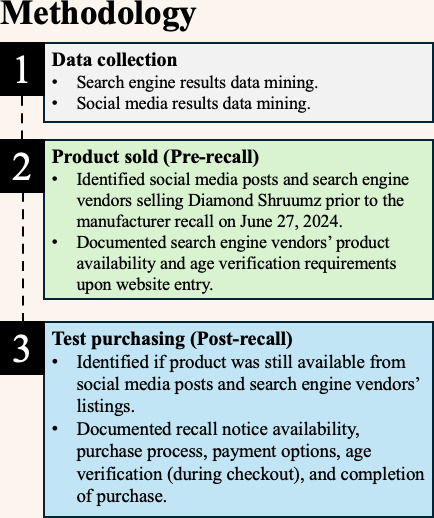
A retrospective online market surveillance of Diamond Shruumz products using structured and automated search queries was employed to identify online product marketing and availability. Online surveillance included the monitoring of multiple social media platforms, cannabis e-commerce websites, and search engine queries between June 22 and June 27, 2024, immediately preceding the manufacturer-initiated recall. Post-recall simulated purchases were then conducted on July 12, 2024, on platforms, websites and domains identified as continuing to actively market and sell the products through online product listings.
Prior to product recall, a total of 4117 product listings across 1600 (38.86%) social media posts and user-generated comments, 11 (0.27%) cannabis e-commerce websites, and 2509 (60.94%) hyperlinks from internet search queries were generated for further content analysis. Review of online sources revealed 49 social media posts, 8 e-commerce shops, and 67 domains that were identified as actively marketing and selling products prior to recall. Post-recall, we identified 45 (67.16%) remaining domains that continued to market the product from these different online sources. Simulated purchases revealed that 15 (33.33%) domains successfully transacted test purchases and 30 (66.66%) transactions failed because of account verification or payment failure.
The Diamond Shruumz recall exemplifies the ongoing challenge of unknown consumer harm associated with new and emerging substances marketed and sold on the internet, which is especially concerning as these products appeal to younger audiences with a variety of edible flavored products. While a recall was initiated and products became unavailable, our study found that post-recall online vendors continued to market and sell the products. This indicates that there are ongoing challenges to effectuate recalls and online enforcement in a diverse e-commerce landscape that can rapidly bring new and novel psychoactive substances to the market.
2024年10月,有报告称食用含钻石舒鲁姆兹(Diamond Shruumz)品牌蘑菇的产品导致住院,这促使制造商召回该产品,限制了这种新兴精神活性产品的销售、分销和获取。
本研究旨在评估一种含蘑菇的可食用产品在多样化电子商务环境中的持续在线可得性,具体目标是确定并描述召回启动前后其在线可得性情况。
采用结构化和自动搜索查询对钻石舒鲁姆兹产品进行回顾性在线市场监测,以确定在线产品营销和可得性。在线监测包括在制造商发起召回前,即2024年6月22日至6月27日期间,对多个社交媒体平台、大麻电子商务网站和搜索引擎查询进行监测。然后在2024年7月12日进行召回后模拟购买,在通过在线产品列表被确定为继续积极营销和销售该产品的平台、网站和域名上进行。
在产品召回前,通过1600条(38.86%)社交媒体帖子和用户生成评论、11个(0.27%)大麻电子商务网站以及2509个(60.94%)来自互联网搜索查询的超链接,共生成了4117个产品列表,以供进一步内容分析。对在线来源的审查发现,在召回前有49条社交媒体帖子、8家电子商务商店和67个域名被确定为积极营销和销售产品。召回后,我们从这些不同的在线来源中确定了45个(67.16%)仍在销售该产品的域名。模拟购买显示,15个(33.33%)域名成功完成测试购买,30个(66.66%)交易因账户验证或支付失败而失败。
钻石舒鲁姆兹召回事件体现了与在互联网上营销和销售的新兴物质相关的未知消费者危害这一持续存在的挑战,尤其令人担忧的是,这些产品通过各种食用口味产品吸引年轻受众。虽然已发起召回且产品不再可得,但我们的研究发现,召回后在线供应商仍继续营销和销售该产品。这表明在多样化的电子商务环境中,要实现召回和在线执法存在持续挑战,因为这种环境能够迅速将新的精神活性物质推向市场。