Burus Todd, Windon Melina J, Jakubek Yasminka A, Lang Kuhs Krystle A
Markey Cancer Center, University of Kentucky, Lexington.
Department of Otolaryngology-Head & Neck Surgery, College of Medicine, University of Kentucky, Lexington.
JAMA Netw Open. 2025 Jun 2;8(6):e2518242. doi: 10.1001/jamanetworkopen.2025.18242.
Poor socioeconomic conditions and corresponding health disparities have historically characterized the Appalachian region of the US. Low uptake of the human papillomavirus (HPV) vaccine and high rates of cervical cancer have been observed in the region; however, a comprehensive assessment of HPV-associated cancer in Appalachia has not been performed.
To compare the burden of HPV-associated cancer incidence between the Appalachian and non-Appalachian regions of the US.
DESIGN, SETTING, AND PARTICIPANTS: This cross-sectional study of HPV-associated cancer incidence rates and trends used the US Cancer Statistics Incidence Analytic Database, covering 99% of the US population and 100% of the Appalachian region. Participants were individuals with an HPV-associated cancer diagnosis reported to a US cancer registry between January 1, 2004, and December 31, 2021. Human papillomavirus-associated cancers include squamous cell carcinomas of the oropharynx, anus, vulva, vagina or penis, or cervical carcinoma. Statistical analysis was performed in December 2024.
Age, sex, race and ethnicity, county of residence, urbanicity, and stage at diagnosis.
Estimated HPV-associated cancer incidence rates for 2017 to 2021 and annual incidence rate trends between 2004 and 2021. Calculated incidence rate ratios (IRRs) and differences in average annual percentage change by Appalachian residence. Additional comparisons were made between Appalachian regions.
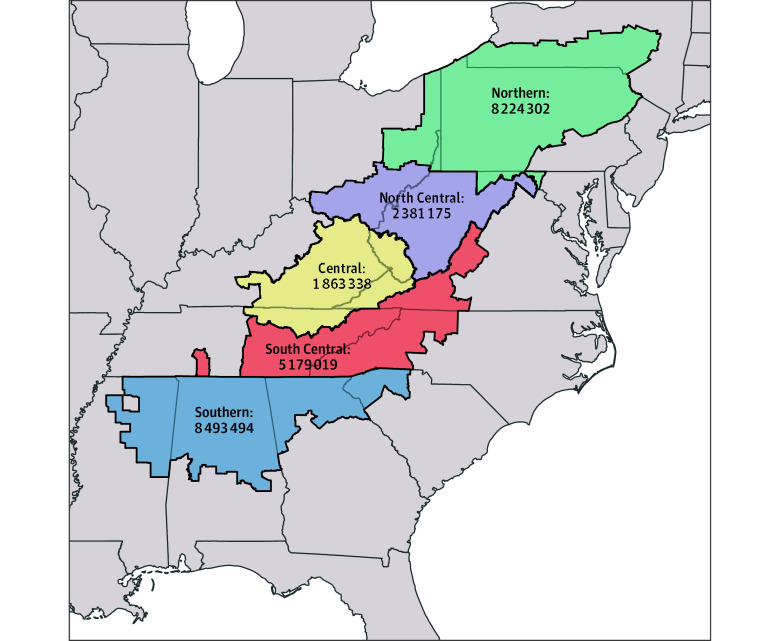
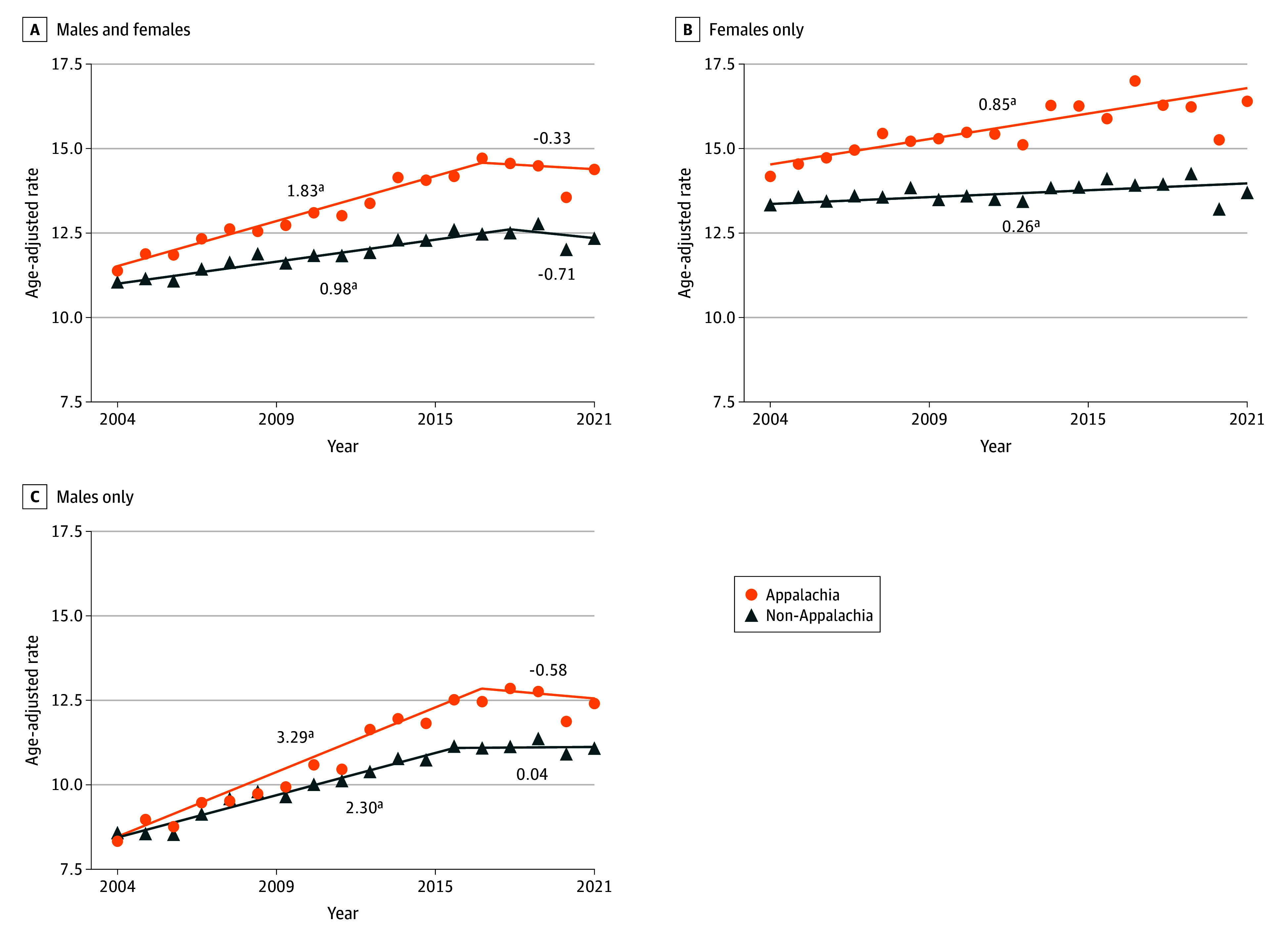
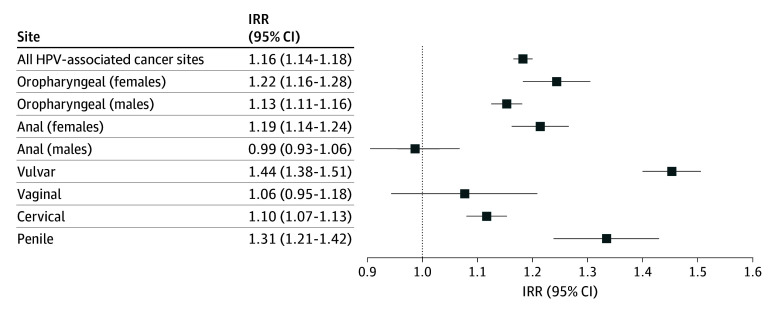
From 2017 to 2021, there were 23 649 cases of HPV-associated cancer diagnosed among Appalachian residents (12 929 females [54.7%]). The overall HPV-associated cancer incidence was 16% higher among Appalachian residents than non-Appalachian residents (IRR, 1.16; 95% CI, 1.14-1.18). Higher site-specific rates among Appalachian residents were noted for all HPV-associated cancer sites, except vaginal cancer and male anal cancer, with the greatest disparity occurring for vulvar cancer (IRR, 1.44; 95% CI, 1.38-1.51). Human papillomavirus-associated cancer incidence increased significantly faster in Appalachia vs non-Appalachia between 2004 and 2021 (average annual percentage change, 1.3% per year [95% CI, 1.0%-1.6% per year]; vs 0.7% per year [95% CI, 0.4%-1.0% per year]; P = .004), with the most marked trend difference occurring for penile cancer (2.1% faster per year in Appalachia; P = .003). Within Appalachia, the highest HPV-associated incidence rates per 100 000 persons were observed in the North Central (16.9 [95% CI, 16.2-17.6]) and Central (16.9 [95% CI, 16.1-17.7]) subregions.
This cross-sectional study of HPV-associated cancer incidence found disproportionately high HPV-associated cancer rates among Appalachian residents compared with non-Appalachian residents. These findings highlight the need for targeted efforts to improve HPV vaccine uptake and encourage adherence to evidence-based screening guidelines for HPV-associated cancers in Appalachia.
社会经济条件差以及相应的健康差距一直是美国阿巴拉契亚地区的特征。该地区已观察到人类乳头瘤病毒(HPV)疫苗接种率低和宫颈癌发病率高的情况;然而,尚未对阿巴拉契亚地区与HPV相关的癌症进行全面评估。
比较美国阿巴拉契亚地区和非阿巴拉契亚地区与HPV相关的癌症发病率负担。
设计、背景和参与者:这项关于HPV相关癌症发病率和趋势的横断面研究使用了美国癌症统计发病率分析数据库,该数据库覆盖了99%的美国人口和100%的阿巴拉契亚地区。参与者为2004年1月1日至2021年12月31日期间向美国癌症登记处报告有HPV相关癌症诊断的个体。与人类乳头瘤病毒相关的癌症包括口咽、肛门、外阴、阴道或阴茎的鳞状细胞癌,或宫颈癌。统计分析于2024年12月进行。
年龄、性别、种族和族裔、居住县、城市化程度以及诊断时的分期。
2017年至2021年估计的与HPV相关的癌症发病率以及2004年至2021年的年发病率趋势。计算发病率比(IRR)以及按阿巴拉契亚居住情况划分的年均百分比变化差异。还对阿巴拉契亚地区之间进行了额外比较。
2017年至2021年期间,阿巴拉契亚居民中有23649例被诊断为与HPV相关的癌症(12929名女性[54.7%])。阿巴拉契亚居民中与HPV相关的癌症总体发病率比非阿巴拉契亚居民高16%(IRR,1.16;95%CI,1.14 - 1.18)。除阴道癌和男性肛门癌外,阿巴拉契亚居民中所有与HPV相关癌症部位的特定部位发病率都更高,外阴癌的差异最大(IRR,1.44;95%CI,1.38 - 1.51)。2004年至2021年期间,阿巴拉契亚地区与HPV相关的癌症发病率增长明显快于非阿巴拉契亚地区(年均百分比变化,每年1.3%[95%CI,每年1.0% - 1.6%];相比之下,每年0.7%[95%CI,每年0.4% - 1.0%];P = 0.004),阴茎癌的趋势差异最为明显(阿巴拉契亚地区每年快2.1%;P = 0.003)。在阿巴拉契亚地区内,中北部(16.9[95%CI,16.2 - 17.6])和中部(16.9[95%CI,16.1 - 17.7])次区域每10万人中与HPV相关的发病率最高。
这项关于HPV相关癌症发病率的横断面研究发现,与非阿巴拉契亚居民相比,阿巴拉契亚居民中与HPV相关的癌症发病率高得不成比例。这些发现凸显了有针对性地努力提高HPV疫苗接种率以及鼓励在阿巴拉契亚地区遵守基于证据的HPV相关癌症筛查指南的必要性。