Bates Timothy, Kulicke Corinna, Gurmessa Sintayehu, Kim Se-Jin, Suresh Sushant, Reyes-Weinstein Jules, Hinchliff Audrey, Burke John, Lewinsohn David, Tafesse Fikadu G
bioRxiv. 2025 Jun 17:2025.06.11.659204. doi: 10.1101/2025.06.11.659204.
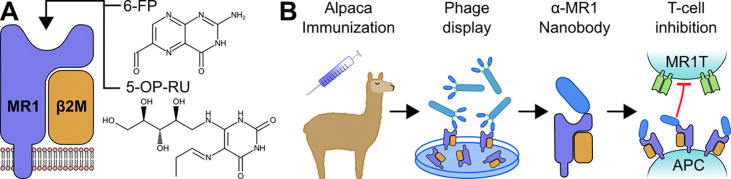
MR1 is a non-polymorphic, ubiquitously expressed, MHC class I-like antigen-presenting molecule that presents small-molecule metabolites to T cells. Studies have shown that MR1 plays a role in microbial infection, inflammation, and tumor immunity. The antigens it presents include metabolites of microbial and self-origin as well as small-molecule drugs and form stable complexes with MR1 that are displayed on the cell surface to activate T cells. However, unlike classical MHC I and II molecules, the fundamental biology of MR1 remains poorly understood, particularly the mechanisms governing antigen loading and intracellular trafficking. This knowledge gap is largely due to the lack of molecular tools available to precisely manipulate MR1 function. In this study, we describe a high-affinity (1.6 nM ) anti-MR1 nanobody, MR1Nb1. We characterize the binding of this nanobody including affinity by ELISA and kinetics by BLI. Crucially, we map the binding epitope of MR1Nb1 on MR1 by HDX-MS, providing key insights into the mechanism through which it blocks MR1T cell activation. In functional assays MR1Nb1 effectively and specifically blocks MAIT cell activation by cells infected with or treated with supernatant. This nanobody represents a unique and versatile tool for the field, as it can be produced inexpensively and expressed intracellularly within antigen-presenting cells. Hence, our study provides a powerful new molecular probe for dissecting the mechanistic underpinnings of MR1 biology and uncover its broader roles in immunity.
MR1是一种非多态性、广泛表达的、与MHC I类相似的抗原呈递分子,它将小分子代谢产物呈递给T细胞。研究表明,MR1在微生物感染、炎症和肿瘤免疫中发挥作用。它呈递的抗原包括微生物来源和自身来源的代谢产物以及小分子药物,并与MR1形成稳定的复合物,这些复合物展示在细胞表面以激活T细胞。然而,与经典的MHC I类和II类分子不同,MR1的基础生物学仍知之甚少,尤其是抗原加载和细胞内运输的调控机制。这一知识空白很大程度上是由于缺乏可精确操纵MR1功能的分子工具。在本研究中,我们描述了一种高亲和力(1.6 nM)的抗MR1纳米抗体MR1Nb1。我们通过ELISA表征了该纳米抗体的结合亲和力,并通过BLI表征了其动力学。至关重要的是,我们通过HDX-MS绘制了MR1Nb1在MR1上的结合表位,为其阻断MR1-T细胞激活的机制提供了关键见解。在功能测定中,MR1Nb1有效且特异性地阻断了感染或用 上清液处理的细胞对MAIT细胞的激活。这种纳米抗体代表了该领域一种独特且通用的工具,因为它可以低成本生产并在抗原呈递细胞内表达。因此,我们的研究为剖析MR1生物学的机制基础并揭示其在免疫中的更广泛作用提供了一种强大的新分子探针。