Zhou Ling, Sun Jingchao, Zhang Yanjun, Chen Yunjuan, Lei Honglei
School of Civil Engineering, Shandong Jianzhu University, Jinan, 250101, China.
Key Laboratory of Building Structural Retrofitting and Underground Space Engineering (Shandong Jianzhu University), Jinan, 250101, China.
Sci Rep. 2025 Jul 1;15(1):21472. doi: 10.1038/s41598-025-07509-1.
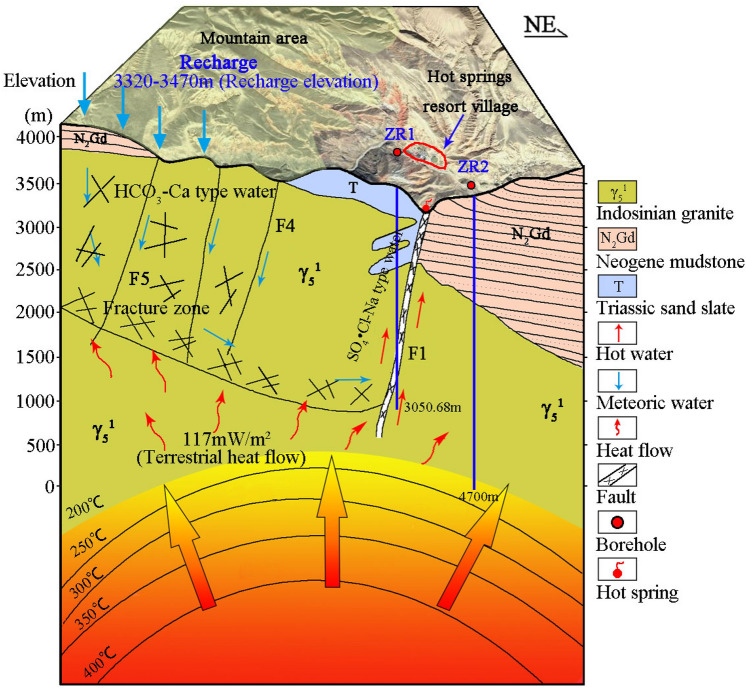
Numerical simulation is the most commonly used method to predict the power generation capacity of EGS during geothermal energy extraction. However, it is time-consuming to optimize the scheme only by comparing the numerical simulation methods, and it is difficult to determine the globally optimal operation strategy. In this study, five key parameters including well spacing, water injection rate, injection temperature, fracture permeability and fracture spacing are considered. Based on the numerical simulation data, optimized Back-Propagation Neural Network (BPNN) prediction models combining the Particle Swarm Optimization (PSO) and the Genetic Algorithm (GA) were developed to investigate the impact of various factors on the heat recovery performance of a three-horizontal-well EGS in the Zhacang geothermal field. On the basis of these PSO-GA-BPNN models, the weights of the evaluation indexes for each geothermal development were calculated by hierarchical analysis method. In this study, an innovative combination of numerical simulation, PSO-GA-BPNN model, and Analytic Hierarchy Process was proposed to establish an EGS comprehensive optimization method, effectively improving the accuracy and computational efficiency of scheme optimization. The results reveal that predicting EGS with PSO-GA-BPNN models has a good prediction accuracy for each performance index. After a comprehensive comparison, the combination of well spacing of 600 m, water injection rate of 27 kg/s, injection temperature of 58 ℃, fracture permeability of 1 × 10 m and fracture spacing of 100 m was identified as the optimal power generation scheme. The EGS power plant is expected to have an installed capacity of 6.05-8.17 MW, with a total generating capacity of 3,163.16 GWh and a levelized cost of electricity of $0.033/kWh. The method is very effective in the development and optimal design of geothermal systems and can also provide a reference for other geothermal projects.
数值模拟是预测增强型地热系统(EGS)在地热开采过程中发电能力最常用的方法。然而,仅通过比较数值模拟方法来优化方案很耗时,而且难以确定全局最优运行策略。在本研究中,考虑了包括井距、注水速率、注入温度、裂缝渗透率和裂缝间距在内的五个关键参数。基于数值模拟数据,开发了结合粒子群优化算法(PSO)和遗传算法(GA)的优化反向传播神经网络(BPNN)预测模型,以研究各种因素对扎仓地热田三水平井EGS热回收性能的影响。基于这些PSO-GA-BPNN模型,采用层次分析法计算了各地热开发评价指标的权重。本研究提出了一种将数值模拟、PSO-GA-BPNN模型和层次分析法创新结合的方法,建立了EGS综合优化方法,有效提高了方案优化的准确性和计算效率。结果表明,用PSO-GA-BPNN模型预测EGS的各项性能指标具有良好的预测精度。经过综合比较,确定井距600 m、注水速率27 kg/s、注入温度58℃、裂缝渗透率1×10 m和裂缝间距100 m的组合为最优发电方案。该EGS发电厂预计装机容量为6.05 - 8.17 MW,总发电量为3163.16 GWh,平准化度电成本为0.033美元/kWh。该方法在地热系统开发和优化设计中非常有效,也可为其他地热项目提供参考。