Bloomfield Max, Reed Hamish, Todd Sue, van der Werff Koen, Balm Michelle, Blackmore Tim
Department of Microbiology, Awanui Laboratories Wellington, Wellington, New Zealand.
Department of Infection Services, Te Whatu Ora/Health NZ-Capital, Coast and Hutt Valley, Wellington, New Zealand.
Open Forum Infect Dis. 2025 Jun 6;12(7):ofaf323. doi: 10.1093/ofid/ofaf323. eCollection 2025 Jul.
Shorter-course treatment for group A streptococcal (GAS) pharyngitis may be equivalent to 10 days for clinical cure but effectiveness for pharyngeal GAS eradication is uncertain. The effect on household transmission has not been examined directly. In 2022, a laboratory antimicrobial stewardship initiative drove an abrupt reduction in treatment durations for GAS pharyngitis locally. This study aimed to assess whether this had any negative effect on key treatment outcomes: clinical failure, microbiological failure, immune sequelae, and household GAS transmission.
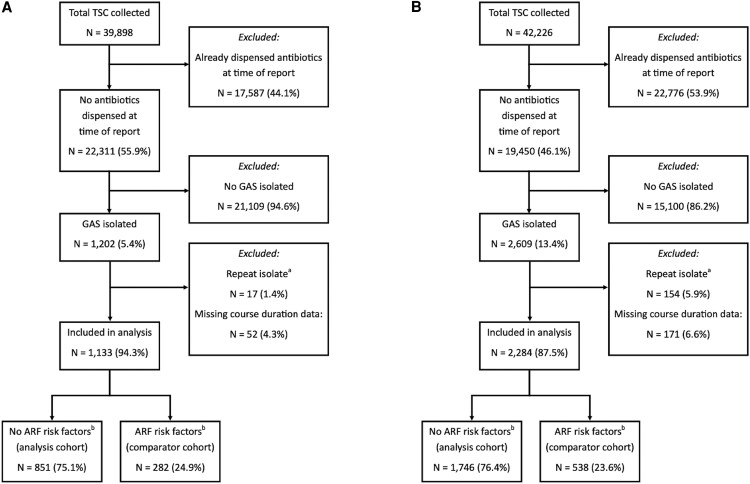
Positive throat swab cultures for GAS 2 years prechange until 25 months postchange were matched to antibiotic dispensing data. Logistic models were fitted to examine associations between treatment duration and 30-day repeat antibiotic treatment, repeat GAS-positive throat swab cultures, hospitalization, incident household cases, and 90-day incidence of rheumatic fever.
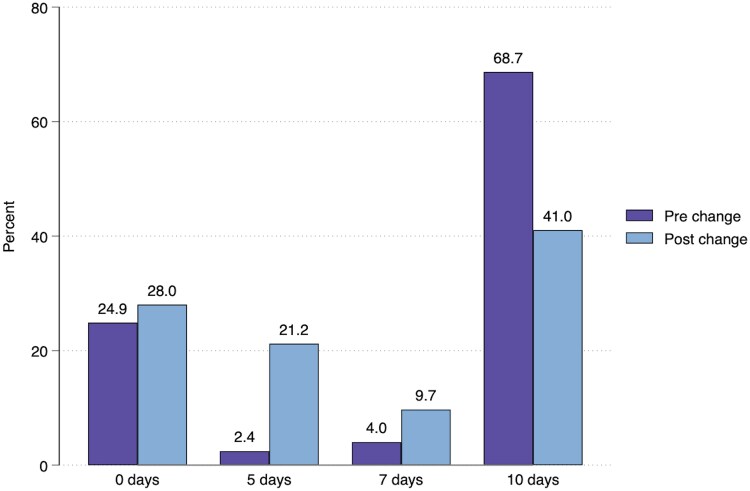
A total of 851 patients prechange and 1746 postchange were included; 31.3% prechange received ≤7 days' treatment versus 59.0% postchange ( < .01). There were no significant differences across any outcome measure between periods. When the postchange period was examined specifically, no significant increases occurred for any outcome measure for patients receiving 0, 5, or 7 days of antibiotics versus 10 days, except higher 30-day antibiotic treatment in those initially receiving no antibiotics (15.6% vs 11.4%, < .01).
Shorter-course treatment had no detectable negative effect on GAS pharyngitis outcomes in this population, including patients receiving no antibiotics. Short-course therapy for GAS pharyngitis has been associated with lower pharyngeal eradication; this did not translate to a detectable increase in household transmission in this real-world setting, which to our knowledge is a novel finding.
A组链球菌(GAS)咽炎的短疗程治疗在临床治愈方面可能等同于10天的治疗,但对咽部GAS清除的有效性尚不确定。对家庭传播的影响尚未直接研究。2022年,一项实验室抗菌药物管理倡议导致当地GAS咽炎的治疗疗程突然缩短。本研究旨在评估这是否对关键治疗结果产生任何负面影响:临床失败、微生物学失败、免疫后遗症和家庭GAS传播。
将改变前2年至改变后25个月的GAS咽拭子培养阳性结果与抗生素配药数据进行匹配。采用逻辑模型来研究治疗疗程与30天重复抗生素治疗、重复GAS阳性咽拭子培养、住院、家庭发病病例以及风湿热90天发病率之间的关联。
共纳入改变前851例患者和改变后1746例患者;改变前31.3%的患者接受了≤7天的治疗,而改变后为59.0%(P<0.01)。各时期的任何结局指标之间均无显著差异。当专门检查改变后时期时,接受0、5或7天抗生素治疗的患者与接受10天治疗的患者相比,任何结局指标均未出现显著增加,但最初未接受抗生素治疗的患者30天抗生素治疗率较高(15.6%对11.4%,P<0.01)。
短疗程治疗对该人群的GAS咽炎结局没有可检测到的负面影响,包括未接受抗生素治疗的患者。GAS咽炎的短疗程治疗与较低的咽部清除率相关;在这个现实环境中,这并没有转化为可检测到的家庭传播增加,据我们所知,这是一个新发现。