
超越血清学:糖谱分析能够鉴定抗原相似性并促使对细菌脂多糖进化进行重新评估。
Beyond serology: saccharide profiling enables identification of antigenically similar and prompts re-evaluation of bacterial lipopolysaccharide evolution.
作者信息
Lewicka Aleksandra J, Lyczakowski Jan J, Pardyak Laura, Dubniewicz Klaudia, Latowski Dariusz, Arent Zbigniew
机构信息
Department of Diagnostics and Clinical Sciences, Faculty of Veterinary Medicine, University of Agriculture in Krakow, Kraków, Poland.
Department of Plant Biotechnology, Faculty of Biochemistry, Biophysics and Biotechnology, Jagiellonian University, Kraków, Poland.
出版信息
Front Mol Biosci. 2025 Jun 17;12:1581587. doi: 10.3389/fmolb.2025.1581587. eCollection 2025.
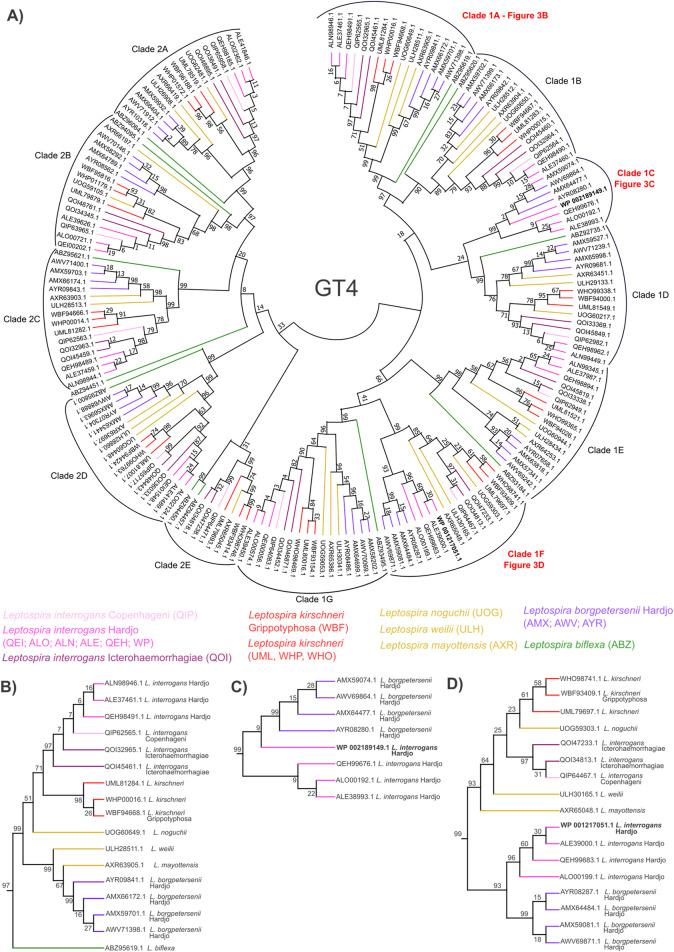
Leptospirosis is a zoonotic infectious disease of growing importance in both human and veterinary medicine. Gram-negative spirochetes of are traditionally classified into serovars based on their antigenic identity, which must be ascertained to design effective treatment procedures for humans and appropriate vaccination strategies in pets and livestock. Unfortunately, identifying serovars is challenging and currently requires access to a wide panel of reference strains, animal-derived antisera, or monoclonal antibodies. Here, we describe a new method for the identification of serovars that is based on monosaccharide composition analysis of the polysaccharide part of bacterial lipopolysaccharide (LPS) structures. Our approach requires no animal sacrifice and can be implemented in any laboratory equipped for chromatographic analysis. An LPS sugar fingerprint that is specific to each bacterial isolate that we studied can be generated. Importantly, sugar profiling of LPS enables distinguishing serovars that are antigenically very similar. Using our new approach, we discover that the LPS structures of two cattle pathogens belonging to two different species: and , and to one serovar: Hardjo, can be distinguished despite sharing major similarities. Through extensive phylogenetic analysis, we reveal which specific glycosyltransferases of the LPS biosynthesis locus likely drove the emergence of these similarities and identify a single glycosyltransferase that might have contributed to the formation of saccharide differences in the LPS structure. Our findings have implications for future work on the evolution of bacterial polysaccharide synthesis and highlight the importance of preventing horizontal gene transfer between pathogenic bacteria.
钩端螺旋体病是一种在人类医学和兽医学中日益重要的人畜共患传染病。革兰氏阴性螺旋体传统上根据其抗原特性分为不同血清型,为人类设计有效的治疗方案以及为宠物和家畜制定合适的疫苗接种策略时必须确定血清型。不幸的是,鉴定血清型具有挑战性,目前需要使用大量参考菌株、动物源抗血清或单克隆抗体。在此,我们描述了一种基于细菌脂多糖(LPS)结构多糖部分单糖组成分析来鉴定血清型的新方法。我们的方法无需牺牲动物,并且可以在任何配备色谱分析设备的实验室中实施。可以生成我们研究的每种细菌分离株特有的LPS糖指纹图谱。重要的是,LPS的糖谱分析能够区分抗原性非常相似的血清型。使用我们的新方法,我们发现属于两个不同物种(问号钩端螺旋体和双曲钩端螺旋体)且属于同一血清型(哈德乔血清型)的两种牛病原体的LPS结构,尽管有许多主要相似之处,但仍可区分。通过广泛的系统发育分析,我们揭示了LPS生物合成位点的哪些特定糖基转移酶可能导致了这些相似性的出现,并确定了一种可能导致LPS结构中糖类差异形成的单一糖基转移酶。我们的研究结果对细菌多糖合成进化的未来研究具有启示意义,并突出了防止病原菌之间水平基因转移的重要性。


 Zotero 插件