Zhang Yanmei, Xiang Zheng, Xu Yan, Cheung Lo Sha, Wang Xiwei, Wang Manni, Wong Howard Ho Wai, Zhu Zhenyao, Zhang Wenyue, Gao Yifan, Luo Xianze, Cheuk Yin Celeste, Zhou Yixin, Zha Xianfeng, Chen Yashi, Li Man, Luo Feifei, Chu Yiwei, Lau Yu-Lung, Liu Yinping, Tu Wenwei
Department of Paediatrics & Adolescent Medicine, Li Ka Shing Faculty of Medicine, The University of Hong Kong, Hong Kong, China.
Department of Microbiology and Immunology, Health Science Center, School of Medicine, Jinan University, Guangzhou, Guangdong, China.
Signal Transduct Target Ther. 2025 Jul 3;10(1):209. doi: 10.1038/s41392-025-02295-8.
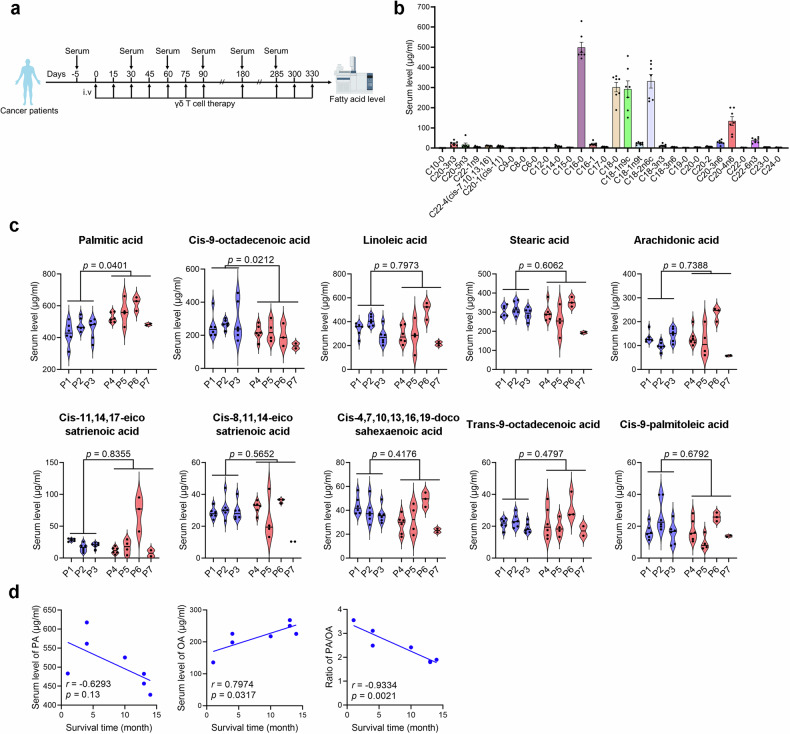
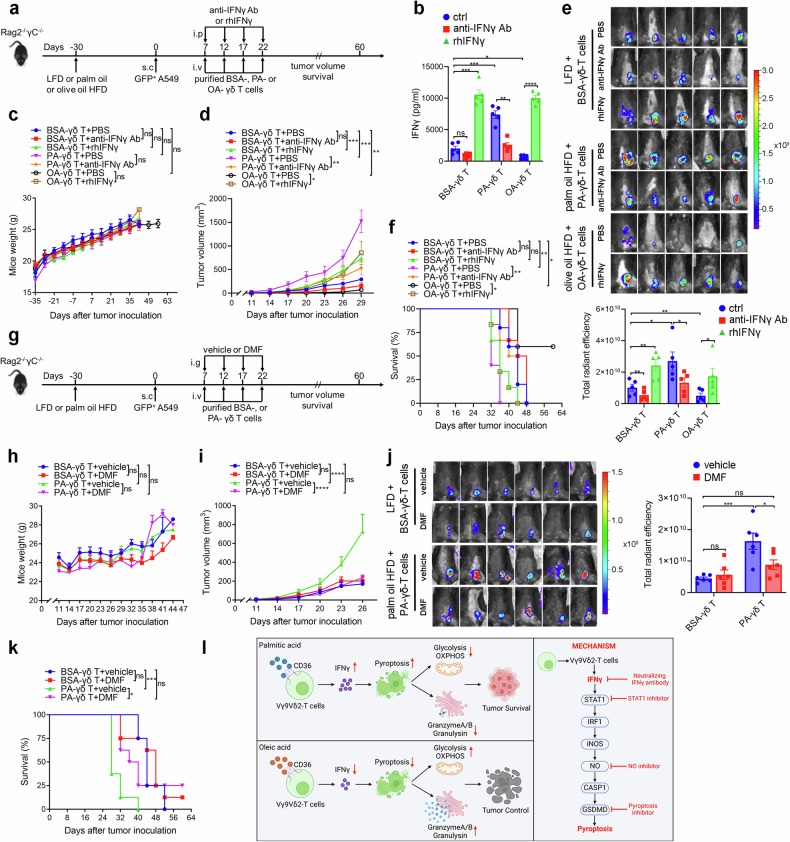
Dietary fatty acids (FAs) are associated with the therapeutic intervention under various health conditions. Human γδ-T cells are indispensable for immunosurveillance toward malignant cells. However, their impact on γδ-T cell metabolism and function remains poorly unexplored. Here, we applied targeted metabolomics analysis to serum FAs among cancer patients undergoing γδ-T cell therapy and discovered that palmitic acid (PA) or oleic acid (OA) levels were associated with the efficacy of Vγ9Vδ2-T cell therapy. We further elucidated that PA suppresses the antitumor activity of Vγ9Vδ2-T cells by disrupting metabolic processes and inhibiting the secretion of lytic granules, whereas OA restores the impaired antitumor activity of Vγ9Vδ2-T cells. Mechanistically, we surprisingly found that PA stimulates Vγ9Vδ2-T cells to secrete excessive IFNγ, which in turn induces cell pyroptosis, ultimately resulting in decreased antitumor activity. In contrast, OA reduces IFNγ secretion and mitigates cell pyroptosis, thereby restoring their antitumor activity. Alternatively, direct blockade of IFNγ by anti-IFNγ mAb or inhibition of pyroptosis by dimethyl fumarate (DMF) also restores their antitumor activity. This study highlights a novel mechanism whereby dietary FAs modulate γδ-T cell function through regulating IFNγ-mediated pyroptosis. Additionally, it offers proof-of-concept for an innovative approach by targeting IFNγ-mediated pyroptosis or dietary OA supplementation to strengthen the antitumor immunity of γδ-T cells against cancers.
膳食脂肪酸(FAs)与多种健康状况下的治疗干预相关。人类γδ-T细胞对于针对恶性细胞的免疫监视不可或缺。然而,它们对γδ-T细胞代谢和功能的影响仍未得到充分探索。在此,我们对接受γδ-T细胞治疗的癌症患者血清中的脂肪酸进行了靶向代谢组学分析,发现棕榈酸(PA)或油酸(OA)水平与Vγ9Vδ2-T细胞治疗的疗效相关。我们进一步阐明,PA通过破坏代谢过程和抑制溶细胞颗粒的分泌来抑制Vγ9Vδ2-T细胞的抗肿瘤活性,而OA则恢复Vγ9Vδ2-T细胞受损的抗肿瘤活性。从机制上讲,我们惊奇地发现PA刺激Vγ9Vδ2-T细胞分泌过量的IFNγ,进而诱导细胞焦亡,最终导致抗肿瘤活性降低。相反,OA减少IFNγ分泌并减轻细胞焦亡,从而恢复其抗肿瘤活性。或者,用抗IFNγ单克隆抗体直接阻断IFNγ或用富马酸二甲酯(DMF)抑制焦亡也能恢复其抗肿瘤活性。这项研究突出了一种新机制,即膳食脂肪酸通过调节IFNγ介导的焦亡来调节γδ-T细胞功能。此外,它为通过靶向IFNγ介导的焦亡或膳食补充OA来增强γδ-T细胞对癌症的抗肿瘤免疫力的创新方法提供了概念验证。