Fakih Hassan H, Tang Qi, Summers Ashley, Gross Katherine Y, Rachid Mohamad Omar, Okamura Ken, Martinez Nuria, Sleiman Hanadi F, Harris John E, Khvorova Anastasia
RNA Therapeutics Institute, University of Massachusetts Chan Medical School, Worcester, MA 01605, USA.
Department of Dermatology, University of Massachusetts Chan Medical School, Worcester, MA 01605, USA.
Mol Ther Nucleic Acids. 2025 May 24;36(3):102579. doi: 10.1016/j.omtn.2025.102579. eCollection 2025 Sep 9.
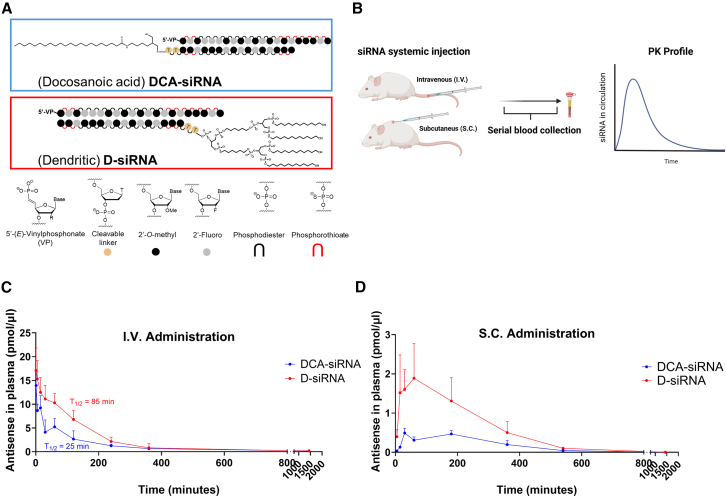
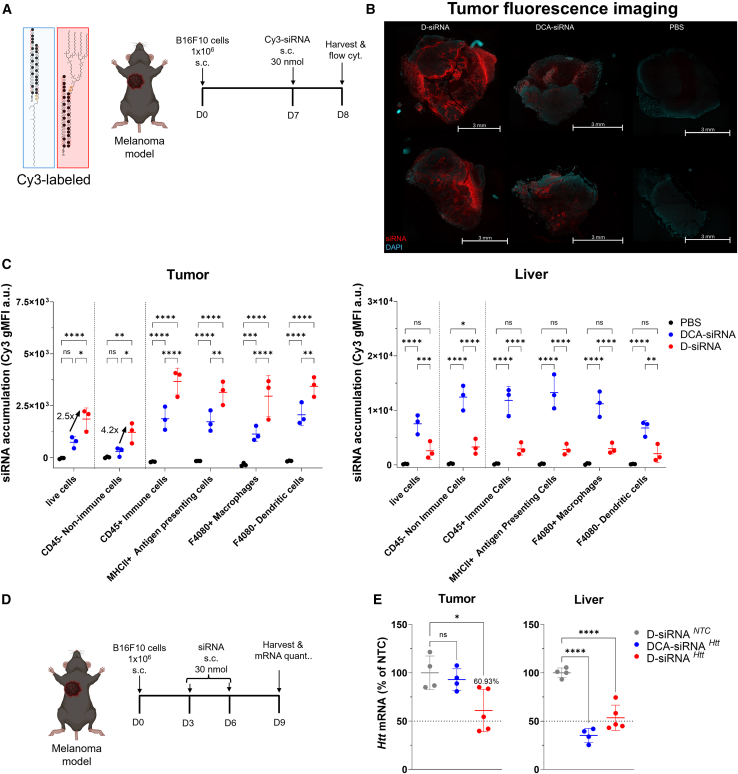
Small interfering RNA (siRNA) therapeutics are a new class of drugs that is rapidly expanding to tackle various diseases. Extrahepatic delivery of siRNAs, especially to the parenchyma of solid tumors, is challenging with multiple strategies being explored such as lipid nanoparticle based delivery and ligand conjugation strategies. Here, we report that an albumin-binding dendritic siRNA (D-siRNA) boosts blood circulation time following systemic administration, leading to improved delivery and silencing activity in a melanoma tumor model, in comparison to non-albumin binding lipophilic siRNAs. D-siRNAs increased the tumor-to-liver delivery ratio, including both immune and non-immune cell types within the tumor parenchyma. Using D-siRNAs to target JAK1 expression as an adjuvant to immune checkpoint inhibitors, we found that D-siRNAs was able to enhance PD1 antibody treatment and slow tumor progression of melanoma. Thus, this work demonstrates the utility of D-siRNAs as a systemically administered tumor delivery strategy, enabling the use of siRNAs as chemotherapeutic agents. Further mechanistic studies into the role of JAK1 in melanoma pathology and progression may expand this into additional targets as potential treatments.
小干扰RNA(siRNA)疗法是一类新型药物,正迅速发展以应对各种疾病。将siRNA递送至肝外组织,尤其是实体瘤实质,具有挑战性,目前正在探索多种策略,如基于脂质纳米颗粒的递送和配体偶联策略。在此,我们报告称,与非白蛋白结合的亲脂性siRNA相比,白蛋白结合树突状siRNA(D-siRNA)在全身给药后可延长血液循环时间,从而在黑色素瘤肿瘤模型中提高递送和沉默活性。D-siRNA提高了肿瘤与肝脏的递送比率,包括肿瘤实质内的免疫细胞和非免疫细胞类型。使用D-siRNA靶向JAK1表达作为免疫检查点抑制剂的佐剂,我们发现D-siRNA能够增强PD1抗体治疗并减缓黑色素瘤的肿瘤进展。因此,这项工作证明了D-siRNA作为一种全身给药的肿瘤递送策略的实用性,使siRNA能够用作化疗药物。对JAK1在黑色素瘤病理和进展中的作用进行进一步的机制研究,可能会将其扩展到其他潜在治疗靶点。